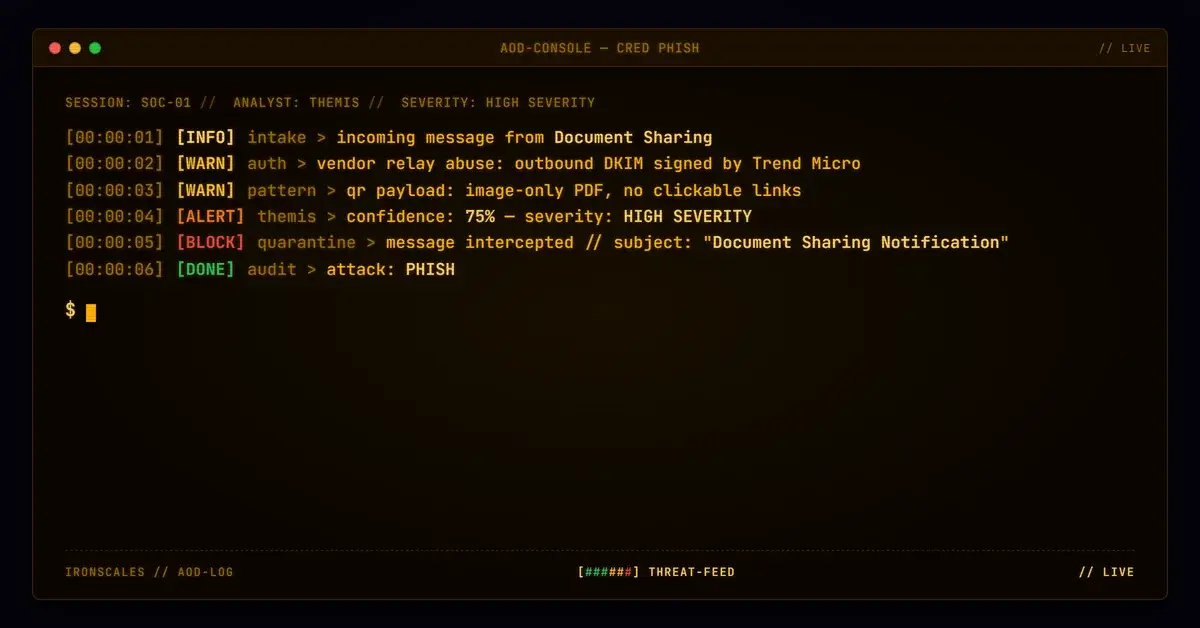
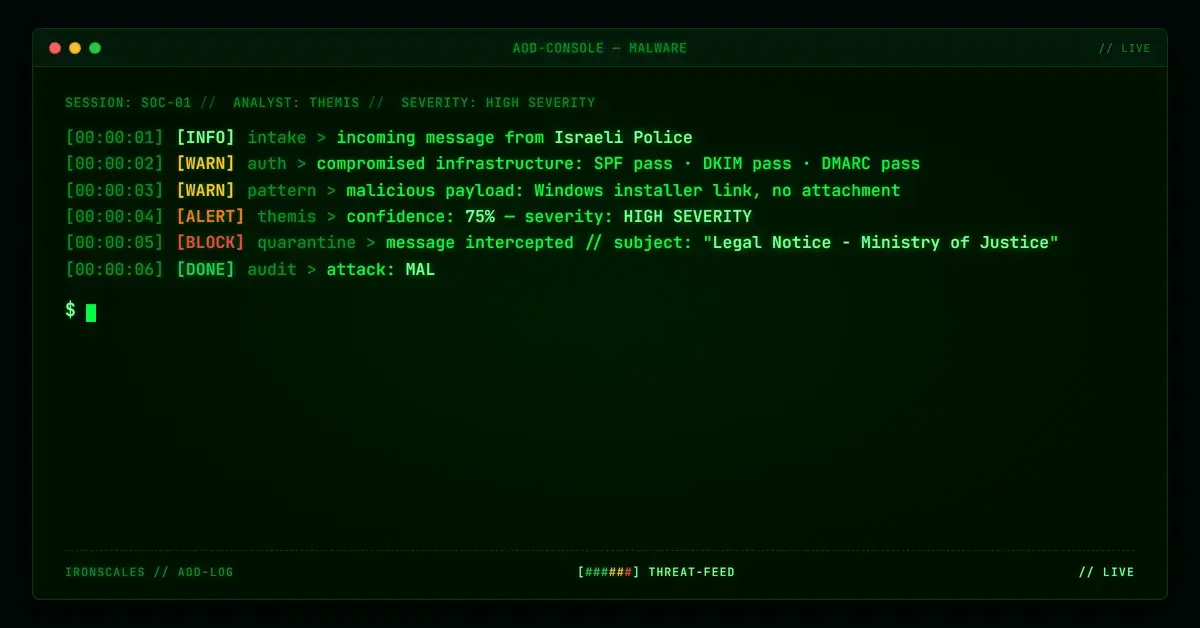
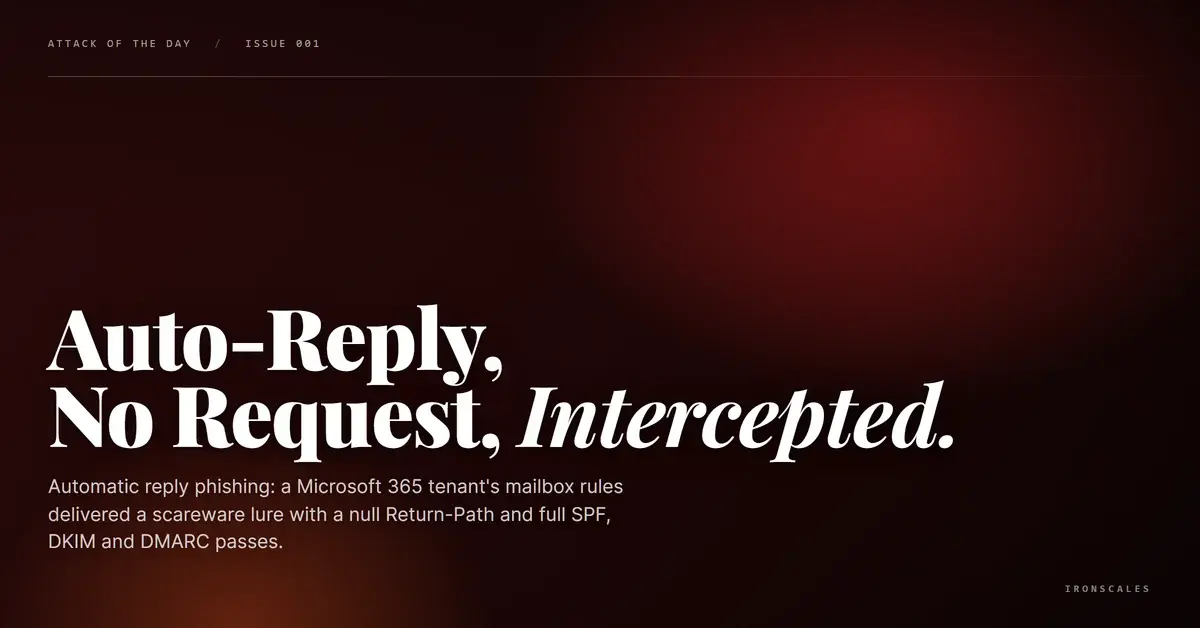
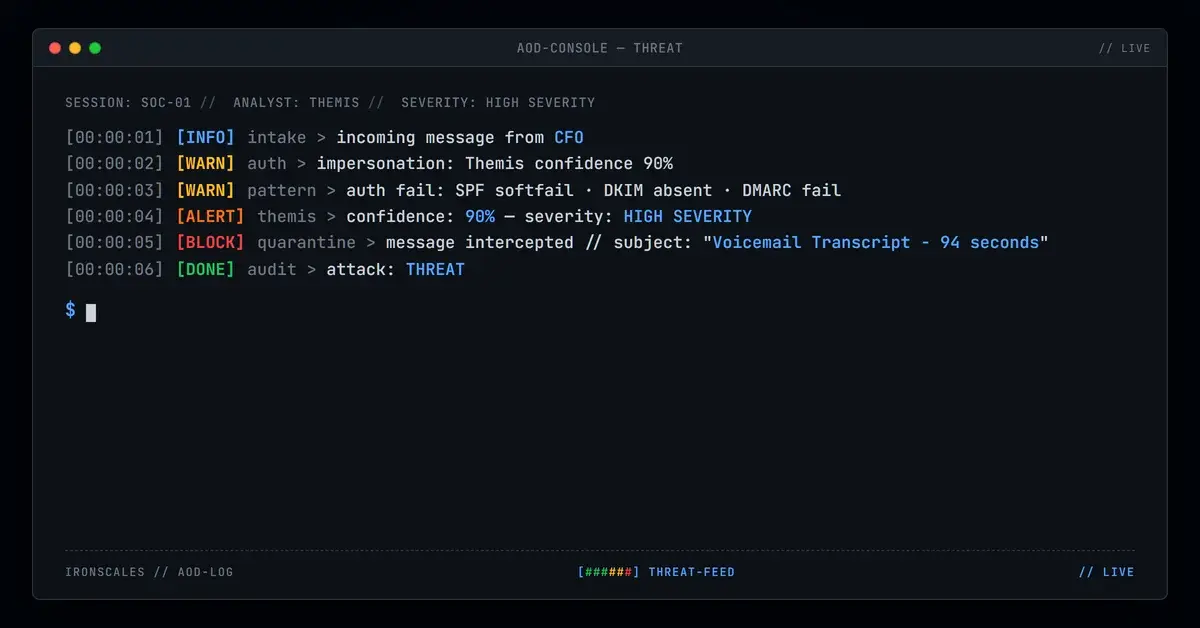
TL;DR A finance executive at a logistics and order-fulfillment provider received a voicemail notification addressed from their own mailbox. The message body opened with a fabricated chip claiming the sender had been verified against the company's safe senders list, a sentence no mail platform produces. Below it, a genuine vendor logo and audio waveform loaded live from a call-tracking platform's real hosts, while the single anchor around that waveform pointed to a disposable third-level host on a service suffix. The hover tooltip was not even a valid hostname. The link scanned clean.
Severity: High Credential-Phishing Brand-Impersonation Executive-Targeting Url-Deception MITRE: T1566.002 MITRE: T1684.001 MITRE: T1204.001 MITRE: T1583.001 MITRE: T1036
Late one evening, a message reached the mailbox of the chief financial officer at a third-party logistics and order-fulfillment provider. It had also been addressed from that mailbox: the From and To headers were the same string, so it presented as something the executive had sent to themselves. Above the message card, the HTML body opened with a bordered chip claiming this sender had been verified from the company's safe senders list. No mail platform emits that sentence. The attacker typed it, styled it, and shipped it as part of the lure.
Everything below the chip looked like a voicemail notification from a call-tracking platform, and most of it genuinely was. The vendor logo and the audio waveform were not rebuilt copies. They loaded live, at render time, from that vendor's real asset CDN and application host, the waveform request even carrying a genuine call identifier and an access key as query parameters. The one anchor wrapped around that waveform pointed somewhere else entirely.
Two Infrastructures Sharing One Rendered Card
That split is the whole case: the pixels that read as proof of authenticity came from a legitimate vendor, the click target from the attacker.
The attacker hotlinked assets from CallRail, a call-tracking and voicemail-notification platform whose asset URLs are publicly reachable by design, rather than copying them: a live request to a known vendor host renders crisply and carries provenance a screenshot does not. Nothing suggests the vendor was compromised; it is a bystander. Whether the borrowed call identifier and access key came from the target's own account or a leaked template cannot be determined.
The anchor resolved to a disposable third-level host on a .com.de service suffix, path /643helper/. The label in front of that suffix ended in a numeric string, reading like one host minted per target. Its title attribute, the hover tooltip, displayed the company's own name followed by /call-center with no top-level domain at all. It could never have resolved; it existed only to be glanced at.
The waveform image was the sole click target. The visible call-back prompt beneath it was styled like a link and was inert, concentrating every path forward onto the one element a person instinctively clicks to hear a voicemail. That is MITRE ATT&CK T1566.002 delivered through masquerading, on the acquired infrastructure of T1583.001.
Trust Chrome Is Attacker-Controlled Content
The forged banner inverts a control defenders spent years teaching users to rely on. External-sender warnings and gateway verdict stamps are injected by the platform, outside the body. Anything appearing inside the body was composed by the sender, verification chips included. Once that distinction blurs, the attacker writes the security verdict on their own message.
Speed is why that works. The 2024 Verizon Data Breach Investigations Report puts the median time to click a phishing link at 21 seconds. The same report finds the human element a component of 68% of breaches. Nobody audits raw HTML in 21 seconds. They read the card, see a vendor logo and a verification chip, and press play. CISA's phishing guidance makes the same point: any control that depends on a user reading message chrome correctly is the weakest link in the chain.
See Your Risk: Calculate how many threats your SEG is missing
Authentication Never Said Otherwise
The header story was blunt. A single external hop delivered the message straight into the tenant's Microsoft 365 edge, with no legitimate gateway in the path. SPF returned a softfail for the sending IP against the spoofed envelope domain, DKIM was absent entirely with no signing domain, DMARC failed with an action of quarantine, and composite authentication came back as none with reason code 451.
The originating address geolocated to Germany with no reverse DNS record. Spam confidence was maxed at 9, the message was categorized as high-confidence spam, and delivery headers show it went to Junk, not the inbox.
One hardening note: the spoofed domain published a softfail SPF policy rather than a hard fail, inviting receivers to treat a forgery as inconclusive. DMARC, per RFC 7489, is only as useful as the policy behind it.
A Subject Line That Argued With Its Own Body
Kit reuse left fingerprints. The subject announced a transcript of a call lasting 94 seconds from one caller. The body described a new caller whose call had lasted five minutes and 55 seconds, attributed to a different person, then signed off with the recipient's own name. Two durations, three identities, one message.
The card's product string was stitched together the same way, welding an unrelated manufacturer's brand onto the company's own name to invent a voice-center product that does not exist. Both Importance: high and X-Priority: 1 were set, the usual attempt to buy attention before scrutiny. It is impersonation assembled from mismatched parts and never reconciled.
What Flagged It, and What Did Not
The link layer did not catch this. The URL's own scan verdict in the platform record was clean.
What flagged it was identity and authentication logic plus community signal. Themis, our Adaptive AI analyst, returned a confidence of 90 with an explicit impersonation tag for a similar display-name pattern, alongside two community-reputation insights tying it to previously resolved phishing elsewhere. Microsoft independently maxed out its spam score. One mailbox was affected, and the message was quarantined roughly four seconds after it landed. A self-addressed message to a finance executive is the opening move of most business email compromise attempts, and treating sender identity as the primary signal closed the gap the URL scanner left open. NIST defines phishing by the deception of the recipient, not the reputation of a link.
Where the Link Went Is Still Unsettled
Scanning recorded an HTTP 200 behind a Cloudflare CDN with a valid TLS certificate, reputation checks around 0.6 for phishing risk, and no blocklist entry at analysis time. Content extraction failed, so no page body and no form were ever observed, which leaves no basis for calling it a credential prompt.
Stranger still, the stored render for that scan shows the ordinary homepage of an unrelated industry marketing nonprofit, while the scan record states there was no redirect chain. Whether the host cloaked, whether a redirect occurred, or whether the artifact is a quirk of the scan cannot be resolved from what was captured. No age claim is available either: the host's WHOIS is fully redacted, a private-domain status with every field empty.
Three absences, then. But the self-addressed From, the invented safe-senders chip, the asset host that disagreed with the anchor host, the tooltip with no top-level domain, and the subject that contradicted its own body were all present in the raw message, and all readable before anybody clicked.
How to Catch the Next One
- Treat any trust banner, verdict stamp, or verification chip inside a message body as untrusted content. Platform notices live outside the body.
- Diff the hosts images load from against the host in the anchor around them. Real vendor notifications do not route clicks to a third party's disposable subdomain.
- Compare each anchor's
href against its title attribute. A tooltip that is not a resolvable hostname has no benign explanation.
- Alert on inbound mail whose From address matches the recipient's own mailbox, weighted higher for finance roles.
- Never read a clean URL verdict as an all-clear. It scores what a scanner reached, not what a person would have seen.
Indicators of Compromise
| Type | Indicator | Context |
|---|
| URL | hxxps://lifesaving131[.]forestirow[.]com[.]de/643helper/ | Sole click target, behind the waveform image. Returned a clean scanner verdict. |
| Domain | forestirow[.]com[.]de | Attacker-controlled landing domain on a .com.de service suffix, path /643helper/. WHOIS fully redacted, all fields empty. |
| Host | lifesaving131[.]forestirow[.]com[.]de | Disposable host for this target. Numeric-suffixed label suggests one host per victim. |
| IP | 213[.]190[.]29[.]112 | Originating sender IP, geolocated to Germany, no PTR record. Not in the spoofed domain's SPF record. |
| Body string | This sender has been verified from [company] safe senders list. | Forged trust chip above the message card. No mail platform generates this text. |
| Anchor title | hxxps://[company]/call-center | Hover tooltip on the malicious anchor. Not a valid hostname, no top-level domain. |
| Header anomaly | From equals To | Self-addressed spoof of the finance executive's own mailbox. |
| Auth result | spf=softfail; dkim=none; dmarc=fail action=quarantine; compauth=none reason=451 | Single external hop into Microsoft 365, no gateway in path. |
| URL (bystander) | hxxps://public-assets[.]calltrk[.]com/email-assets/logo-dark-30px@2x[.]png | Real call-tracking vendor asset CDN, hotlinked for visual authenticity. Not attacker-owned, not compromised. |
| URL (bystander) | hxxps://app[.]callrail[.]com/calls/CALcc24ea8f…/waveform.png?access_key=[redacted]&overlay=waveform-play-button | Real vendor application host, hotlinked with a genuine call ID and access key (both truncated here). Not attacker-owned. |
MITRE ATT&CK Mapping
| Technique | ID | How it appeared |
|---|
| Phishing: Spearphishing Link | T1566.002 | One anchor around a waveform image carried the only click target. |
| Impersonation | T1684.001 | Self-addressed From header, borrowed vendor layout, fabricated product name. |
| User Execution: Malicious Link | T1204.001 | The lure depended on the recipient pressing play on a fake voicemail. |
| Acquire Infrastructure: Domains | T1583.001 | Disposable .com.de host with fully redacted registration data. |
| Masquerading | T1036 | Real vendor logo and waveform assets dressing an attacker-controlled anchor, plus a forged verification banner. |
Email Attack of the Day is a daily series from
IRONSCALES spotlighting real phishing attacks caught by Adaptive AI and our community of 35,000+ security professionals. Each post breaks down a real attack. What it looked like, why it worked, and what to do about it.







/Blue%20Feature%20Flower%20Icons/gear%20head%20icon.svg)
/Misc%20Icons/icon-nav-credential-theft.svg)










/Leadership%20Headshots/Audian%20Paxson%20Headshot%201000x1000%20032026.webp?width=100&height=100&name=Audian%20Paxson%20Headshot%201000x1000%20032026.webp)



.png?width=50&height=50&name=Untitled%20-%20July%2030%2c%202026%20at%2014.53.38%20(3).png)



/Misc%20Icons/icon-red-teaming-agent-gradient-simple.svg)
/Misc%20Icons/icon-phishing-soc-agent-gradient-simple.webp?width=158&height=167&name=icon-phishing-soc-agent-gradient-simple.webp)
/Misc%20Icons/icon-phishing-simulation-agent-gradient-simple.svg)


/Misc%20Icons/icon-nav-encryption.svg)