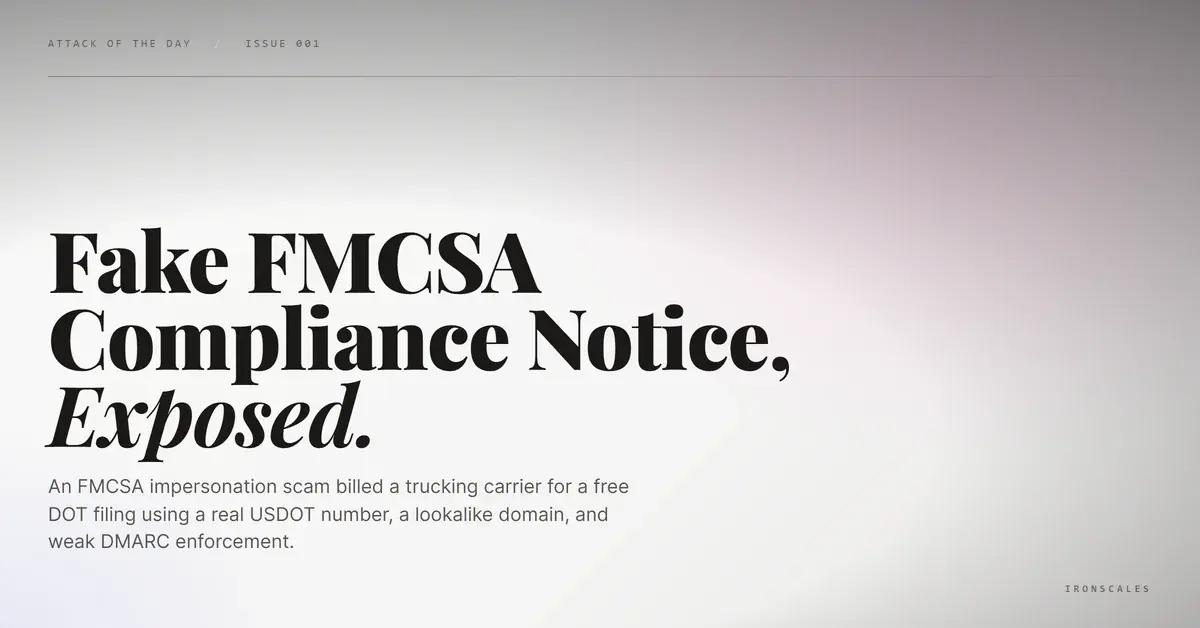
TL;DR A logistics carrier received an email demanding payment for a required FMCSA biennial MCS-150 update. The message looked official because it used genuine government terminology and the carrier's real USDOT number, paired with fear framing about fines and deactivation. The sender domain was a lookalike registration firm, its asset and unsubscribe links resolved to a different host, and DMARC enforcement was set to none with inconsistent DKIM across hops. The filing it sold can be completed for free at the official FMCSA portal. Behavioral analysis flagged the mismatch and the manufactured urgency before any payment moved.
Severity: High Brand Impersonation Payment Fraud Regulatory Impersonation MITRE: T1566.002 MITRE: T1684.001
The notice landed in a logistics company's inbox on a routine Tuesday, and at first glance it looked exactly like the kind of thing a fleet operator cannot afford to ignore. The header read "Required FMCSA Biennial Update," followed by the carrier's genuine USDOT number printed right there in the subject line. Below it, clean federal-looking branding, a navy logo, and the phrase every motor carrier knows by heart: keep your USDOT number active.
Whoever opened it was not looking at a scam in the obvious sense. There was no broken English, no clumsy lookalike of a bank login. There was a real regulatory requirement, a real identifier, and a price.
A Notice Written in the Government's Own Vocabulary
The Federal Motor Carrier Safety Administration genuinely requires carriers to update their MCS-150 form every two years, even when nothing has changed. Miss it, and your operating authority can be deactivated. The email said precisely that. It explained the biennial cadence, warned about hefty fines, and offered to manage the filing "from start to finish."
Then it presented a menu of payment options: two-year, four-year, and lifetime registration tiers, priced by number of trucks. Click the link matching your fleet size, pay, and provide your driver and vehicle details afterward.
For a small carrier without a compliance officer, this reads like a service, not a threat. The terminology was correct. The deadline pressure mapped to a real obligation. And the message carried the one detail no generic spam ever has: the recipient's own DOT number, accurate and verifiable in public SAFER records.
That is the entire trick. The MCS-150 update is free at the official FMCSA portal. The email was selling a paid layer on top of a no-cost government function, wrapped in enough authentic detail to make the recipient feel like a late payment carried legal consequences.
The Registration Firm That Wasn't
The sender was not the FMCSA. It was a domain called dotregistrationsfirm[.]com, registered through GoDaddy in August 2023 and styling itself as a "DOT Registrations Firm." The footer even carried a disclaimer admitting the company is not the Department of Transportation, the FMCSA, or any government agency, and that the offer is not endorsed by the government. Disclaimers like that are legal cover, not honesty signals. Most recipients never scroll to the fine print after a deadline-driven subject line has already done its work.
Phishing is any attempt to trick a recipient into taking an action that benefits an attacker, usually by impersonating a trusted source. This message impersonated the trust of a federal agency rather than the agency itself, a subtler and more durable form of the same play.
The routing told a quieter story. The message was sent through a marketing platform and relayed through a security gateway before reaching the carrier's Microsoft 365 tenant. SPF, one of three core email authentication checks that confirms a server is authorized to send for a domain, passed for the sending platform. But DMARC, the policy layer that tells a receiver whether to trust or reject messages that fail alignment, was set to p=none for the visible sender domain. That means failures are logged but delivered anyway. DKIM, the check that cryptographically signs a message so tampering can be detected, verified at one hop and failed at the final receiver. Inconsistent signatures across a relay chain are exactly the kind of seam a confident-looking brand uses to slip past trust.
The clickable links compounded the problem. Every button was wrapped in a gateway redirector, which masks the true destination until you resolve it. When investigators unwrapped them, the asset and unsubscribe links did not resolve to the sender's brand at all. They pointed to a different host entirely. A genuine government notice does not show one name on the envelope and route its assets to another.
The behavior maps cleanly to known adversary tradecraft. MITRE ATT&CK catalogs this as spearphishing via service and impersonation, where an attacker borrows a legitimate identity to lower a target's guard.
| Type | Indicator | Context |
|---|
| Domain | dotregistrationsfirm[.]com | Lookalike "registration firm" sender domain, registered Aug 2023 via GoDaddy |
| Email | shelbi@dotregistrationsfirm[.]com | Sender persona ("assigned agent") soliciting payment |
| Auth | DMARC p=none | Weak enforcement on visible sender domain; failures monitored, not blocked |
| Auth | DKIM inconsistent across hops | Verified at relay, failed at final receiver |
| Behavior | Wrapped links to a mismatched host | Asset and unsubscribe links resolved to a domain different from the sender brand |
See Your Risk: Calculate how many threats your SEG is missing
What Signature Filtering Missed
A traditional Secure Email Gateway, the legacy filter that scans mail at the perimeter for known-bad signatures, had little to flag here. The sending platform was reputable. SPF passed. There were no malicious attachments and no obvious credential-harvesting page. On signature and reputation alone, this message looks clean.
What exposed it was behavior. The mismatch between the sender brand and the domains its links resolved to, the DMARC policy too weak to enforce anything, the manufactured fine-and-deactivation urgency, and a payment request that no real government agency issues by email all pointed the same direction. None of those signals is malware. Together they describe a message pretending to be authoritative while behaving like a solicitation. Adaptive AI scored that pattern and surfaced it for review before anyone wired a payment, and Themis, the agentic AI SOC analyst, assembled the full picture across sender, routing, and link behavior so a human could act on it in minutes rather than after the fact.
This matters because the human element is the dominant entry point. The 2026 Verizon Data Breach Investigations Report (DBIR) found the human element involved in 62 percent of breaches, with phishing accounting for 16 percent of initial access and pretexting, the manipulation tactic at the heart of this notice, newly representing 6 percent. The FBI's 2024 IC3 report documents billions in business email compromise and payment-fraud losses, a category this attack sits squarely inside. The Microsoft Digital Defense Report 2024 likewise traces a rise in identity-based and impersonation-driven attacks that authentication checks alone cannot stop.
What This Costs and How to Refuse It
The IBM Cost of a Data Breach 2024 report puts the average breach in the millions, and payment-fraud incidents like this one bleed money directly without ever triggering a malware alert. CISA's guidance on how to recognize and report phishing reinforces the only reliable defense against a notice like this: verify out of band.
A few specifics for any carrier or compliance team:
Never act on a regulatory notice through the link it provides. Go directly to the official FMCSA or SAFER site, confirm your filing status there, and remember that the MCS-150 update is free.
Treat a real identifier as worthless proof of legitimacy. Your USDOT number is public. A scammer quoting it back to you is not a sign of authority, it is a sign they did a public lookup.
Strengthen DMARC enforcement. A policy of p=none lets lookalike domains reach the inbox. Moving toward quarantine or reject closes that gap.
Most of all, recognize the shape of this phishing play. The most dangerous compliance notices are not the fakes that get the details wrong. They are the ones that get the government's words exactly right, then attach a payment link the government never would. Detection has to read intent and behavior, not just check whether the envelope was signed, because Themis and Adaptive AI catch the story the signatures miss.
Email Attack of the Day is a daily series from
IRONSCALES spotlighting real phishing attacks caught by Adaptive AI and our community of 36,000+ security professionals. Each post breaks down a real attack. What it looked like, why it worked, and what to do about it.







/Blue%20Feature%20Flower%20Icons/gear%20head%20icon.svg)
/Misc%20Icons/icon-nav-credential-theft.svg)










/Leadership%20Headshots/Audian%20Paxson%20Headshot%201000x1000%20032026.webp?width=100&height=100&name=Audian%20Paxson%20Headshot%201000x1000%20032026.webp)



.png?width=50&height=50&name=Untitled%20-%20July%2030%2c%202026%20at%2014.53.38%20(3).png)



/Misc%20Icons/icon-red-teaming-agent-gradient-simple.svg)
/Misc%20Icons/icon-phishing-soc-agent-gradient-simple.webp?width=158&height=167&name=icon-phishing-soc-agent-gradient-simple.webp)
/Misc%20Icons/icon-phishing-simulation-agent-gradient-simple.svg)


/Misc%20Icons/icon-nav-encryption.svg)