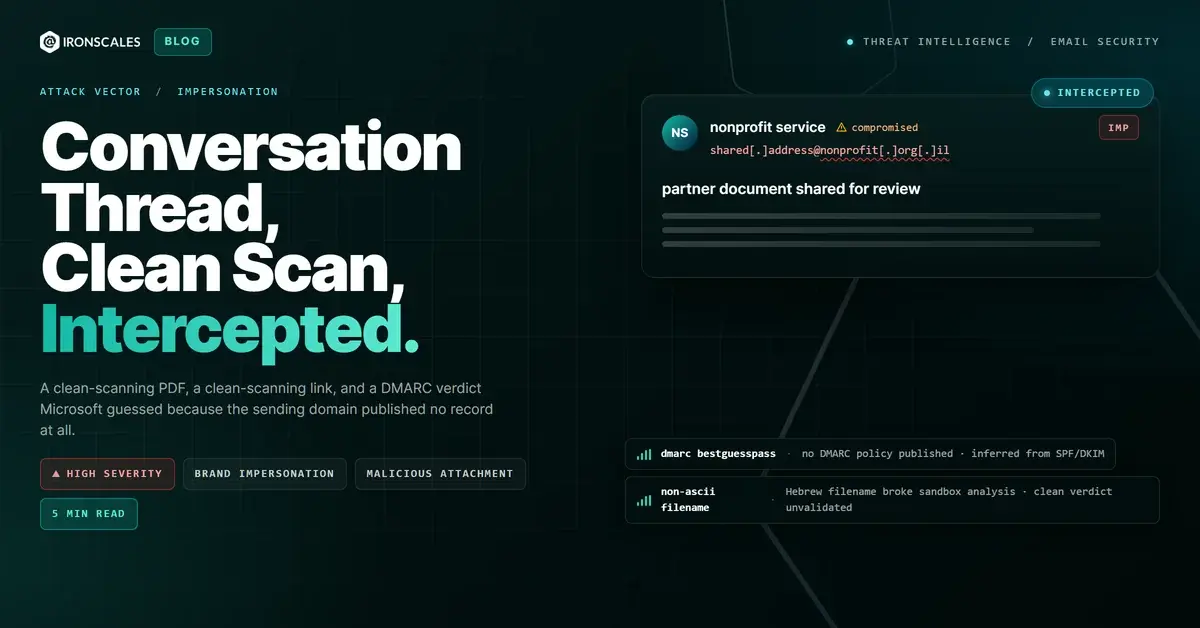
TL;DR A compromised shared mailbox at a small Israeli nonprofit replied into an email conversation that already existed, sending a calm Hebrew note about a partner document and a PDF named for a payment report. The attachment scanned clean and so did the link inside it. The sending domain publishes no DMARC record, so Microsoft returned a best-guess pass, signed the message for its own tenant domain, stamped it with a phishing safety marker, and delivered it anyway. The linked page impersonated SharePoint from a compromised third-party web host.
Severity: High Thread Hijacking Compromised Mailbox Abuse Brand Impersonation Malicious Attachment MITRE: T1566.001 MITRE: T1566.002 MITRE: T1586.002 MITRE: T1204.001 MITRE: T1204.002 MITRE: T1684.001
The message arrived as a reply, a genuine continuation of a conversation already in progress, carrying an In-Reply-To header and a three-deep References chain. The oldest message ID in that chain belonged to a municipal government mail server, so the thread predated everyone who later mattered. One of its participating mailboxes had simply stopped answering only to its owner.
That mailbox was a shared service address at a small Israeli nonprofit whose website, phone number and signature block our SOC matched against public listings. From it came a short, calm Hebrew note to a chief-of-staff mailbox at a large Israeli food manufacturer: a partner document had been shared for review, please pass it to finance. Attached was a PDF named, in Hebrew, "payment report."
The attachment scanned clean. The link inside it scanned clean. Microsoft stamped the message with its own phishing safety classification and delivered it anyway.
A Reply Into A Conversation That Already Existed
Nothing in the envelope was forged, which is why nothing in the envelope helped. The mailbox belonged to a participant in the thread, so the attacker needed no lookalike domain and no invented display name. The note refused to escalate: no deadline, no threat, no payment demand. It said a document was ready for review and asked the recipient to forward it to finance, which is the real attack surface: the recipient becomes the distribution mechanism, and the next hop arrives from a trusted internal address.
Four mailboxes on the recipient domain were hit over roughly 48 hours. Three received the first subject variant inside an eleven-minute window one morning. A different Hebrew subject reached a fourth two days later, and only that one has any mitigation recorded against it.
The DMARC Pass That Was Never A Policy Decision
The final Authentication-Results header reads, in substance: SPF pass, DKIM pass with the signature verified, DMARC bestguesspass, composite authentication pass. Read carefully, that is three near-misses stacked into a green light.
The verdict is not "pass," it is "bestguesspass," which is what Microsoft returns when the sending domain publishes no DMARC record at all. The receiver inferred an outcome from the SPF and DKIM results it already held. RFC 7489 defines DMARC as alignment plus a published policy. Half of that was absent, and the log line reporting its absence contains the word "pass."
Next, what DKIM covered. The signing domain is the sender's own onmicrosoft.com tenant domain, not the domain in the From header, so alignment is organizational at best. Before egress, the message showed DKIM none, not signed, DMARC none. The proof everyone downstream relied on was applied on the way out by the compromised tenant itself, which is what account takeover buys an attacker.
Then the ARC trap. The message carries two Microsoft ARC seals. The first records SPF pass, DKIM pass for the From domain and DMARC pass. The second demotes DMARC to bestguesspass and moves the DKIM pass to the tenant domain. Read the preserved set instead of the final evaluation and you see a clean DMARC pass that never existed.
Microsoft's own verdict is the last twist. The anti-spam report carries the phishing safety-tip classification alongside a spam confidence level of 1 and a filter verdict of not spam. The platform saw phish, scored it harmless and delivered it. The 2024 Verizon Data Breach Investigations Report found the human element present in 68 percent of breaches and stolen credentials involved in 38 percent.
See Your Risk: Calculate how many threats your SEG is missing
What The Byte Scan Could And Could Not See
The deep attachment analysis never ran. Every structural tool in the chain, from the metadata readers to the embedded-file lister, failed with "No such file or directory" against the file's Hebrew name. A non-ASCII filename reduced a full sandbox pass to nothing, and the record still reported an attachment verdict of clean.
What did execute was a naive raw-byte keyword search across the whole 187,635-byte file, looking for eleven markers. It returned exactly two hits: a URI action and an Additional-Actions object. No JavaScript, embedded-file, form, field, encryption or object-stream markers. Because those two keys sat in plaintext, the document's top-level dictionaries appear uncompressed.
But this is not another PDF that fires on open. No open-action key appears anywhere in the file, and that is the only key that fires when a reader opens a document. A bare Additional-Actions object triggers on other events entirely, depending on which dictionary holds it, and the record does not say which. Nor can a byte scan see inside compressed streams, and no structural parse ever succeeded. The defensible statement is narrow: no script markers appear in the plaintext portions of the file. That is what was visible, not a clean bill of health.
What the PDF demonstrably carries is an address, the same URL that also appears as a body link under Hebrew anchor text meaning "open file." A second attachment, declared as image.png, is not a PNG: its MIME type and leading bytes identify GIF data.
The Gate That Echoed The Attachment
The URL resolves to a page under a /cgi_readme/ path on the website of a real Argentine agro-industrial company, fronted by Cloudflare and returning HTTP 200. That company has no connection to the lure, and its registry publishes no dates, so no registration-age argument runs either way. Treat the owner as a compromised bystander.
The page is a teal-and-white SharePoint imitation with a Hebrew subtitle meaning "secure document access." A document card below it echoes the attachment's own title, and its date stamp matches the day the mail arrived, which suggests the page was built for this campaign rather than reused. Its size chip does not match, reading 2.4 MB against an attachment of roughly 183 KB.
There is not a single input box on that page. Below the card, a padlock, a line asserting the document requires verification, and one full-width button reading, in Hebrew, "access the document now." What sits behind that button was never captured. No Microsoft domain, tenant or asset is involved anywhere in this attack; the imitation is purely visual, on someone else's compromised server.
What Actually Flagged It
Every content control returned green: a clean PDF verdict and a clean link scan carrying a partial verdict. Both CISA phishing guidance and the NIST definition of phishing define the threat by deception and elicited action rather than by files and URLs, which is the framing this case needs.
It was caught on relationships. Themis, our Adaptive AI, scored the incident at 59 percent confidence under a VIP-recipient label, on the strength of a link its own engine flagged as malicious, which is our assessment rather than a URL scanner's verdict, plus two community reputation signals drawn from how similar incidents resolved elsewhere. That is a cross-tenant reputation call, not a payload verdict, and it was the only control in the stack with a chance here. The 2023 FBI IC3 Internet Crime Report put reported business email compromise losses near $2.9 billion, and losses at that scale come from real accounts saying things their owners never sent.
Mitigation was partial. Of the four affected mailboxes, one was quarantined and reverted. The other three carry no mitigation action at all.
What To Take Into Monday
Treat "bestguesspass" as "no record found," and publish a DMARC record for your own domains so nobody has to guess. Check which domain DKIM signed, and read the final authentication results rather than the preserved copy of an earlier one. And test your attachment pipeline against non-ASCII filenames, because a clean verdict on a file no parser could open is an absence of evidence dressed up as a result.
Indicators of Compromise
| Type | Indicator | Context |
|---|
| URL | hxxps://cenciagroindustrial[.]com[.]ar/cgi_readme/verify.html | SharePoint-imitation access gate. Hosted on a real Argentine company's compromised website; the page is the attacker's, the host is a bystander |
| Domain | cenciagroindustrial[.]com[.]ar | Compromised third-party web host. Registry publishes no dates, so no age claim is possible in either direction |
| IP | 104[.]21[.]4[.]80 | Cloudflare address fronting the landing host; shared CDN, origin masked, no block value |
| IP | 172[.]67[.]131[.]205 | Second Cloudflare address for the same host |
| Hash (MD5) | e1c64a0baa775dfea478521a63bc6fcf | The PDF courier, 187,635 bytes, platform verdict clean. The best indicator in the case precisely because every scanner passed it |
| Hash (MD5) | b93ca25469788a079de006f902660ef9 | Second attachment, 39,092 bytes, declared as PNG but carrying GIF data |
| File | דוח תשלום.pdf | Attachment name, Hebrew for "payment report". This non-ASCII name is what broke the entire deep-analysis tool chain |
| File | image.png | Second attachment; extension does not match the GIF format inside it, 212 by 13 pixels |
| PDF structure | URI action at offset 11638, Additional-Actions object at offset 31936 | The only two markers a raw-byte scan found. No open-action key was present anywhere in the file |
| Auth result | SPF pass, DKIM pass for the tenant onmicrosoft.com domain, DMARC bestguesspass action none, compauth pass reason 109 | Signed on egress by the compromised tenant; the From domain publishes no DMARC record |
| Header | SCL:1; SFV:NSPM; CAT:NONE; SFTY:9.25 | Microsoft's phishing safety classification fired while the spam verdict stayed clean and the message was delivered |
| Sending IP | 2a01:111:f403:c207::3 | Microsoft 365 outbound address that SPF passed for; shared platform, no block value |
| Sender | Withheld (shared service mailbox, small Israeli nonprofit) | Compromised legitimate mailbox in the organization's own tenant. Bystander, not an attacker asset and not actionable as a block |
| Camouflage URL | support[.]microsoft[.]com/en-US/security/protect-yourself-from-phishing | Genuine Microsoft awareness page, one of three real Microsoft URLs padded into the message to lift its reputation |
| Delivery pattern | Four mailboxes, two Hebrew subject variants, roughly 48 hours | Three in an eleven-minute window, a fourth two days later; one quarantined, three unmitigated |
MITRE ATT&CK Mapping
Email Attack of the Day is a daily series from
IRONSCALES spotlighting real phishing attacks caught by Adaptive AI and our community of 35,000+ security professionals. Each post breaks down a real attack. What it looked like, why it worked, and what to do about it.







/Blue%20Feature%20Flower%20Icons/gear%20head%20icon.svg)
/Misc%20Icons/icon-nav-credential-theft.svg)










/Leadership%20Headshots/Audian%20Paxson%20Headshot%201000x1000%20032026.webp?width=100&height=100&name=Audian%20Paxson%20Headshot%201000x1000%20032026.webp)



.png?width=50&height=50&name=Untitled%20-%20July%2030%2c%202026%20at%2014.53.38%20(3).png)



/Misc%20Icons/icon-red-teaming-agent-gradient-simple.svg)
/Misc%20Icons/icon-phishing-soc-agent-gradient-simple.webp?width=158&height=167&name=icon-phishing-soc-agent-gradient-simple.webp)
/Misc%20Icons/icon-phishing-simulation-agent-gradient-simple.svg)


/Misc%20Icons/icon-nav-encryption.svg)