TL;DR A senior commercial leader at a pharmaceutical contract development and manufacturing organization received a personalized industry-summit invitation with a brochure PDF attached. The attachment scanner returned a malicious verdict, yet SPF, DKIM, and DMARC all passed, because the sending domain belonged to the attacker and was configured correctly. The domain was roughly seven months old at first send, so age heuristics gave nothing back. Four more named mailboxes at the same company were hit six weeks later with rotated conference pretexts. Adaptive AI scored the message at 90 percent and mitigated it across every affected mailbox.
Severity: High Malicious Attachment Phishing Malware Delivery MITRE: T1566.001 MITRE: T1583.001 MITRE: T1204.002
On July 9, 2026, a senior commercial leader at a pharmaceutical contract development and manufacturing organization received an invitation to an industry summit. The greeting used their first name. The subject line named a specific, plausible facility-engineering conference in a specific host city, prefixed with a conversational "Re:" as though a thread already existed. Attached was a brochure PDF of about 1.5 MB, roughly the size a real event prospectus would be.
Every authentication check on that message passed. The attachment scanner returned a verdict of malicious.
One message like that is a short teardown. What makes this one worth reading is the shape the platform recorded around it.
One Target List, Worked for Six Weeks
The affected-mailbox record for this incident does not stop at the reported message. Six weeks after the first send, on August 20, 2026, four more individually named mailboxes at the same organization were hit by the same operator. Each opened with a personalized greeting built from the recipient's own first name. Each named a different, differently branded industry summit, with a matching brochure attachment.
That is at least five named individuals at one company, addressed by name, across a run of more than six weeks. It is not a spray. Somebody assembled a list of specific people inside a specific organization, then kept iterating pretexts against that same list, swapping the conference name and the host city while the delivery mechanism stayed put. The rotation is what buys longevity: a defender who blocks one subject line has blocked one variant of a template, not the campaign.
That pattern also says something about intent. Spray campaigns optimize for volume because any credential will do. A campaign that keeps returning to the same curated list is optimizing for one particular organization, which usually means the operator has a downstream objective in mind and is willing to spend weeks getting a foothold.
Authentication Had Nothing to Say About It
The message authenticated cleanly and completely. SPF passed. DKIM passed. DMARC passed under a quarantine policy on the sending domain. Microsoft composite authentication returned a pass with the maximum confidence reason code.
None of that is a bypass, and no filter was tricked. The domain in the From header belonged to the attacker, who had configured it properly and was sending through a mainstream cloud productivity suite. There was no spoofing to detect because nothing was spoofed. DMARC, as specified in RFC 9989, answers exactly one question: did the domain owner authorize this message. When the domain owner is the attacker, the honest answer is yes.
Reputation was similarly quiet. Mail from a paid tenant on a major cloud platform arrives with that platform's sending reputation attached, so an IP or network-block check reads as ordinary business correspondence.
The Domain Was Not Freshly Minted
The obvious next control is domain age, and it produced nothing here either. WHOIS shows the sending domain created on December 5, 2025 through a mainstream retail registrar, with all registrant fields privacy-shielded. That puts it at roughly seven months old on the day of the first recorded send, and about eight and a half months old by the last hit we observed.
Newly registered domain rules catch operators in a hurry. This one registered infrastructure, let it age past every common threshold, and only then started sending. In ATT&CK terms that is straightforward infrastructure acquisition, and it is cheap. The price of waiting seven months is a registration fee and patience.
By the Time It Was Reported, the Sender Was Not a Stranger
Here is the detail that should change how you think about a sustained campaign. On this specific report, the platform recorded the sender as an established correspondent rather than a first-time sender to the recipient.
Read that again from the attacker's side. First-time-sender novelty is one of the strongest behavioral signals available in email security, and this operator dissolved it without a single technical trick. They kept mailing the same organization until the relationship stopped looking new. Persistence had worn the behavioral surface smooth.
That is the practical difference between this case and a compromised-vendor delivery. A hijacked account borrows trust that already exists. This operator built the trust from scratch, on their own domain, over months, and the accumulated history then argued on their behalf.
See Your Risk: Calculate how many threats your SEG is missing
What Actually Caught It
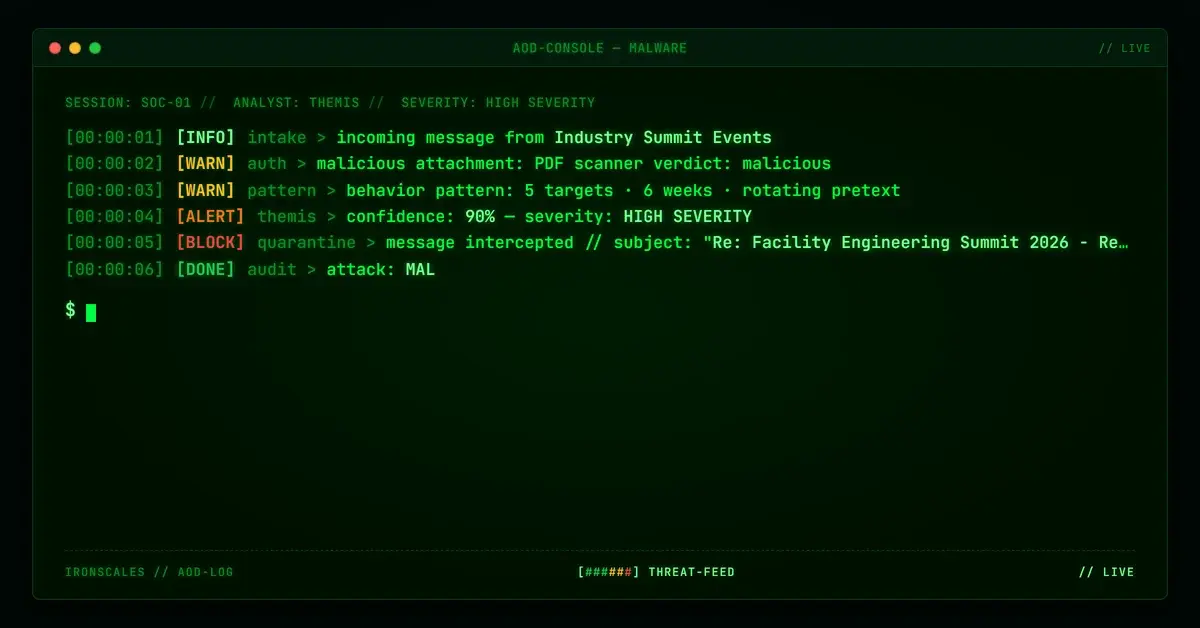
With authentication clean, reputation clean, domain age unremarkable, and the sender relationship established, the catch came from the payload itself. The attachment scanner returned an independent malicious verdict on the brochure PDF, and Themis scored the message at 90 percent confidence, tagging it against a high-value recipient. The platform insight named the offending file directly, and the message was mitigated across the affected mailboxes. No recipient had acted on it before that happened.
It is worth being precise about what that verdict is and is not. A surface byte scan cannot reason reliably about a PDF's internals, because compressed object streams conceal both the presence and the absence of script. Which is why the actionable artifacts here are the verdict, the hash, and the sender, not a theory about which object in the file is hostile. Malicious-attachment defense has to rest on verdicts and behavior, not on a partial read of file internals.
What to Change After a Campaign Like This
The 2026 Verizon Data Breach Investigations Report attributes 16 percent of breaches to phishing as the initial access vector, and 62 percent to the human element overall. A personalized invitation to a real-sounding professional event, arriving with clean authentication and a document that looks exactly like what it claims to be, is engineered to land squarely inside that statistic.
Three changes follow from this case. First, treat event invitations that carry attachments as their own review category, and verify any conference through the organizer's own published channels rather than through the email in hand. Second, when one malicious attachment is confirmed, sweep the whole tenant for the same subject template and the same sending domain instead of closing the single report, because the reported message is frequently one slot in a mail merge. Third, stop leaning on sender novelty and domain age as primary discriminators against a patient operator, and put the weight on payload verdicts plus per-recipient behavioral context.
CISA phishing guidance and the NIST definition of phishing both frame the problem the way this case does: the deception is social, and the technical controls exist to reduce how often a person has to be the last line of defense.
Indicators of Compromise
| Type | Indicator | Context |
|---|
| Domain | nexora-summits[.]com | Attacker-registered sending domain, created 2025-12-05, retail registrar, privacy-shielded registrant |
| Email address | diana.may@nexora-summits[.]com | Attacker sender identity, recorded at high risk level |
| File | Brochure_[conference name] Summit.pdf | Brochure attachment, roughly 1,594,532 bytes, scanner status and verdict both malicious. The real filename named a narrow engineering specialism and is generalized here |
| Hash (MD5) | 71d2f2f9896c628ca1e0e16a1b366c33 | MD5 of the malicious brochure PDF |
| Subject pattern | Re: Hello [first name], discover the [ordinal] [conference name] Summit in [city] | Mail-merge template with a per-recipient greeting and a rotating conference name and host city |
| Authentication | spf=pass; dkim=pass; dmarc=pass (p=quarantine); compauth=pass reason=100 | Full clean authentication on attacker-owned, correctly configured infrastructure |
MITRE ATT&CK Mapping
| Technique | ID | Application |
|---|
| Phishing: Spearphishing Attachment | T1566.001 | Personalized conference invitation delivering a malicious brochure PDF |
| Acquire Infrastructure: Domains | T1583.001 | Purpose-registered sending domain, aged roughly seven months before first use |
| User Execution: Malicious File | T1204.002 | The attack requires the recipient to open the attached document |
See You Next Time
The uncomfortable part of this case is how little of it was a trick. A registration fee, a paid mail tenant, correct DNS records, seven months of patience, and a list of names. Every layer that normally raises a hand had a legitimate reason to stay quiet, which is exactly why the layer that inspects the payload, and the layer that understands who normally emails whom, have to be doing real work.
Email Attack of the Day is a daily series from
IRONSCALES spotlighting real phishing attacks caught by Adaptive AI and our community of 35,000+ security professionals. Each post breaks down a real attack. What it looked like, why it worked, and what to do about it.







/Blue%20Feature%20Flower%20Icons/gear%20head%20icon.svg)
/Misc%20Icons/icon-nav-credential-theft.svg)










/Leadership%20Headshots/Audian%20Paxson%20Headshot%201000x1000%20032026.webp?width=100&height=100&name=Audian%20Paxson%20Headshot%201000x1000%20032026.webp)



.png?width=50&height=50&name=Untitled%20-%20July%2030%2c%202026%20at%2014.53.38%20(3).png)



/Misc%20Icons/icon-red-teaming-agent-gradient-simple.svg)
/Misc%20Icons/icon-phishing-soc-agent-gradient-simple.webp?width=158&height=167&name=icon-phishing-soc-agent-gradient-simple.webp)
/Misc%20Icons/icon-phishing-simulation-agent-gradient-simple.svg)


/Misc%20Icons/icon-nav-encryption.svg)