TL;DR A sales specialist at a luxury real estate brokerage received a reply inside an ongoing property showing thread. It carried a Join the Zoom meeting link and an explicit instruction to install a Zoom update before joining. The link pointed at a path on a law firm's own website, a genuine domain registered in the mid-2000s with no relationship to Zoom or to the brokerage. That path served a convincing fake Zoom join screen. An automated link verdict called the page benign law firm content, and a screenshot proved otherwise.
Severity: High Brand-Impersonation Fake-Software-Update Payload-Staging Url-Abuse MITRE: T1566.002 MITRE: T1204.002
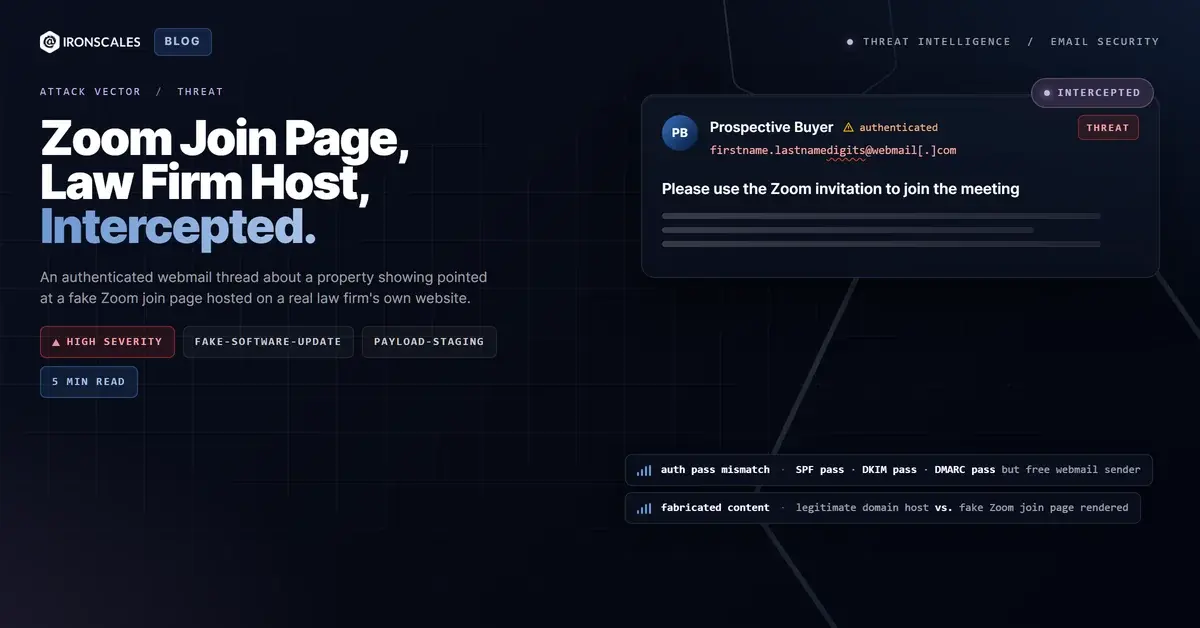
The reply landed inside a conversation already running: a prospective buyer following up about a specific unit at a branded luxury residence, ready to move the next step onto a video call. It reached a sales specialist at a luxury real estate brokerage in an offshore financial center, in a thread with quoted history, a believable cadence, and one line that should have stopped it. "Just download and install the zoom through the invite," the buyer wrote. A later message in the same thread added, "Please use the Zoom invitation to join the meeting. If you are prompted to update Zoom, please complete the update before joining."
The "Join the Zoom meeting" link did not point at Zoom. It pointed at a path on a law firm's own website.
Authentication proved the mailbox, not the message
Every check passed. SPF passed on a sending address designated by the webmail provider, DKIM passed on the provider's signing domain, DMARC passed, the composite authentication verdict came back as a pass at the highest confidence reason code, and the ARC seals applied across the relay chain validated cleanly.
None of that was a bypass. The message really was sent through a major consumer webmail service, from a free account the attacker registered, with nothing spoofed. Authentication under RFC 7489 settles a narrow question, whether a sender is entitled to use the domain in the header, and a free mailbox on a global provider is entitled to it. The human behind that mailbox, and the destination of the links in the body, sit outside what those protocols measure. The platform rated this sender high risk on relationship grounds alone: a free webmail persona, local part a first and last name run together with two digits, no prior correspondence with the mailbox it wrote to.
A meeting link that pointed at a law office
The visible call to action resolved, before any gateway rewriting, to a /meetings/ path on a domain with nothing to do with video conferencing. Registration records named a genuine law practice as the registrant, with a creation date in the mid-2000s, nameservers at a regional hosting provider, and no ownership relationship to Zoom or to the brokerage. This was not a lookalike, not a homoglyph, not a typo variant, and not a domain registered last week behind a privacy shield.
That inverts the cheap defensive heuristics at once. Domain age argues for the link, WHOIS transparency argues for the link, and the absence of string similarity to a brand means no lookalike detection fires. An attacker who plants a page on an established website owned by someone else inherits every reputation signal that site earned, and the question shifts from "is this domain suspicious" to "does this content belong to this domain," which is far more expensive to answer. The law practice is a bystander, genericized here for that reason.
See Your Risk: Calculate how many threats your SEG is missing
The page behind the link was a fabricated join screen
A direct screenshot of that URL settled what the link actually served. Not law firm content. A convincing imitation of a Zoom join page: a numeric meeting identifier as the heading, a fabricated host name with matching initials in an avatar circle, three people expected to join, a "Joining Meeting" button, and a reassuring line about camera and microphone permissions.
Read that page against the instructions already in the thread and the design intent is obvious. The recipient had been told twice, in advance, that an update prompt was expected and should be completed before joining. Anyone reaching a page that looks like a real join flow and then presents an update step has been pre-authorized to run whatever it offers, which is how fake update prompts get a target to execute an attacker's file voluntarily, catalogued as user execution of a malicious file at T1204.002.
What the button delivered was never captured, and that limit is worth stating plainly. The evidence proves a fabricated Zoom join page reached by a link in a message telling the recipient to install an update. Which file or prompt waited on the other side of the click is unknown. The pretext is documented. The payload is not.
Two verdicts for one URL, and the screenshot won
The automated link analysis run against that destination concluded the page was benign law firm content that did not host a Zoom web client. A screenshot of the same URL showed a fake Zoom web client. Both outputs are real.
A fetch based verdict reasons about the host: its age, its reputation, its certificate, the markup it returns. All of that pointed at a legitimate law practice, because one genuinely owns the name. A screenshot asks what a visitor sees. Where a page is planted on an established third party host, host reputation dominates the automated conclusion and only the rendered image contradicts it, which is why malicious URL analysis that stops at reputation keeps producing confident wrong answers.
No confidence score was recorded for this incident, so none is quoted here. Detection came from suspicious link and suspicious message signals plus a report from inside the recipient organization, and the reversal came from an analyst looking at the picture. Four related messages to that mailbox, delivered inside roughly two hours, were quarantined by manual approval. Weighing an unfamiliar sender against a mismatched destination and an installation instruction is judgment work rather than pattern matching, which is what Themis is built to do.
The tells that survived the polish
Two artifacts betrayed rushed assembly. A second copy of the link in the same thread had a stray word concatenated onto the file name, a variant that returns a 404, not the fake join page: whoever built the lure pasted the URL into template text and clipped the boundary. The embedded invitation also named a meeting date that contradicts the timestamps on the thread itself, which no legitimate calendar workflow produces.
Neither tell is technical, and both are things a reader notices only when unhurried. The 2024 Verizon Data Breach Investigations Report puts the median time from opening a phishing message to clicking a link at 21 seconds, and finds the human element in 68% of breaches. Nobody reconciles a truncated file name or two conflicting dates inside 21 seconds.
So the durable control is procedural. Meeting platforms should be something a seller supplies rather than accepts, and an inbound join link carrying installation instructions is a category to escalate rather than evaluate. NIST's definition of phishing rests on the deception rather than the payload, and awareness training naming fake update prompts gives a target language for what they are seeing. CISA's guidance on stopping the attack cycle treats sender verification as the control that holds when the payload is unremarkable, and here it was never seen.
Indicators of Compromise
| Type | Indicator | Context |
|---|
| Email (sender) | *****77@gmail[.]com | Attacker operated free webmail account posing as a property buyer; local part was a fabricated persona name plus two digits, masked here |
| URL (payload) | hxxps://lawfirm[.]example[.]com/meetings/index[.]html | Genericized. A /meetings/ path on an unrelated law practice's own long registered domain, serving a fabricated Zoom join page |
| URL (malformed variant) | hxxps://lawfirm[.]example[.]com/meetings/index[.]htmlFor | Same path, stray word concatenated onto the file name; returns HTTP 404. Template assembly error |
| Domain (bystander) | Established law practice domain, created in the mid-2000s, regional hosting nameservers | Genericized. WHOIS registrant is a genuine law firm, no tie to Zoom or the recipient, no role in the attack |
| Landing page artifact | Numeric meeting identifier heading, fabricated host name with avatar initials, "3 people are expected to join", "Joining Meeting" button | Fake Zoom interface, not the law firm content the automated verdict reported |
| Body instruction | "download and install the zoom through the invite" and "complete the update before joining" | Pre-authorizes an endpoint install step before the target reaches the page |
| Authentication | SPF pass, DKIM pass on the provider's signing domain, DMARC pass, ARC valid, composite pass at the top reason code | Unspoofed consumer webmail; proves the mailbox is real, not that its content is safe |
| Behavioral | Four flagged messages to one mailbox inside roughly two hours, no prior sender history | Quarantined by manual analyst approval |
MITRE ATT&CK Mapping
| Technique | ID | How it showed up |
|---|
| Phishing: Spearphishing Link | T1566.002 | Reply inside a live property showing thread carrying one join link to a fabricated page on a third party host |
| User Execution: Malicious File | T1204.002 | The thread instructed the target to install a client update before joining; no file was captured, so this maps the instructed action, not an observed execution |
See You Next Friday
Almost nothing here is technically advanced. The sender authenticated because it had nothing to hide at the protocol layer. The destination scored well because someone else spent nearly two decades building its reputation. The page was markup and a button. The attack rests on a meeting link the recipient did not choose and an instruction to install the update first. Neither has a signature.
Email Attack of the Day is a daily series from
IRONSCALES spotlighting real phishing attacks caught by Adaptive AI and our community of 35,000+ security professionals. Each post breaks down a real attack. What it looked like, why it worked, and what to do about it.







/Blue%20Feature%20Flower%20Icons/gear%20head%20icon.svg)
/Misc%20Icons/icon-nav-credential-theft.svg)










/Leadership%20Headshots/Audian%20Paxson%20Headshot%201000x1000%20032026.webp?width=100&height=100&name=Audian%20Paxson%20Headshot%201000x1000%20032026.webp)



.png?width=50&height=50&name=Untitled%20-%20July%2030%2c%202026%20at%2014.53.38%20(3).png)



/Misc%20Icons/icon-red-teaming-agent-gradient-simple.svg)
/Misc%20Icons/icon-phishing-soc-agent-gradient-simple.webp?width=158&height=167&name=icon-phishing-soc-agent-gradient-simple.webp)
/Misc%20Icons/icon-phishing-simulation-agent-gradient-simple.svg)


/Misc%20Icons/icon-nav-encryption.svg)