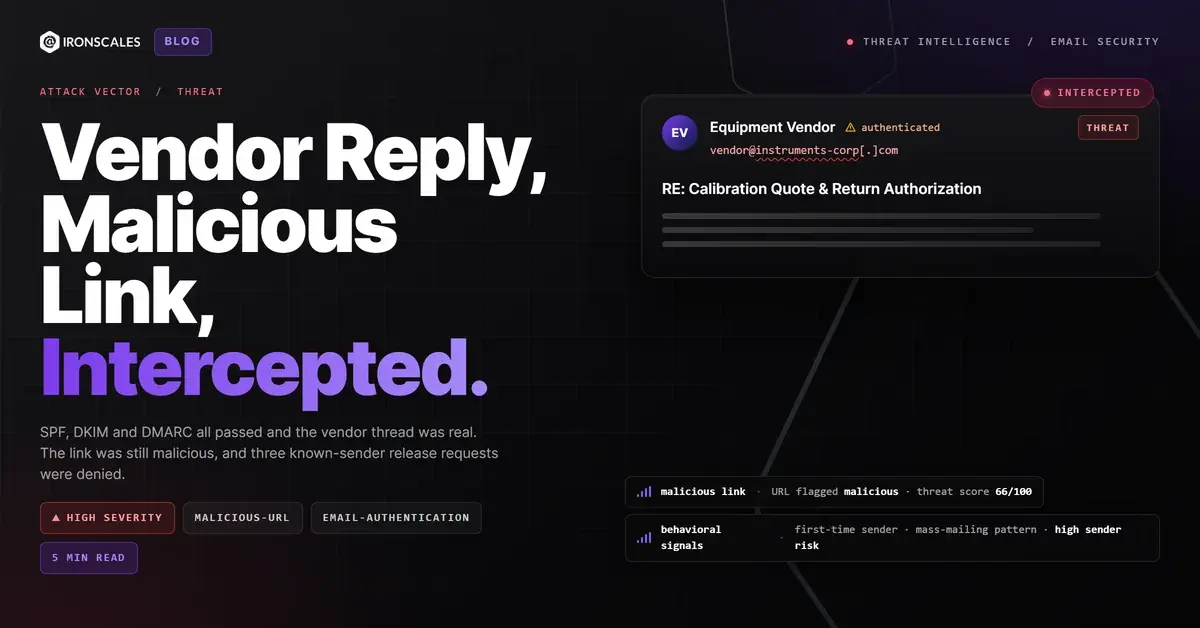
TL;DR A logistics coordinator at a regional healthcare system got a reply to a service request sent a week earlier. It referenced the right case, the right instruments, and it came through a real vendor's own CRM sending stream with SPF, DKIM, DMARC and composite authentication all passing. One link inside ordinary paragraph text carried a recorded malicious verdict, corroborated by an external sandbox score. The message was quarantined on arrival and twice more on repeat delivery, and three separate release requests filed on known-sender grounds were all denied with the disposition held.
Severity: High Malicious-Url Trusted-Infrastructure-Abuse MITRE: T1566.002 MITRE: T1204.001
A logistics coordinator supporting the air-medical program at a regional U.S. healthcare system had sent a routine service request in mid-July 2026, asking a long-standing equipment vendor for calibration quotes and a return authorization on two instruments. A week later the reply arrived. It quoted the original message back correctly, acknowledged a service case reference, and listed the same instrument serial numbers that had been submitted plus a third item the service center had received. It came from the vendor's own corporate domain, sent through that vendor's customer relationship management platform. SPF passed. DKIM passed with the signature verified. DMARC passed. Microsoft's composite authentication returned a perfect score of 100.
One hyperlink in the message body carried a recorded verdict of malicious.
A Reply That Fit the Thread, and Authentication That Held Up
This was not a cold approach with a stolen logo. The prior message in the thread genuinely existed, because the recipient had written it. The service case genuinely existed. The serial numbers matched the instruments actually shipped for calibration. Every contextual check a trained user is told to run, do I know this sender, did I start this conversation, do the details match my own records, returned the answer that says proceed.
The technical checks agreed. SPF passed with the envelope sender aligned to the sending company's domain, and the receiving gateway confirmed that the transmitting address was a permitted sender for that domain. DKIM passed under the same domain, signed by a selector the company maintains for its CRM sending stream, with the signature verified rather than merely present. DMARC passed with the header From aligned, and the platform-level headers confirmed genuine CRM Email-as-a-Service delivery rather than a spoofed relay. The path ran from the CRM platform's own outbound mail transfer agent into Microsoft's mail flow and then to the mailbox, with no authentication failure at any hop.
That is the part defenders most often misread. DMARC alignment, as specified in RFC 9989, establishes that the domain owner authorized the message and that the signed content survived transit intact. It is an identity control, with no opinion about whether a URL inside the authorized, intact message is currently weaponized. NIST defines phishing by the deception and the objective, not by forged headers, and this message satisfied that definition without forging anything.
The One Element That Carried a Verdict
The flagged link sat inside ordinary paragraph text, not a styled button or a branded call to action. In the middle of standard service-desk boilerplate about submitting a purchase order or payment details in advance, the text read as a sentence boundary that had become an anchor: the entire process[.]To help ensure timely processing. The two words spanning that period were hyperlinked, and the destination was hxxps://process[.]to/.
What the record establishes is the verdict, not the authorship. The link scanner recorded a status of malicious on that URL directly against the incident. An analyst comment on the case quoted independent external corroboration, a sandbox analysis returning a threat level of malicious with a threat score of 66 out of 100. Whether that hyperlink was introduced deliberately or produced incidentally, for example by autolink handling that turned a sentence break into a URL, is not established in the record, and it does not need to be. The destination was scored malicious by two independent systems while sitting in a message that every trust signal had already cleared.
Microsoft Defender for Office 365 had already rewritten the URL through Safe Links in transit. That is a routing change, not an adjudication. The wrapper was applied and the destination still resolved to something two scanners called malicious, which is the practical difference between rewriting a link and evaluating one. Adaptive AI scored the message with a recommendation confidence of 90, combining the flagged URL with behavioral signals that the clean authentication never touched: a first-time sender for this mailbox, a mass-mailing content pattern, and an overall high sender risk level despite the perfect header results.
See Your Risk: Calculate how many threats your SEG is missing
Three Release Requests, Three Denials
The message was quarantined on arrival, within seconds of delivery. The same subject and case reappeared and was independently quarantined two more times over the following days, each attempt ending in mitigation rather than delivery.
Then came the part that matters most. Three separate release requests were submitted against this message, each with the reason recorded as known sender. All three were handled, and all three left the case exactly where it started, at a malicious-content disposition. The disposition itself had been reached automatically, with the analyst comment arriving later as corroboration rather than as the deciding input.
The release argument was not unreasonable. Someone looking at that message had a real vendor, a real thread, a real case number, and flawless authentication, which is more supporting evidence than most legitimate mail can produce. It was still the wrong argument, because none of it spoke to the flagged element. A verdict on a URL can only be overturned by a re-evaluation of that URL. Sender familiarity is a different question, and answering it correctly does not answer this one.
The Sending Company's Role Was Incidental
The domain that sent this message belongs to a genuine, long-established multinational measurement-instruments and calibration business. Its outbound stream was properly authorized, correctly signed under its own domain, and behaving exactly as a legitimate CRM integration should. The record contains no evidence of domain compromise, account compromise, or tampering with the sending tenant. The flagged link sat in ordinary prose rather than in attacker-styled content, and how it came to be there is not established.
Its involvement here was incidental, and the same pattern could surface under any organization whose service platform sends templated replies at volume.
What This Should Change About Release Decisions
The 2026 Verizon Data Breach Investigations Report puts the human element in 62% of breaches and phishing as the initial access vector in 16%. Cases like this one show why those numbers stay stubborn even in environments with mature authentication. The human element failure here was not clicking. It was the release request, filed three times, made in good faith, based on evidence that felt overwhelming and was entirely beside the point.
Two changes follow directly. First, treat authentication as an identity control and score content separately, which is precisely what CISA's phishing guidance means when it puts URL and payload handling on a different track from sender validation. Advanced URL and malware protection has to run against every message, including the ones that pass every header check, because the messages that pass are the ones users argue hardest to release.
Second, require verdict-level evidence in the release workflow itself. A request that cites a relationship should not overturn a finding about a URL. In a healthcare logistics function like this one, where a delayed vendor reply has operational consequences, that pressure is predictable, which is why the rule needs to be structural rather than left to whoever fields the ticket.
Indicators of Compromise
| Type | Indicator | Context |
|---|
| URL | hxxps://process[.]to/ | The single malicious element. Recorded scanner status of malicious, corroborated by an external sandbox analysis at threat level malicious, score 66 of 100. Rewritten through Safe Links in transit without changing the verdict. |
| Domain | process[.]to | Landing domain for the flagged link. No WHOIS data available, so registration history is unverified. |
| Anchor text | the entire process[.]To help ensure timely processing | The hyperlink sat on a sentence-boundary word pair inside ordinary service-desk prose, not on a styled call to action. |
| Email | vendor-mailbox@vendor-domain[.]com (genericized) | Bystander sender mailbox. Domain and local part both genericized. |
| Domain | vendor-domain[.]com (genericized) | Bystander sending domain, legitimately signing its own CRM outbound stream. No evidence of compromise. |
| IP | 35[.]177[.]31[.]212 | Sending mail transfer agent for the CRM platform's Email-as-a-Service infrastructure. Legitimate, not attacker controlled. |
| Auth result | SPF pass, DKIM pass (verified), DMARC pass, composite authentication pass reason 100 | Every check cleared. Header spoofing was not part of this attack. |
| Detection signal | Adaptive AI recommendation confidence 90 | Driven by the flagged URL plus first-time-sender, mass-mailing-pattern and sender-risk signals, not by any authentication failure. |
| Disposition | Malicious content, three quarantine actions, three denied release requests | Same subject and case quarantined on three delivery attempts. Three known-sender release requests handled, disposition unchanged. |
MITRE ATT&CK Mapping
| Technique | ID | How it appeared |
|---|
| Phishing: Spearphishing Link | T1566.002 | A hyperlink to a destination scored malicious by two independent systems, delivered inside a fully authenticated reply within a genuine, recipient-initiated service thread. |
| User Execution: Malicious Link | T1204.001 | Execution depended on the recipient following the link. Thread continuity, matching serial numbers and a valid case reference supplied the motivation. |
Email Attack of the Day is a daily series from
IRONSCALES spotlighting real phishing attacks caught by Adaptive AI and our community of 36,000+ security professionals. Each post breaks down a real attack. What it looked like, why it worked, and what to do about it.







/Blue%20Feature%20Flower%20Icons/gear%20head%20icon.svg)
/Misc%20Icons/icon-nav-credential-theft.svg)










/Leadership%20Headshots/Audian%20Paxson%20Headshot%201000x1000%20032026.webp?width=100&height=100&name=Audian%20Paxson%20Headshot%201000x1000%20032026.webp)



.png?width=50&height=50&name=Untitled%20-%20July%2030%2c%202026%20at%2014.53.38%20(3).png)



/Misc%20Icons/icon-red-teaming-agent-gradient-simple.svg)
/Misc%20Icons/icon-phishing-soc-agent-gradient-simple.webp?width=158&height=167&name=icon-phishing-soc-agent-gradient-simple.webp)
/Misc%20Icons/icon-phishing-simulation-agent-gradient-simple.svg)


/Misc%20Icons/icon-nav-encryption.svg)