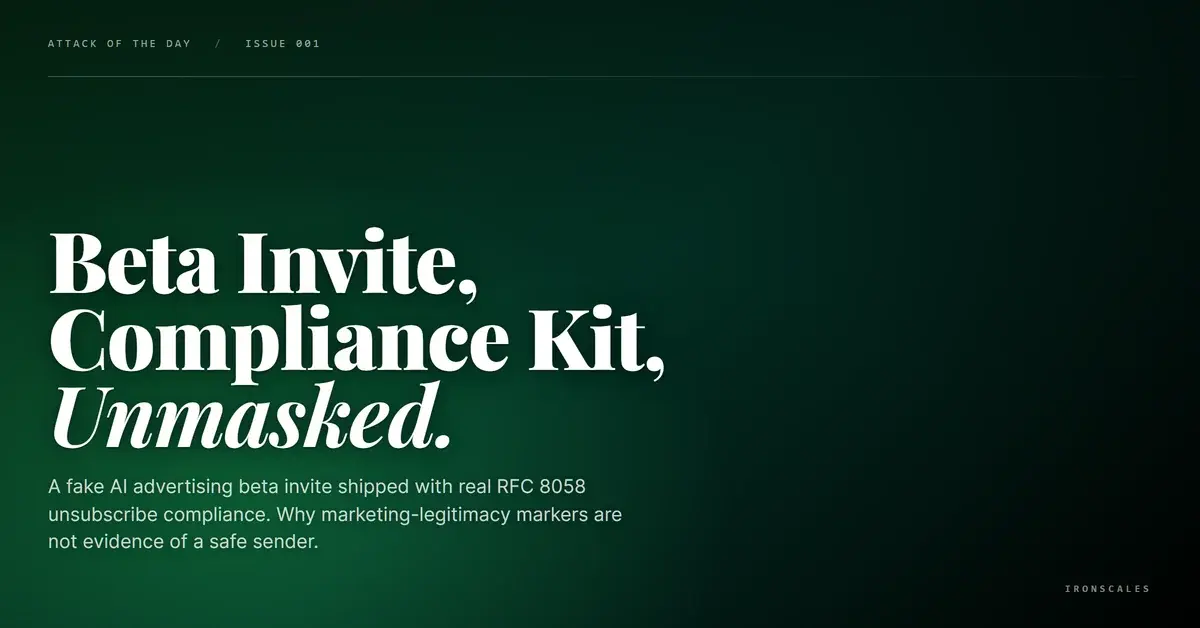
TL;DR A paid-media manager at a global digital advertising agency received an invite to an early-access AI advertising workspace. The attacker had registered the sending domain itself thirteen days earlier, then reproduced the full legitimate bulk-mail compliance checklist on it: an RFC 8058 one-click unsubscribe header, both HTTP and mailto unsubscribe forms, a mailbox that genuinely received mail, and a postal address in the footer. Those markers exist so reviewers can wave ordinary marketing through. The single button led to a convincing clone of an AI product interface. Nothing was mitigated.
Severity: High Product-Onboarding-Pretext Brand-Impersonation Attacker-Registered-Infrastructure MITRE: T1566.002 MITRE: T1583.001 MITRE: T1585.002 MITRE: T1684.001 MITRE: T1204.001
A message landed in the inbox of a paid-media manager at a global digital advertising and media agency on a Monday in late August, offering early access to an AI-powered advertising workspace. It arrived with an RFC 8058 one-click unsubscribe header. It arrived with a second unsubscribe option in mailto form, pointing at a mailbox that genuinely received mail. It arrived with a corporate postal address in the footer, in Delaware. Those three things are precisely the furniture a reviewer looks for when deciding whether an unfamiliar bulk send is ordinary marketing or something worth escalating.
The attacker had built every piece of it, on a domain it registered itself thirteen days before the send.
The Compliance Checklist Is Not a Credential
Legitimate bulk mail is identifiable, in practice, by paperwork. A real marketing sender maintains a functioning unsubscribe path, honours the one-click header, and publishes a physical business address because commercial mail regulations require one. Analysts and automated triage both lean on that pattern, because a criminal operation with a short shelf life has no reason to build an opt-out mechanism.
This sender invested. The message carried both accepted unsubscribe forms, an HTTP link and a mailto address, plus the one-click post header that tells a mailbox provider the HTTP endpoint will honour an automated opt-out. The domain's mail exchange records were pointed at a free forwarding service so the unsubscribe mailbox would actually collect anything sent to it. None of it was decoration, and none of it was borrowed. It was a compliance kit assembled from scratch, in a few hours of DNS and template work, for the price of a domain registration.
That is the reframing this case forces. Every marker on the list is purchasable. What the list actually measures is effort, and effort is cheap now.
A Pretext Aimed at One Profession
The lure copy contained no threat, no deadline and no urgency, which is unusual enough on its own. It announced that early access to an AI advertising workspace was open on the recipient's account, described planning, launching and measuring campaigns from a single workspace, and noted that connecting an account was a one-time step taking under a minute. The greeting was a generic hello. There was no account number, no invoice, no attachment and no QR code.
The targeting lived somewhere less visible. The recipient's own mailbox address rode along inside the unsubscribe link as an encoded query token, and again in plaintext as the body parameter of the mailto unsubscribe form. That is a mailing list built for named people, not a spray. And the person on it manages paid media at an advertising agency, which is the single profession for whom an unsolicited invitation to test an AI advertising product is the expected thing rather than the suspicious thing.
The visual layer matched. The body was hand-built HTML in the impersonated brand's own design language: its signature link blue, its type stack, its text grey, an uppercase blue call to action, and a hidden preheader padded with zero-width non-joining characters so it would preview cleanly without showing filler. The sender alias read "Gemini Ads", not Google, and the platform's impersonation engine never fired, because no real Google identity and no internal executive was mimicked. Impersonation by product-name association leaves nothing for a display-name comparison to catch. The 2026 Verizon Data Breach Investigations Report newly tracks pretexting as 6% of initial access vectors, and frames AI's contribution to email attacks as operational, scaling techniques that already worked rather than inventing new ones.
Nothing for a Header Check to Contradict
The authentication layer is a supporting fact here, not the story, because there was nothing wrong with it. The message travelled a single hop from a commodity transactional email service delivering through Amazon SES in the eu-west-1 region straight into the recipient provider's mail exchanger. SPF passed. DKIM passed twice, once with a signature on the attacker's own domain and once with the sending platform's routine signature. DMARC passed with genuine alignment, because the signing domain and the visible sender domain were the same attacker-owned domain.
The one weak signal in that layer is worth naming. The attacker published a DMARC policy of none, the weakest available, and still earned a pass, because a pass measures alignment rather than enforcement. Reading policy strength, not just result, is the difference between DMARC monitoring as a telemetry source and DMARC as a verdict.
See Your Risk: Calculate how many threats your SEG is missing
The Front Door Was Onboarding, Not a Login Form
One button, with two wordings depending on whether a Microsoft client or a standard one rendered the message, resolved to the attacker's apex domain. That page is a faithful clone of an AI chat interface, reskinned as an advertising-account connector: a gradient headline inviting the visitor to connect a Google Ads account, a chat composer whose send button reads Connect, a sign-in pill in the navigation, and suggestion chips referencing client centres, linked clients, cross-account setup and budget and billing. That vocabulary is agency-fluent, which is audience-specific tradecraft rather than generic theming.
What happens after that click is not in the record. There was no login form, no captured submission endpoint and no consent request, and automated content extraction could not fetch the page's dynamic behaviour. Scanners returned a malicious verdict on the destination, but the collection mechanism behind the facade is unknown. What can be said precisely is that the front door is a convincing product-onboarding surface, and that reading matters: a connect step inside a product tour does not feel like an authentication event, so the internal alarm a fake sign-in screen triggers never gets a chance to sound. This is MITRE ATT&CK T1204.001 with the friction removed.
What Flagged It, and What Was Never Done
Detection came from destination and reputation. The payload link scanned malicious. Themis, our Adaptive AI analyst, recorded 90% confidence and cited three reasons: the malicious link verdict, community reputation similarity to previously reported phishing, and a newly registered return-path domain. Sender risk scored high. The case reached the platform through IRONSCALES Community reporting rather than a user report or an analyst queue, which is 36,000+ security professionals across 18,000+ organizations functioning as a shared early-warning layer for exactly the sender an authentication check cannot fault.
Then nothing happened. Both affected-mailbox rows show no mitigation date, no action and no status. The record shows two receive timestamps for the same mailbox. A message that satisfied every legitimacy heuristic in the stack, and was correctly scored as malicious anyway, still sat in a working inbox. That gap between a confident verdict and an executed response is the operational lesson, and it is more useful than the phishing itself.
For screening practice, the correction is narrow: unsubscribe compliance, a postal footer and clean authentication should be treated as neutral, never as exculpatory. Weight domain age, destination verdict and the plausibility of the relationship instead. CISA phishing guidance and the NIST definition of phishing both centre the deception, not the plumbing, and RFC 9989 is explicit that DMARC describes alignment policy rather than sender intent.
Indicators of Compromise
| Type | Indicator | Context |
|---|
| Domain | gemini-beta-invites[.]com | Attacker-registered sender and landing domain. Created thirteen days before the send via a mainstream registrar, registrant behind a WHOIS privacy service. |
| Domain | send.gemini-beta-invites[.]com | Attacker-configured envelope-sender subdomain for its transactional sending identity. |
| Email | invites@gemini-beta-invites[.]com | Attacker From and Reply-To address. |
| Email | unsubscribe@gemini-beta-invites[.]com | Attacker mailbox in the mailto unsubscribe form. Domain mail exchange points at a free forwarding service, so it genuinely receives mail. |
| URL | hxxps://gemini-beta-invites[.]com/ | Sole payload destination, reached from the Activate button. Scanner verdict malicious. Clone of an AI chat interface reskinned as an advertising-account connector. |
| URL | hxxps://www[.]gemini-beta-invites[.]com/ | The www host the apex redirects to. Scanner verdict partial. |
| URL | hxxps://gemini-beta-invites[.]com/unsubscribe?e=REDACTED_RECIPIENT_TOKEN | Unsubscribe endpoint. The real token is the recipient's own mailbox address, base64-encoded. Token redacted here; defanging the domain does not remove encoded recipient data. |
| IP | 54[.]240[.]3[.]11 | Amazon SES eu-west-1 egress address. Shared platform infrastructure, not an attacker-controlled host. |
| IP | 216[.]198[.]79[.]1 | Landing-page address record, on a public hosting platform with no reverse DNS. Shared platform address, not attacker-owned. |
| Header artifact | DKIM selector resend on the attacker domain | The attacker published its own signing key under this selector. The selector string is verified; any vendor inferred from it is not. |
| Header artifact | MIME boundary prefix ----_NmP- | Toolchain artifact indicating a scripted send rather than a mail client. |
| Subject | Your Gemini Ads workspace is ready | Product-onboarding pretext with no urgency, deadline or threat. |
MITRE ATT&CK Mapping
| Technique | ID | Application |
|---|
| Spearphishing Link | T1566.002 | A single link in a Google-styled product invitation, with no attachment and no QR code. |
| Acquire Infrastructure: Domains | T1583.001 | Purpose-registered sending and landing domain, privacy-shielded, aged thirteen days before use. |
| Establish Accounts: Email Accounts | T1585.002 | A paid transactional sending identity plus a working unsubscribe mailbox on the attacker's own domain. |
| Impersonation | T1684.001 | Brand impersonation by product name and visual language, without display-name or identity spoofing. |
| User Execution: Malicious Link | T1204.001 | The click is framed as a one-time account connection inside a product tour, not as a sign-in. |
Email Attack of the Day is a daily series from
IRONSCALES spotlighting real phishing attacks caught by Adaptive AI and our community of 35,000+ security professionals. Each post breaks down a real attack. What it looked like, why it worked, and what to do about it.







/Blue%20Feature%20Flower%20Icons/gear%20head%20icon.svg)
/Misc%20Icons/icon-nav-credential-theft.svg)










/Leadership%20Headshots/Audian%20Paxson%20Headshot%201000x1000%20032026.webp?width=100&height=100&name=Audian%20Paxson%20Headshot%201000x1000%20032026.webp)



.png?width=50&height=50&name=Untitled%20-%20July%2030%2c%202026%20at%2014.53.38%20(3).png)



/Misc%20Icons/icon-red-teaming-agent-gradient-simple.svg)
/Misc%20Icons/icon-phishing-soc-agent-gradient-simple.webp?width=158&height=167&name=icon-phishing-soc-agent-gradient-simple.webp)
/Misc%20Icons/icon-phishing-simulation-agent-gradient-simple.svg)


/Misc%20Icons/icon-nav-encryption.svg)