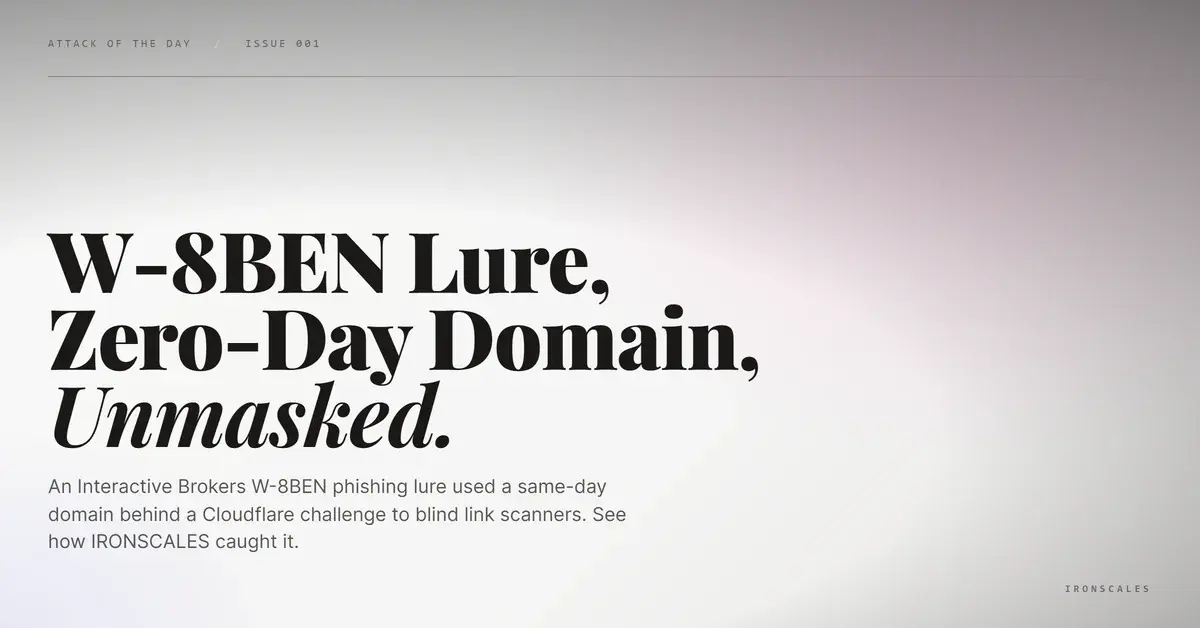
TL;DR An email impersonating Interactive Brokers told recipients their W-8BEN tax form had expired and pushed them to a Renew Certification button. That button ran through the recipient organization's own link-protection wrapper, which reported it clean because the proxy loaded. The real destination was a domain registered the same day the message was sent, and it answered automated scanners with a Cloudflare challenge instead of a page. A 0-day domain behind a bot-check gives a reputation scanner nothing to grade, so it returns unknown while the credential-harvest page waits behind the gate.
Severity: High Credential-Harvesting Brand-Impersonation MITRE: T1566.002 MITRE: T1684.001 MITRE: T1036.005 MITRE: T1204.001
The destination domain was zero days old. It was registered the same morning the email left the sender, and when an automated scanner tried to look at it, the domain answered with a Cloudflare challenge page instead of a login form. That single move is the whole game: a fresh domain behind a bot-check gives a reputation scanner nothing to grade, so the verdict comes back "unknown" while the harvesting page sits safely behind the gate.
The lure was an Interactive Brokers impersonation. The subject line read "Notification of W-8BEN Expiration and Required Tax Documentation Update," and the body leaned hard on regulatory authority: IRS Section 1441, foreign-person withholding, treaty benefits, and a warning that the recipient's account would default to standard withholding rates unless the W-8BEN was renewed. The branding was clean, right down to the "Interactive Brokers, member NYSE, FINRA, SIPC" footer. The only visible action was a button labeled "Renew W-8BEN Certification."
The tell was in who received it
The interesting part is not the pretext. It is the target list. A W-8BEN certifies foreign tax residency for people holding US brokerage accounts, so a legitimate Interactive Brokers renewal notice would go to account holders. This one landed in the inboxes of staff at a US healthcare provider, including an occupational therapist and three of her colleagues, none of whom have any reason to hold an Interactive Brokers account. The SOC analysis flagged the message as generic, with no account-specific identifiers beyond the recipient address. That is the signature of an untargeted spray, not a targeted account takeover. The attacker was casting the W-8BEN net wide and hoping a few recipients happened to have a brokerage relationship, or would simply panic at the regulatory language and click.
That reliance on volume over precision matters because it is the common case, not the exotic one. The Verizon 2026 Data Breach Investigations Report attributes 16% of breaches to phishing as the initial access vector and finds credentials involved in 39% of breaches across the kill chain. A W-8BEN "renewal" that quietly collects identity and account details feeds directly into both numbers.
Three domains, none of them Interactive Brokers
Follow the infrastructure and the impersonation falls apart in seconds.
The message displayed "Interactive Brokers" as the sender name, but the actual sending address sat on jlrimes[.]com, a domain registered on June 19, 2025, roughly six months before the send. The "Renew W-8BEN Certification" button did not point anywhere near interactivebrokers.com either. It pointed to ehdgmsrd[.]com, a random-looking label registered on December 5, 2025, the same day the email was sent, sitting behind Cloudflare nameservers with a privacy-redacted registrant.
So the display name claimed one brand, the envelope came from a second domain, and the payload lived on a third. Any one of those mismatches is a problem. Together they map cleanly to MITRE ATT&CK impersonation (T1684.001) and masquerading (T1036.005), with the button itself being the spearphishing link (T1566.002) that leads to user execution (T1204.001).
Why the authentication story is not "SPF failed, done"
It is tempting to close this case on the authentication results alone: SPF fail, DKIM fail, DMARC fail. But a security reader should not stop there, because the SPF failure is misleading.
The message was forwarded through a legitimate AppRiver secure email gateway before it reached Microsoft. When Microsoft evaluated SPF, it checked the gateway's IP against the sending domain's SPF record, which of course does not list a third-party gateway, so SPF failed. That is a normal forwarding artifact, and treating it as proof of malice will burn you on legitimate forwarded mail.
The signal that actually matters is the DKIM result. The message carried a DKIM signature claiming d=jlrimes[.]com, and it failed on a body-hash mismatch, meaning the signed content did not match what was delivered. Pair a failed DKIM signature with a domain that publishes DMARC p=none, so there is no enforcement to fall back on, and you have a sender that cannot prove message integrity and has explicitly opted out of anyone rejecting it for that. Worth noting: Interactive Brokers' own DMARC record was never in play here, because the attacker never spoofed interactivebrokers.com. They registered their own domains and pasted the brand into the body, which is why authentication protocols alone were never going to catch this.
See Your Risk: Calculate how many threats your SEG is missing
The wrapper said clean, and it was wrong
Here is the detection gap in one sentence. The recipient organization's own link-protection wrapper rewrote the button URL through its EdgePilot proxy, and because that proxy loaded successfully, the wrapper reported the link "clean."
A wrapped link is not a verified-safe link. The wrapper confirmed that its proxy returned a success status, not that the final destination was benign. And the final destination was a 0-day domain that answered automated inspection with a Cloudflare challenge. A bot-check is a legitimate anti-abuse tool, but attackers weaponize it: the scanner cannot solve the challenge, cannot render the page, and cannot see the credential form waiting behind it, so the best it can honestly return is "partial" or "unknown." Reputation feeds could not help either, because a domain registered hours earlier has no history to score. Microsoft's own filtering tagged the message as phishing and dropped it to Junk, but on a domain this fresh, reputation scoring is running blind.
This is the structural reason single-signal tools keep losing to this pattern. No individual check was decisive. What resolves it is convergence, and that is where our Adaptive AI earns its keep. Themis weighs the whole picture at once: a display name claiming a major brokerage, a sending domain unrelated to that brand, a DKIM body-hash failure, a same-day-registered destination hiding behind a bot-check, an urgent request for sensitive tax data, and near-zero personalization sprayed across multiple mailboxes. Any one signal is deniable. All of them together are not. Across the more than 36,000 security professionals using the platform, SEGs still miss roughly 67.5 phishing emails per 100 mailboxes every month, and same-day domains behind challenge pages are a big part of that gap.
For defenders, the takeaway is blunt. Stop treating "the link scanner said clean" as the end of the inquiry, especially when the destination is a brand-new domain refusing inspection. Weight domain age and reachability alongside content and authentication, and invest in credential-harvesting protection that reads sender intent instead of waiting for a blocklist to catch up. As CISA's phishing guidance frames it, breaking the attack cycle early beats cleaning up after a credential is gone. And when an email tells you to "manually enter our official website address into your browser," as this one did in a nice touch of borrowed credibility, take the advice literally and never through the button it hands you.
Indicators of Compromise
| Type | Indicator | Context |
|---|
| Sending domain | jlrimes[.]com | Registered 2025-06-19. DKIM body-hash fail, DMARC p=none. Display name spoofed as "Interactive Brokers." |
| Sender address | login@jlrimes[.]com | From address behind the "Interactive Brokers" display name. |
| Destination domain | ehdgmsrd[.]com | Final destination of the CTA. Registered 2025-12-05 (0 days old at send). Returned a Cloudflare challenge to automated scanners. |
| Wrapped CTA | hxxps://link.edgepilot[.]com/s/...?u=hxxps://ehdgmsrd[.]com/?token=... | The recipient organization's own EdgePilot link-protection wrapper, rewritten around the malicious destination. The wrapper is a legitimate service, not attacker infrastructure; it reported the link clean because the proxy loaded. |
| Subject | Notification of W-8BEN Expiration and Required Tax Documentation Update | Regulatory-authority pretext (IRS Section 1441, foreign-person withholding). |
Email Attack of the Day is a daily series from
IRONSCALES spotlighting real phishing attacks caught by Adaptive AI and our community of 36,000+ security professionals. Each post breaks down a real attack. What it looked like, why it worked, and what to do about it.







/Blue%20Feature%20Flower%20Icons/gear%20head%20icon.svg)
/Misc%20Icons/icon-nav-credential-theft.svg)










/Leadership%20Headshots/Audian%20Paxson%20Headshot%201000x1000%20032026.webp?width=100&height=100&name=Audian%20Paxson%20Headshot%201000x1000%20032026.webp)



.png?width=50&height=50&name=Untitled%20-%20July%2030%2c%202026%20at%2014.53.38%20(3).png)



/Misc%20Icons/icon-red-teaming-agent-gradient-simple.svg)
/Misc%20Icons/icon-phishing-soc-agent-gradient-simple.webp?width=158&height=167&name=icon-phishing-soc-agent-gradient-simple.webp)
/Misc%20Icons/icon-phishing-simulation-agent-gradient-simple.svg)


/Misc%20Icons/icon-nav-encryption.svg)