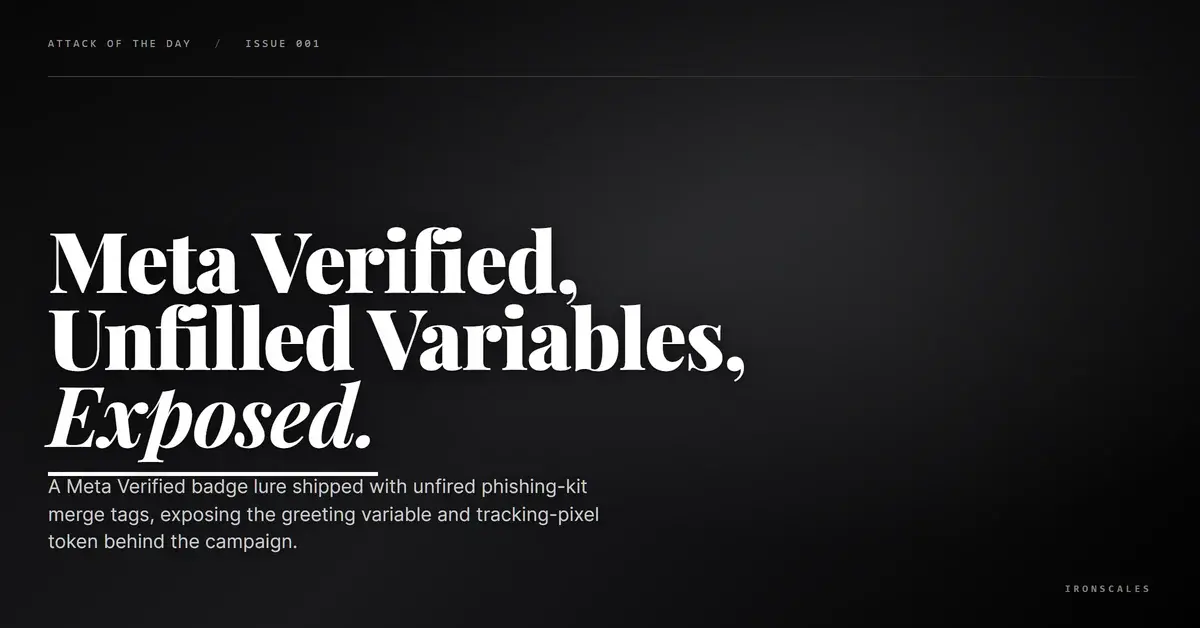
TL;DR A badge-verification lure impersonating Meta reached a public university mailbox with its template engine visibly broken. The greeting still carried a literal bracketed placeholder holding a mailbox alias, and a hidden tracking pixel still pointed at a stock example host with an unreplaced unique-ID token. The sending domain authenticated for itself but had no relationship to Meta, no DMARC record of its own, and a spoofed Reply-To. The tenant scored the mail as spam, and automated detection classified and mitigated it about five seconds after it arrived.
Severity: Medium Brand-Impersonation Credential-Harvesting Phishing-Kit-Artifact MITRE: T1566.002 MITRE: T1684.001
The message opened with a greeting that had not finished assembling itself. Hi [admissions-alias@example[.]edu], it said, square brackets included. The address inside those brackets was a shared departmental alias at a public university, and it was not the mailbox that received the mail. That landed with an IT security staff member instead, bad luck for the sender, because the broken greeting was only the first piece of exposed wiring.
The pretext was a blue checkmark. Subject line: "Final step: Claim your Meta Verified badge before it expires." Display name: "Meta Business Support." The body carried a fabricated Application ID, #F3XV-IDQN-GCYC, to imply a process already underway, and one button, "Get My Blue Checkmark Now," to finish it. Badge lures work by dangling a status marker the recipient already wants, then attaching a deadline.
The greeting that shipped as raw source
Mass phishing is template work. A kit holds the creative in one place and a target list in another, and a sending script walks the list, substituting a value into each variable slot before the mail goes out. The greeting slot never got substituted, so the token shipped exactly as the operator wrote it.
No genuine platform notification greets you with a bracketed email address, so this is an own goal. It is also informative: the unfired variable shows the kit personalizes on raw address rather than a parsed name, so the target list carries no identity data. And because the placeholder address did not match the mailbox that received the message, the artifact exposed something else: the campaign was aimed at an internal alias, and forwarding redirected it to someone whose job is reading email like this.
A tracking pixel pointed at nowhere
The second unfired variable was hidden in the HTML. A one-pixel tracking image pointed at hxxps://yourdomain[.]com/track/open.php?id=[[UNIQUE_ID]], a stock example host plus a raw token where a per-recipient identifier belonged. Both halves are placeholder text: the operator built from a kit whose sample configuration was never edited.
When that pixel works it is reconnaissance, confirming a live, monitored mailbox the moment a message renders and narrowing a broad list into a validated one. Here it pointed nowhere, so the campaign gave up its own telemetry along with its greeting.
See Your Risk: Calculate how many threats your SEG is missing
Authenticated for itself, unrelated to Meta
The envelope is where the sloppiness stopped. The message came from oroaliabbntouaftmgglot@thoimmo[.]com, a random local-part on a privacy-protected domain registered roughly four years earlier, relayed through Google Workspace. It authenticated: SPF passed for the sending domain, DKIM against a Workspace signing domain, thoimmo-com[.]20230601[.]gappssmtp[.]com.
The DMARC result was best-guess pass, and that distinction matters. It means the receiver found no published DMARC record for the sending domain and inferred alignment from the SPF and DKIM results instead. It is not a policy evaluation, because there was no policy. RFC 7489 defines DMARC as a domain owner publishing a stance on unaligned mail. A domain that never published one has expressed no stance, and reading that silence as approval is how an unrelated sender inherits trust it never earned.
None of it had anything to say about Meta. Authentication answers whether a message came from the domain in the envelope, not whether that domain has any claim to the brand in the display name. The gap was papered over with a Reply-To pointed at support@meta[.]com, so a recipient glancing at the reply field would see the promised brand instead of the address that sent the mail.
Where the blue checkmark actually pointed
The lone call to action ran through a link shortener, hxxps://ln[.]run/ilovemail, which strips the destination out of anything a recipient could inspect by hovering. Link analysis followed the redirect toward a host resembling rewards_bluetick_id195[.]insz[.]us, which presented a certificate hostname mismatch and returned only a partial verdict. A reward, a blue tick, and a numeric campaign ID on a throwaway host is the shape of a credential-harvesting page waiting for a business login.
Five seconds, and no single clean signal
Nothing here hinged on a blocklist hit. The tenant's filtering scored the message as spam with a confidence level of 5, which kept it out of a clean inbox but stopped short of calling it an attack. Automated detection then classified and mitigated it about five seconds after receipt, at 16:05:33 against an arrival at 16:05:28, with no analyst action required.
What did the work was the combination: a display name claiming a global platform against a sending domain with no relationship to it, a shortener resolving only to a partial verdict, a certificate mismatch at the end of the chain, and no sending history with the recipient. Any one is arguable alone. Stacked, they describe impersonation, the kind of judgment that belongs to Adaptive AI weighing signals in context rather than a rule waiting for a known-bad string. That matters in education, where shared aliases and forwarding rules make the sender-history baseline hard to keep.
What kit residue is worth to a defender
Unfired placeholders are a gift. The 2024 Verizon Data Breach Investigations Report puts the median time to click a phishing link at 21 seconds and to submit data at 28 seconds, with stolen credentials involved in 38% of breaches. Nobody is running an investigation on that clock, and a greeting that reads as machine output is one of the few tells that registers in a half-second glance. The residue is also intelligence: an unedited sample host says the kit was never customized, so other campaigns from the same buyer should carry the fingerprint.
Indicators of Compromise
| Type | Indicator | Context |
|---|
| Email | oroaliabbntouaftmgglot@thoimmo[.]com | Sender; random local-part, display name spoofed as "Meta Business Support" |
| Domain | thoimmo[.]com | Sending domain, unrelated to the brand; privacy-protected, relayed via Google Workspace |
| DKIM domain | thoimmo-com[.]20230601[.]gappssmtp[.]com | Workspace signing domain; DKIM passed for the sender, not the brand |
| Email | support@meta[.]com | Spoofed Reply-To matching the impersonated brand |
| URL | hxxps://ln[.]run/ilovemail | Sole call to action; shortener hiding the destination |
| Host | rewards_bluetick_id195[.]insz[.]us | Redirect target; certificate hostname mismatch, partial verdict only |
| URL | hxxps://yourdomain[.]com/track/open.php?id=[[UNIQUE_ID]] | Hidden open beacon, example host and ID token unreplaced |
| Template artifact | Bracketed recipient address in the greeting | Unfired merge variable, exposing the intended alias target |
| Reference string | #F3XV-IDQN-GCYC | Fabricated "Application ID" implying an in-progress request |
MITRE ATT&CK Mapping
| Technique | ID | How it showed up |
|---|
| Phishing: Spearphishing Link | T1566.002 | Single shortened link leading toward a credential-harvesting host |
| Impersonation | T1684.001 | Display name and Reply-To dressed as a global platform's support team |
CISA's phishing guidance on stopping the attack cycle is the practical baseline here, and NIST's definition of phishing is a reminder that the technique is defined by the deception, not the delivery.
See You Next Friday
The best evidence here was produced by the attacker, for free, twice. A greeting that never merged and a beacon that never got a target ID turned a routine badge scam into a schematic of the tooling behind it. Do not count on that. The envelope work was competent, the authentication was real, and a more careful operator would have shipped the same lure with none of the tells. Verify a badge, an invoice, or an account status inside the platform itself, not through the link that told you about it.
Email Attack of the Day is a daily series from
IRONSCALES spotlighting real phishing attacks caught by Adaptive AI and our community of 36,000+ security professionals. Each post breaks down a real attack. What it looked like, why it worked, and what to do about it.







/Blue%20Feature%20Flower%20Icons/gear%20head%20icon.svg)
/Misc%20Icons/icon-nav-credential-theft.svg)










/Leadership%20Headshots/Audian%20Paxson%20Headshot%201000x1000%20032026.webp?width=100&height=100&name=Audian%20Paxson%20Headshot%201000x1000%20032026.webp)



.png?width=50&height=50&name=Untitled%20-%20July%2030%2c%202026%20at%2014.53.38%20(3).png)



/Misc%20Icons/icon-red-teaming-agent-gradient-simple.svg)
/Misc%20Icons/icon-phishing-soc-agent-gradient-simple.webp?width=158&height=167&name=icon-phishing-soc-agent-gradient-simple.webp)
/Misc%20Icons/icon-phishing-simulation-agent-gradient-simple.svg)


/Misc%20Icons/icon-nav-encryption.svg)