TL;DR An account consultant at a life-sciences manufacturer received a two line note claiming a document was waiting in Microsoft OneDrive. Authentication passed cleanly because the message genuinely left a medical specialty practice's own Microsoft 365 mailbox. The tell was the addressing: From, To and CC were all set to that one compromised mailbox, so the real recipient appeared nowhere a reader could see. There was no link and no attachment, only a signature whose contact details did not line up with the practice's published information.
Severity: High Account-Takeover Business-Email-Compromise Credential-Harvesting MITRE: T1566 MITRE: T1078
A note reached an account consultant in a sales role at a life-sciences manufacturer, carrying a subject line assembled from the name of a medical specialty practice in another state. SPF passed. DKIM passed with the signature verified against the practice's own domain. The ARC chain sealed clean across two hops, so the receiving provider could confirm the authentication results had survived transit rather than merely looking plausible on arrival. DMARC evaluation passed too, on Microsoft's best-guess result, the one applied when the sending domain publishes no policy of its own.
None of that was forged. The mail genuinely left the practice's Microsoft 365 tenant, signed by the practice's domain, relayed by Microsoft's own outbound infrastructure. The authentication was real because the sender was real. The mailbox had simply stopped being under its owner's control.
Every Visible Recipient Field Pointed Back at the Sender
The tell is not in the authentication stack. It is in the addressing.
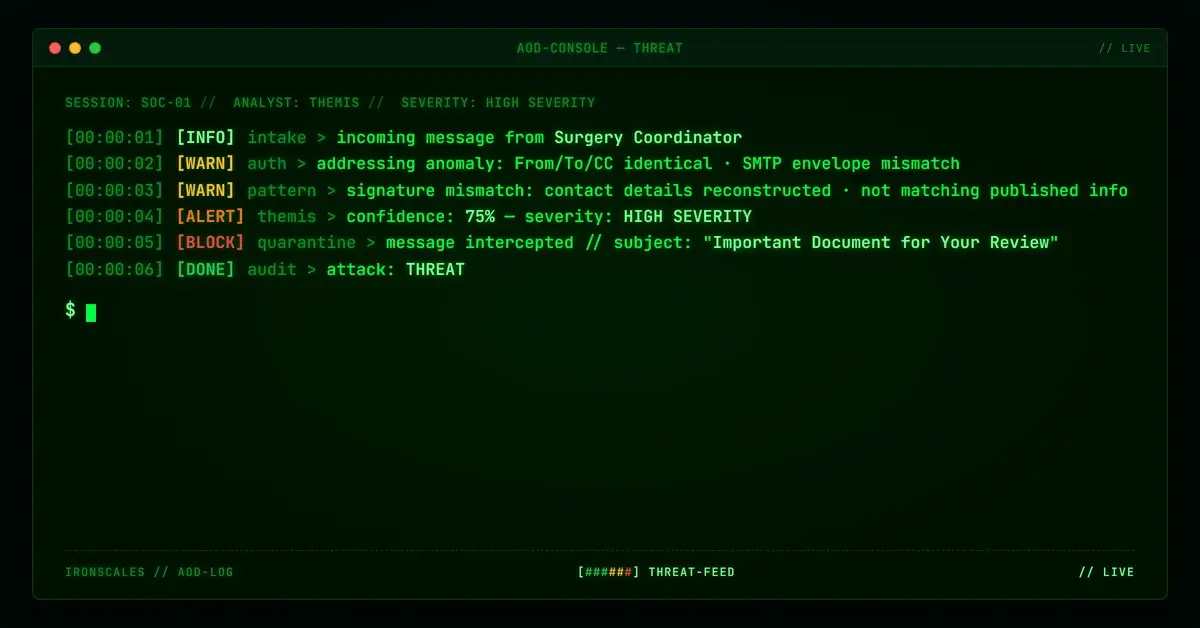
From, To and CC were all set to the same value: the compromised mailbox at the practice. Read literally, this is one mailbox writing to itself and copying itself. Yet the message arrived as external mail in the inbox of an employee at an unrelated company in an unrelated industry, which means the address that actually received it appeared nowhere a reader could see. It travelled in the SMTP envelope, in the recipient command the mail client does not render.
That construction is a bulk-send artifact. An operator working inside a hijacked mailbox who wants to reach a harvested address list has no interest in building personalized headers for each target. Filling the visible recipient fields with the sending mailbox and letting the envelope carry the real addresses is faster, and it keeps the target list invisible to anyone who receives a single copy. It has a useful side effect as well: each message reads, at a glance, like something the sender wrote to themselves and passed along.
A header block that resolves entirely to the sender, with a recipient named nowhere in it, is a contradiction available at inspection time. It needs no link resolved and no attachment opened, which matters here, because there was neither.
Authentication Answered a Different Question
DMARC asks one narrow thing: did the domain owner authorize this message, and did the signed content survive transit. Account takeover does not bypass that question. It inherits it. Whoever holds the mailbox answers truthfully in the owner's name, and the domain's accumulated sending reputation transfers with the answer.
The best-guess DMARC result sharpens the point rather than softening it. The practice was not even asserting how a failure should be handled, because it published no policy. The pass was genuine, the policy behind it was absent, and neither fact carries any information about who was sitting in the mailbox that morning.
This is why the identity layer keeps losing ground to stolen access. The 2024 Verizon Data Breach Investigations Report puts stolen credentials at the top of the initial-action list, present in 38 percent of breaches, with the human element a component of 68 percent. Credentials are not a way around authentication controls. They are a way to satisfy them.
Two Lines and No Payload
The body ran to three sentences: a morning greeting, a claim that an important document had just been sent over Microsoft OneDrive for the recipient's perusal, and a request to review it and come back with questions. Then a signature block naming the practice, a surgery coordinator role, a street address, a phone number and a fax number.
There was no OneDrive link. There was no attachment. Link scanning surfaced only three generic Microsoft phishing-education URLs, all benign, the sort of boilerplate that rides along in a tenant's mail template.
So the first message carried nothing to detonate. The entire ask is a reply, or a follow-up click on something delivered later. That is deliberate. A conversation the target opens is a conversation the target trusts, and a real destination handed over in message two arrives inside a thread the recipient started. Pretexting of this kind, most of it business email compromise, is the top social-engineering pattern in the same DBIR data, with a median transaction around 50,000 dollars. The 2023 FBI IC3 Internet Crime Report records roughly 2.9 billion dollars in reported BEC losses in a single year. Almost none of that requires a malicious attachment.
See Your Risk: Calculate how many threats your SEG is missing
A Signature That Did Not Line Up
The signature is the second contradiction, and it sits in a place most recipients read as decoration.
The SOC record notes that the contact details in that block do not line up with the information the practice publishes for itself. We are not printing either set of digits, and we are not re-verifying them against a live directory, because listings change and the underlying assertion was not independently confirmed. The direction is what matters: the block appears to have been assembled to resemble the practice rather than copied from it. Someone with mailbox access and no desk in that office reconstructed the footer from memory or from a scrape, and got a routing detail wrong.
Taken with the addressing, it points at the same conclusion. The domain was never in attacker hands. One account inside it was.
Where the Detection Actually Came From
No analyst adjudicated this message on arrival. It surfaced when automated retroactive re-evaluation went back over already-delivered mail and re-scored it, which is worth stating plainly: at delivery time, every control that examines sender identity had returned a pass.
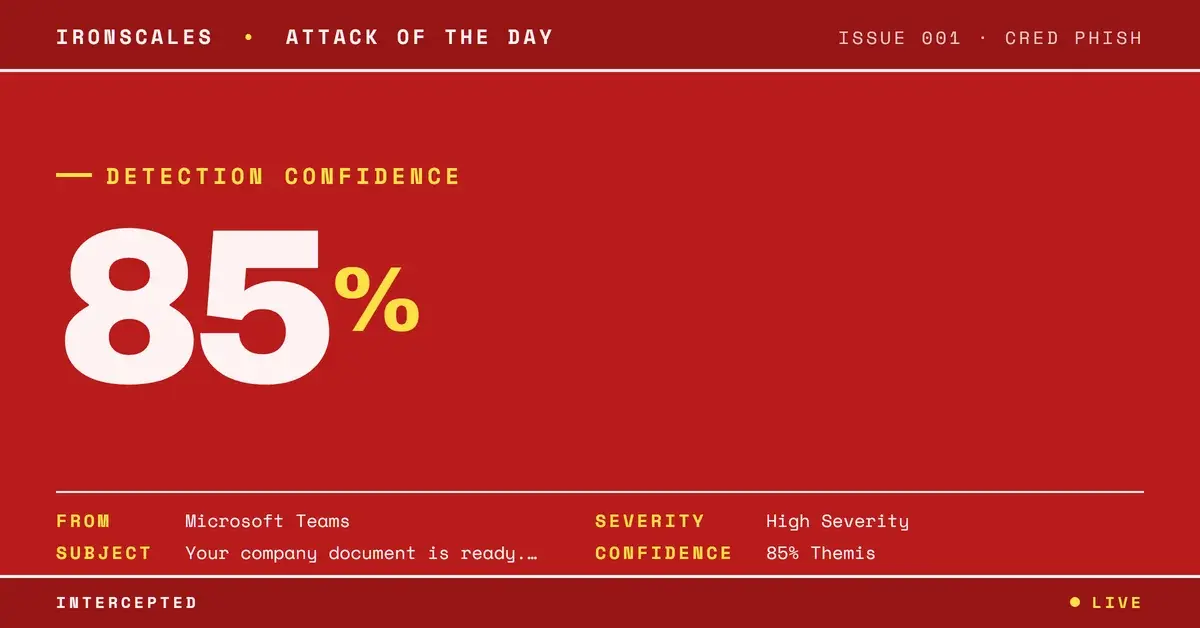
Adaptive AI scored the message credential theft at 88 percent confidence. That label is an inference about intent drawn from the message as a whole, and it deserves separating from what was observed. Nothing in the record shows a credential page, a form or a harvesting URL. What the model had to work with was a sender with no prior correspondence with this organization, a document claim with no document, and recipient fields that folded back on themselves.
What This Should Change
Score addressing as its own signal, independently of authentication. A message whose header recipients all equal its header sender, delivered externally to someone else, is anomalous on its face. That check costs a string comparison and does not depend on resolving anything.
Treat a payload-free message as a stage, not a false alarm. Reply-bait is under-weighted by tooling built to grade links and attachments, and account takeover is what makes it work, because the second message arrives from an address the target has already answered once. CISA's phishing guidance separates sender validation from payload handling for this reason. Here there was no payload to handle and the sender validated perfectly, which left behavior as the only surface with anything on it.
Indicators of Compromise
| Type | Indicator | Context |
|---|
| Email | compromised-mailbox@practice-domain[.]example (genericized) | Bystander mailbox at a real medical specialty practice, used simultaneously as From, To and CC. Local part and domain both withheld: the account was taken over, the domain was not. |
| Domain | practice-domain[.]example (genericized) | Bystander sending domain, registered several years earlier and operating normally. Passed SPF and DKIM legitimately under its own Microsoft 365 tenant. Not a block candidate. |
| Header pattern | From, To and CC all identical to the sending mailbox | The external delivery address existed only in the SMTP envelope. Highest-value indicator in the case and detectable without resolving anything. |
| IP | 40[.]107[.]209[.]114 | Microsoft 365 outbound relay that passed SPF for the sending domain. Shared provider infrastructure, not attacker-controlled. |
| Auth result | SPF pass, DKIM pass (verified, signing domain matches the sender), DMARC pass on a best-guess policy, ARC pass across two seals | Every identity check cleared. No published DMARC policy governed the sending domain. |
| Subject | Notice line built from the compromised practice's own name | Withheld, because printing it names the bystander organization. |
| Lure | Claim that a document was sent via Microsoft OneDrive, with no link and no attachment present | Three benign Microsoft phishing-education URLs were the only links in the message. No landing page was captured. |
| Signature | Practice name, a surgery coordinator role, a street address, a phone and a fax number | Contact details do not line up with the practice's published information per the SOC record. Digits withheld and not independently re-verified. |
| Detection signal | Adaptive AI confidence 88, label credential theft | Inference from sender history, the missing document and the self-addressed recipient fields. No credential page was observed. |
MITRE ATT&CK Mapping
| Technique | ID | How it appeared |
|---|
| Phishing | T1566 | A document-review pretext with no attachment and no link, sent to solicit a reply that would carry the real destination. |
| Valid Accounts | T1078 | Delivery ran through a legitimate, fully authenticated Microsoft 365 mailbox at a medical practice, so every sender-identity control returned a pass. |
Email Attack of the Day is a daily series from
IRONSCALES spotlighting real phishing attacks caught by Adaptive AI and our community of 35,000+ security professionals. Each post breaks down a real attack. What it looked like, why it worked, and what to do about it.







/Blue%20Feature%20Flower%20Icons/gear%20head%20icon.svg)
/Misc%20Icons/icon-nav-credential-theft.svg)










/Leadership%20Headshots/Audian%20Paxson%20Headshot%201000x1000%20032026.webp?width=100&height=100&name=Audian%20Paxson%20Headshot%201000x1000%20032026.webp)



.png?width=50&height=50&name=Untitled%20-%20July%2030%2c%202026%20at%2014.53.38%20(3).png)



/Misc%20Icons/icon-red-teaming-agent-gradient-simple.svg)
/Misc%20Icons/icon-phishing-soc-agent-gradient-simple.webp?width=158&height=167&name=icon-phishing-soc-agent-gradient-simple.webp)
/Misc%20Icons/icon-phishing-simulation-agent-gradient-simple.svg)


/Misc%20Icons/icon-nav-encryption.svg)