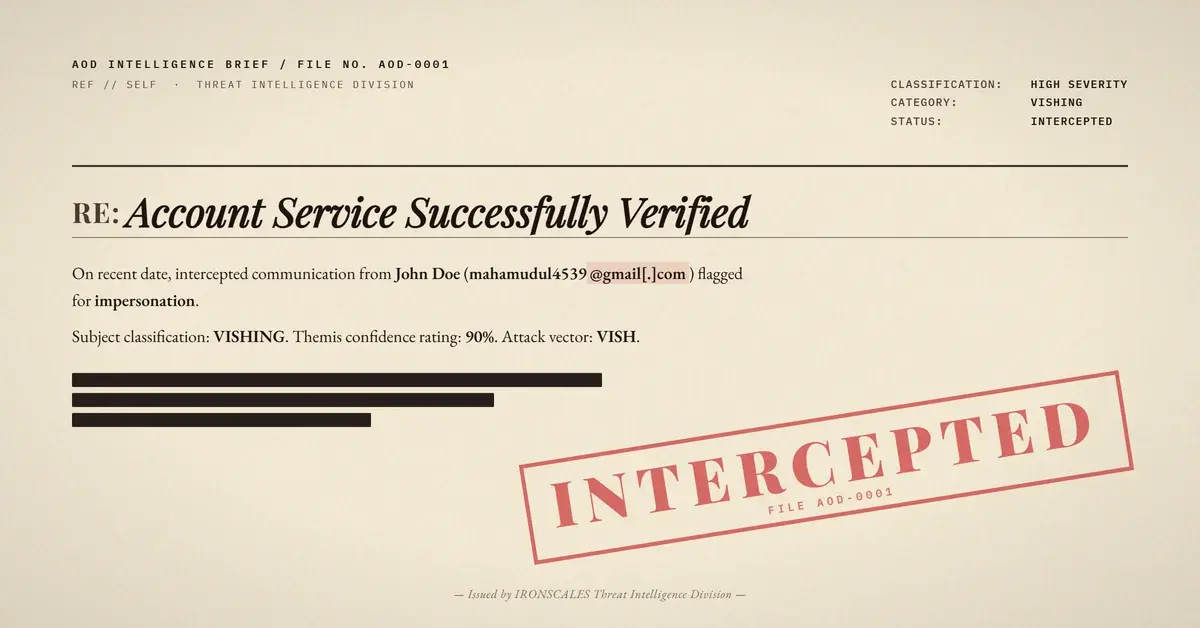
TL;DR One employee mailbox received a fabricated McAfee subscription renewal receipt with no links and no attachments. The sender was a first-time Gmail account submitting from a client IP geolocated in Bangkok with no PTR record, and the display name on the message was the real name of the mailbox owner, so the mail appeared to arrive from the recipient's own identity. The only call to action was a support phone number, listed twice. Gmail authentication passed cleanly. Adaptive AI labelled the message vishing at 90 percent confidence and the incident resolved automatically.
Severity: High Callback-Phishing Vishing Brand-Impersonation Display-Name-Impersonation Freemail-Abuse MITRE: T1566 MITRE: T1566.004 MITRE: T1684.001 MITRE: T1585.002
One employee mailbox received an email with the subject "Account Service Successfully Verified." Inside was a fabricated McAfee membership overview: a three-year subscription, a reference code, a charge of USD 367.99, and a support telephone number listed twice above a fabricated agent signature. No links. No attachments. No QR code, no redirect chain. On the usual scale of renewal-invoice scams it was unremarkable, right up to the From header.
The display name on the message was the real name of the person who owned the mailbox it was delivered to.
The Sender Identity Was Borrowed From the Recipient
Not a colleague. Not an executive. Not a McAfee billing alias. The name rendered in the inbox belonged to the recipient, so in the message list, the preview pane, and most mobile clients, the mail appeared to have been sent by the person reading it.
That works on a different reflex than ordinary display-name impersonation. Impersonating a vendor asks the recipient to trust someone else. Impersonating the recipient removes trust from the equation, because there is no stranger to evaluate. Self-addressed mail reads as an artifact of one's own activity, a receipt forwarded from another device or a confirmation triggered by something already done, so the billing pretext arrives pre-authorized. Of course there is a subscription. Apparently it was handled.
The mechanic also survives the interface. Clients truncate or omit the sending address in favor of the display name, and some group self-addressed mail into threads the recipient already trusts. None of it requires a spoofed domain, which is what makes it cheap.
The Sending Account Had No History Here
The message came from a consumer Gmail account at mahamudul4539@gmail[.]com. Gmail is a legitimate provider, not attacker infrastructure, and that is the point. There was no lookalike domain to block and no reputation deficit to inherit.
What the account did have was a complete absence of relationship. This was a first-time sender, with no prior correspondence to that recipient or tenant. The received chain adds the detail worth keeping: the SMTP submission into Gmail came from client IP 43[.]152[.]237[.]47, geolocated to Bangkok, Thailand, with no PTR record at all. From there it took the ordinary Gmail outbound path through smtp[.]gmail[.]com into the mailbox. No gateway, no sanitization relay, no unusual hop.
Absent reverse DNS is a soft signal alone. Stacked, it is not. An account asserting a major security brand, submitting from an address with no reverse lookup and no hosting attribution, in an unrelated region, with zero history to the tenant, is a coherent picture of a compromised mailbox or one stood up for the campaign. That picture lives in the received headers, not the authentication results, which is why it gets skipped.
Authentication Was Clean and Told Us Nothing
SPF passed, with the Google outbound IP legitimately permitted to send for gmail[.]com. DKIM passed with a gmail[.]com signing identity. DMARC passed. Composite authentication had no objection, because nothing in the envelope was forged. A real Gmail account really sent this.
That is the ceiling on domain-anchored controls here. Alignment as defined in RFC 7489 answers a narrow question: did a domain authorize this message. Gmail did. The impersonation lived one layer above, in a human-readable string authentication has no opinion about, which MITRE ATT&CK tracks separately as impersonation and CISA phishing guidance warns about directly: authenticated mail still requires content and context review.
See Your Risk: Calculate how many threats your SEG is missing
Nothing to Scan, Only Someone to Call
The entire attack vector was the phone number. That makes this telephone-oriented attack delivery, which MITRE ATT&CK maps as spearphishing voice and defenders shorthand as callback phishing or vishing. The email is only the introduction. The fraud happens once the recipient dials, where a live operator handles objections in real time and the usual destinations are a remote-access session, a refund flow through the victim's own bank portal, or a card capture framed as cancelling the charge.
For an inspection pipeline this is close to a blank page. No URL to detonate, no attachment to hash, no credential page to fingerprint. Every element that could be scanned is inert, and the one that matters is ten digits of plain text. The 2024 Verizon Data Breach Investigations Report puts a human element in 68 percent of breaches, and a payload-free lure reduces the attack surface to that element alone.
What Flagged It Was the Relationship
With no artifact to analyze, the only evaluable material was behavior. Themis, the IRONSCALES Adaptive AI analyst, holds a per-recipient model of who legitimately corresponds with a mailbox and under what identity. It weighed a first-time sender against a phone-first call to action, a consumer mailbox asserting a major security brand, conversational cues typical of voice fraud, and a display name conflicting with the sending address, then labelled the message vishing at 90 percent confidence. Community resolution history on similar incidents rated that verdict highly confident. Detection was automated, one mailbox was affected, and the incident resolved as phishing with no one put on the spot.
That matters more than the confidence figure. When the payload is a conversation, the final control is a person deciding whether to dial, so the human element of the platform belongs in the detection stack rather than bolted on beside it.
What To Take From This Case
Mail that appears to come from the recipient is a testable condition, and every interesting fact here sat in the received chain rather than the authentication summary, so both belong in a rule set instead of an analyst's intuition. Then give people one instruction for phone numbers in unsolicited billing mail: never dial the number in the message, look the vendor up independently, report it. A callback lure only pays if somebody calls.
Indicators of Compromise
| Type | Indicator | Context |
|---|
| Email | mahamudul4539@gmail[.]com | Attacker-controlled Gmail account, display-named to match the targeted mailbox owner's real name |
| IP | 43[.]152[.]237[.]47 | SMTP submission client IP into Gmail, geolocated to Bangkok, Thailand, no PTR record, likely the operator origin or account access point |
| Phone | 1-813-543-3783 | Callback number presented as McAfee support, listed twice, the sole call to action |
| Subject | "Account Service Successfully Verified" | Implies an account action had already completed |
| Artifact | Reference Code 596420 | Fabricated membership reference giving the invoice the texture of a real one |
| Artifact | USD 367.99 charge for a three-year McAfee subscription | Fabricated amount, high enough to alarm and low enough to be plausible |
| Behavior | First-time sender, no history to the tenant | Relationship signal, present despite a full authentication pass |
| Behavior | Zero URLs, zero attachments, phone number as the only action | Payload-free structure leaving nothing for a scanning pipeline |
MITRE ATT&CK Mapping
See You Next Time
Authentication tells you a domain sent a message. It does not tell you the name on the front belongs to the sender, even when that name is your own. Check back tomorrow.
Email Attack of the Day is a daily series from
IRONSCALES spotlighting real phishing attacks caught by Adaptive AI and our community of 36,000+ security professionals. Each post breaks down a real attack. What it looked like, why it worked, and what to do about it.







/Blue%20Feature%20Flower%20Icons/gear%20head%20icon.svg)
/Misc%20Icons/icon-nav-credential-theft.svg)










/Leadership%20Headshots/Audian%20Paxson%20Headshot%201000x1000%20032026.webp?width=100&height=100&name=Audian%20Paxson%20Headshot%201000x1000%20032026.webp)



.png?width=50&height=50&name=Untitled%20-%20July%2030%2c%202026%20at%2014.53.38%20(3).png)



/Misc%20Icons/icon-red-teaming-agent-gradient-simple.svg)
/Misc%20Icons/icon-phishing-soc-agent-gradient-simple.webp?width=158&height=167&name=icon-phishing-soc-agent-gradient-simple.webp)
/Misc%20Icons/icon-phishing-simulation-agent-gradient-simple.svg)


/Misc%20Icons/icon-nav-encryption.svg)