TL;DR An invoice-payment request reached a regional airport's finance department having passed every authentication check, because it truly originated from a public university's compromised outbound mail system. The visible sender was aligned and signed, but the Reply-To quietly redirected to an impersonated vendor-consultant domain, and the thread told finance to route banking details to a domain built to mimic the airport's own name rather than its real corporate domain. Two clean PDF attachments served as legitimacy props. Adaptive AI flagged the identity mismatch that authentication could not see.
Severity: High Business-Email-Compromise Vendor-Impersonation Invoice-Fraud Payment-Diversion MITRE: T1566.001 MITRE: T1585
The Invoice Fraud That Came From a University Mail Server
A finance administrator at a regional airport opened a message that a normal email gateway had already blessed. Every technical check a filter could run had come back green. SPF passed. DKIM verified. DMARC aligned. The composite authentication verdict scored a perfect pass. On paper, this was one of the most trustworthy messages to hit the mailbox that week.
It was also an attempt to steer the airport's money into an account the sender controlled.
The reason the authentication looked flawless is the reason this case is worth studying. The email genuinely left a public university's own outbound mail servers. It was not spoofed. The sending domain was real, the signature was real, and the alignment was real, because the message truly traveled through infrastructure authorized to send on that domain's behalf. The university here is a victim, not a villain. Its mail system was abused, and everything downstream inherited that borrowed trust.
Authentication that vouched for the wrong thing
SPF passed against the university's authorized sending address. DKIM produced a valid signature for the same domain. DMARC saw an aligned, policy-satisfying message and let it through. This is exactly what those protocols are designed to confirm: that a message really came from where it claims to have come from.
What none of them evaluate is intent. Email authentication answers a narrow question, "did this message leave a server allowed to send for this domain," and here the honest answer was yes. The moment an attacker gets their content onto legitimate, authorized infrastructure, whether by compromising a mailbox or abusing an open send path, authentication stops being a defense and starts being a character reference. The 2024 Verizon Data Breach Investigations Report notes that pretexting, the category that includes business email compromise, is now the leading social-engineering pattern, and that the human element factors into roughly two-thirds of breaches. Clean authentication does nothing to blunt a message aimed squarely at a person's judgment.
The Reply-To was the real sender
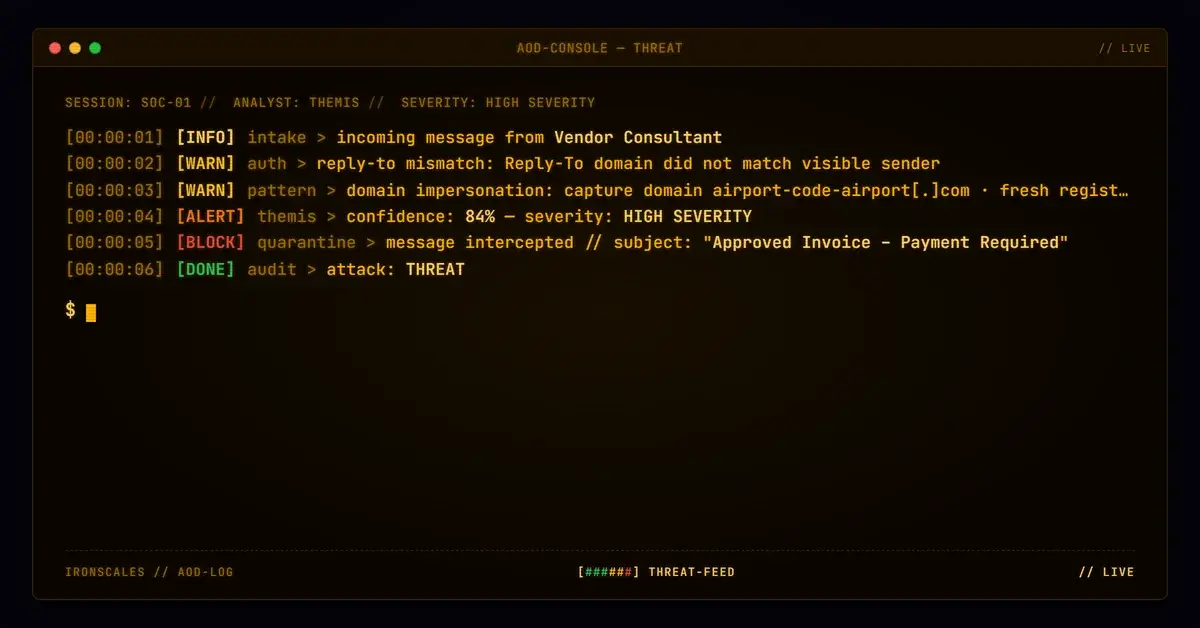
The visible From address belonged to the university. The Reply-To did not. When the recipient hit reply, the conversation would have quietly redirected to a vendor contact at an impersonated consulting domain, defanged here as brightworkcs[.]com, that had nothing to do with the university that actually sent the mail.
This is the mechanic that makes vendor email compromise so durable. The victim sees a trusted, authenticated identity in the header. Any response, and any follow-up questions about the payment, flows to the attacker instead. The display name matched a real vendor-consultant contact the finance team would plausibly recognize, so the pivot from the university's servers to the attacker's inbox felt like nothing more than a normal thread.
A payment address dressed up as the airport
The body carried an approved-invoice narrative, complete with a quoted internal approver to make the request feel like it had already cleared review. Two PDF attachments rode along as legitimacy props: an invoice document and a W-9 tax form, both scanned clean because neither actually needed to carry malware. Their job was to look like paperwork.
The ask was the payload. The thread instructed the finance team to send banking and billing details to a capture domain built to mimic the airport's own name, rendered here generically as [airport-code]-airport[.]com, rather than the airport's genuine corporate domain. That single substitution is the whole attack. To a busy reader, a domain assembled from the airport's own three-letter code reads as "us." It was not. It was a freshly stood-up capture domain, fronted by Microsoft-hosted mail, publishing a permissive DMARC policy of p=none, and completely unrelated to the real organization.
Why clean auth is not clean intent
Nothing in the authentication stack could catch this, because nothing was technically broken. The tell was identity, not cryptography. The Reply-To domain did not match the visible sender. The payment-redirect domain did not match the recipient's real corporate domain. Those are relationship and identity anomalies, and they are invisible to a gateway that stops at SPF, DKIM, and DMARC.
This is where behavioral analysis earns its place. IRONSCALES and its Adaptive AI scored the message on display-name similarity and community-level pattern matching, the kind of signals that compare who a message claims to be against how that identity has actually behaved across a shared threat community. Themis raised the case at 84% confidence, flagging the mismatch between a trusted-looking sender and a payment path that pointed somewhere it should not. A filter that trusts a green authentication verdict clears this message. A system that models identity and relationships does not.
Payment-diversion fraud like this is not a fringe risk. The FBI's 2023 Internet Crime Report attributed roughly $2.9 billion in losses to business email compromise, and the 2024 DBIR pegs the median BEC transaction near $50,000. A single wire based on a lookalike domain can cost more than a year of security tooling. For teams facing this pattern daily, purpose-built business email compromise protection is the difference between a flagged anomaly and a funded fraud.
The human control matters just as much. Any change to banking or payment details should be verified through a known, out-of-band channel, a phone number you already had, not one printed in the email. If your finance workflow can be redirected by a Reply-To header, it can be redirected by an attacker. If you want to see how behavioral detection surfaces these clean-auth cases, request a demo.
Indicators of Compromise
| Indicator | Type | Note |
|---|
brightworkcs[.]com | Reply-To domain | Impersonated vendor-consultant identity, used only to capture replies |
[airport-code]-airport[.]com | Payment-capture domain | Lookalike of the airport's own name, not its real domain; DMARC p=none |
c205e4ec74907dd07b735274c0839bb5 | MD5, invoice PDF | Clean verdict; legitimacy prop only |
19efa614168b8ca1196a54ae3b674a84 | MD5, W-9 form PDF | Clean verdict; legitimacy prop only |
MITRE ATT&CK mapping
- T1566.001 (Spearphishing Attachment): invoice and W-9 PDFs delivered as trust-building props alongside the fraudulent payment instruction.
- T1585 (Establish Accounts): the attacker-controlled capture domain, stood up to mimic the airport's own identity and receive diverted banking details.
For the underlying protocol behavior, the DMARC specification (RFC 7489) explains what an aligned pass actually certifies, and CISA's guidance on stopping the phishing attack cycle covers the process controls that catch what authentication cannot.
See you next time
Authentication tells you a message is who it says it is. It does not tell you the message is honest. When fraud arrives on genuinely authorized infrastructure, the only remaining signals are behavioral: who a sender claims to be, where replies actually go, and whether a payment address matches the organization it pretends to serve. Verify the money out of band, and let your email security score identity, not just cryptography.
Email Attack of the Day is a daily series from
IRONSCALES spotlighting real phishing attacks caught by Adaptive AI and our community of 36,000+ security professionals. Each post breaks down a real attack. What it looked like, why it worked, and what to do about it.







/Blue%20Feature%20Flower%20Icons/gear%20head%20icon.svg)
/Misc%20Icons/icon-nav-credential-theft.svg)










/Leadership%20Headshots/Audian%20Paxson%20Headshot%201000x1000%20032026.webp?width=100&height=100&name=Audian%20Paxson%20Headshot%201000x1000%20032026.webp)



.png?width=50&height=50&name=Untitled%20-%20July%2030%2c%202026%20at%2014.53.38%20(3).png)



/Misc%20Icons/icon-red-teaming-agent-gradient-simple.svg)
/Misc%20Icons/icon-phishing-soc-agent-gradient-simple.webp?width=158&height=167&name=icon-phishing-soc-agent-gradient-simple.webp)
/Misc%20Icons/icon-phishing-simulation-agent-gradient-simple.svg)


/Misc%20Icons/icon-nav-encryption.svg)