TL;DR Four mailboxes at a large vacation-ownership resort operator received a counterfeit voicemail-transcript notification within about twenty minutes of each other. Each copy presented as self-addressed internal mail from the organization's own alternate domain, and each carried a unique subject line whose every character was separated by invisible zero-width padding to defeat text matching. The payload was a small file named with a doubled extension and a trailing dot, delivered as a generic binary stream. Authentication failed on every check and the message still reached the inbox.
Severity: High Malicious-Attachment Brand-Impersonation Filter-Evasion Credential-Harvesting MITRE: T1566.001 MITRE: T1036.007 MITRE: T1036.005
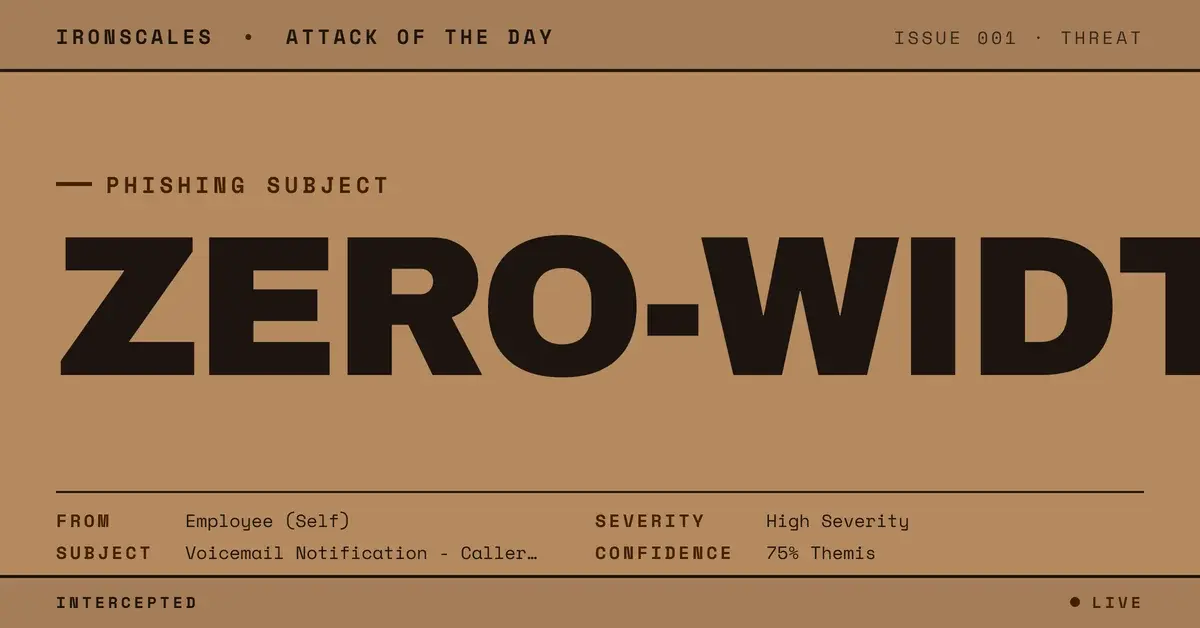
Four mailboxes at a large vacation-ownership resort operator received the same fake voicemail notification inside a window of roughly twenty minutes, and no two copies were identical. Each one claimed a missed call with a transcript attached. Each one appeared to have been sent by the person receiving it. And each one carried a subject line that looked like ordinary English on screen but was, at the byte level, unsearchable.
That last detail is the reason this case is worth taking apart. Most evasion tries to make a message look legitimate. This one tried to make the message look like nothing at all to the systems reading it, while looking entirely normal to the person reading it.
A subject line assembled to be unsearchable
The visible subject followed a template anyone in a corporate mailbox would recognize without thinking: an account name, a note that a caller had left a message, a duration in seconds, and an opaque reference identifier of the form VMSG-7eae3dbc617e.... On screen it is boring in exactly the way a system notification should be boring.
In the raw header it was something else. Every single character was separated from the next by zero-width joiner and zero-width space characters. These are legitimate Unicode codepoints with a legitimate purpose in typesetting, and they render as absolutely nothing. To a human, the subject reads cleanly. To a filter, a keyword rule, a regular expression, or a signature written against the phrase "caller left" or against a voicemail-notification template, there is no such phrase present. The string has been shattered into fragments with invisible mortar between them.
This is homoglyph-style evasion applied to the one field almost every mail rule inspects first. It costs the attacker nothing, does not degrade the lure, and defeats exact-match detection completely. Worse, each of the four copies used its own padding pattern and its own reference identifier, so a fingerprint of one subject would not match the next. This was automated volume, not one careful send.
Mail that appeared to come from inside the building
The second layer was the sender identity. The message presented as self-addressed internal mail: the visible sender and the recipient resolved to the same person, built on an alternate short form of the organization's own domain rather than the primary one the mailboxes lived on. Opened in a client, it does not read as external mail from a stranger. It reads as an automated notice generated somewhere inside the tenant, arriving in your inbox because it is about you.
Our Adaptive AI platform flagged this pattern as direct-send phishing, and the classification matters. Self-addressed mail is a behavioral anomaly with almost no legitimate counterpart in normal corporate mail flow, and a real voicemail system does not impersonate the person it is notifying. But because the pattern carries the organization's own name, it inherits familiarity, and familiarity is the point. The 2024 Verizon Data Breach Investigations Report puts the median time from opening a phishing email to clicking a link at twenty-one seconds. Mail that appears to come from your own account does not get twenty-one seconds of scrutiny.
Every authentication check failed, and it landed anyway
The delivery path was a single external hop from a generic hosting block, reverse DNS pointing at the provider rather than any corporate mail infrastructure. The received header recorded the loopback address as its origin, a sloppy sending-tool artifact rather than a real routing hop.
The authentication results were unambiguous. SPF returned a soft failure, because the domain sits in a transitional posture rather than a hard-fail one. DKIM was absent entirely; the message was never signed. DMARC failed outright with an override action of reject, and Microsoft's composite authentication returned a flat failure with no mitigating reason code. Every gate said no.
The message still reached the inbox at a middling spam confidence score. Four times. Publishing an enforcement policy is not the same as having failures enforced at delivery, and a soft failure on a transitional domain is exactly the ambiguous result that gets recorded and then waved through. RFC 7489 defines how to publish a policy and how to report on it. It cannot make a receiving pipeline act on the result.
See Your Risk: Calculate how many threats your SEG is missing
The attachment wore two extensions
The payload was not a link. There were no links at all, which alone removes URL-based inspection from the equation. It was a six-kilobyte attachment named ATTOO74..svg.., extension written twice with a trailing dot closing the filename, declared to the mail system as a generic binary stream rather than an image or a document.
That naming is deliberate obfuscation, mapped in MITRE ATT&CK as T1036/007, double file extension. A doubled, dot-terminated extension makes the mail filter, any intermediate archiver, and the operating system shell parse the name differently and disagree about which handler should open it. Declaring the content type as an opaque stream widens that gap. Scalable vector graphics are a favorite carrier for exactly this reason: text-based markup a browser will happily execute, arriving in the costume of a harmless picture. Automated analysis returned a malicious verdict.
The lure contradicted itself twice
For all the technical care in the evasion, the body was carelessly assembled, and it left two free tells.
The subject advertised a forty-six-second voicemail. The body, styled as a conferencing and voicemail notification, claimed a thirty-one-second recording. A real notification does not disagree with itself about the length of the recording it is describing.
The body also carried a badge asserting the sender was verified from a safe-senders list, which is not something a legitimate template announces about itself, and it closed with a confidentiality footer naming an unrelated services company whose domain does not resolve. That footer is leftover kit boilerplate, never cleaned up before the campaign went out. It is not evidence of a second organization being involved. It is evidence that nobody proofread the costume.
Where the detection actually came from
No authentication result stopped this message, and the subject obfuscation was purpose-built to defeat anything matching on text. What caught it was the combination no single check could see: self-addressed mail on an alternate form of the organization's own domain, one hop out of a hosting block with no corporate mail path behind it, a subject padded with invisible characters, a doubled file extension delivered as an opaque binary stream, and a lure that could not keep its own story straight.
Themis scored the message at ninety percent confidence with credential-theft and high-value-recipient labels, and all four copies were automatically resolved as phishing and pulled from the affected mailboxes. This is the class of case that advanced malware and URL attack protection exists to cover, because the file was the entire payload and the filename was designed to lie about it. CISA's phishing guidance makes the same point: interrupting the attack cycle depends on layered controls, not on one gate returning a verdict. And phishing, by definition, is a deception technique, which means the strongest signal available is usually an inconsistency rather than a failed check.
Indicators of Compromise
| Type | Indicator | Context |
|---|
| Filename | ATTOO74..svg.. | Malicious attachment, doubled extension with trailing dot, confirmed malicious by automated analysis |
| Hash (MD5) | 99fe4b39f8b9369af750f01550f0fbf7 | Malicious attachment disguised as a vector-image file |
| File metadata | application/octet-stream, 6,009 bytes | Declared as a generic binary stream rather than its real type |
| IP | 74[.]208[.]113[.]175 | Sending address, generic hosting and platform-provider block |
| Reverse DNS | ip74-208-113-175[.]pbiaas[.]com | Provider-owned PTR record, no corporate mail infrastructure behind it |
| Subject pattern | VMSG-7eae3dbc617e... reference identifier | Unique per copy, every character interleaved with zero-width joiner and zero-width space padding |
| Header anomaly | Loopback address recorded as origin in the received chain | Sending-tool artifact, not a genuine routing hop |
| Sender pattern | Self-addressed mail, sender and recipient the same identity | Built on an alternate short form of the organization's own domain |
| Body artifact | Confidentiality footer naming an unrelated services company, non-resolving domain | Uncleaned phishing-kit boilerplate |
| Body artifact | Badge claiming the sender was verified from a safe-senders list | Fabricated trust signal, absent from legitimate templates |
| Lure inconsistency | Forty-six seconds in the subject, thirty-one seconds in the body | Internal contradiction within one message |
| Authentication | SPF softfail, DKIM none, DMARC fail with reject override, composite authentication fail, moderate spam confidence | Every check failed and the message still reached four inboxes |
MITRE ATT&CK Mapping
- T1566/001, Phishing: Spearphishing Attachment. The malicious file was the entire payload; the message contained no links.
- T1036/007, Masquerading: Double File Extension. The doubled, dot-terminated filename plus a generic content-type declaration created parser disagreement.
- T1036/005, Masquerading: Match Legitimate Name or Location. Self-addressed mail on an alternate form of the organization's own domain, dressed as a system voicemail notice.
Email Attack of the Day is a daily series from
IRONSCALES spotlighting real phishing attacks caught by Adaptive AI and our community of 36,000+ security professionals. Each post breaks down a real attack. What it looked like, why it worked, and what to do about it.







/Blue%20Feature%20Flower%20Icons/gear%20head%20icon.svg)
/Misc%20Icons/icon-nav-credential-theft.svg)










/Leadership%20Headshots/Audian%20Paxson%20Headshot%201000x1000%20032026.webp?width=100&height=100&name=Audian%20Paxson%20Headshot%201000x1000%20032026.webp)



.png?width=50&height=50&name=Untitled%20-%20July%2030%2c%202026%20at%2014.53.38%20(3).png)



/Misc%20Icons/icon-red-teaming-agent-gradient-simple.svg)
/Misc%20Icons/icon-phishing-soc-agent-gradient-simple.webp?width=158&height=167&name=icon-phishing-soc-agent-gradient-simple.webp)
/Misc%20Icons/icon-phishing-simulation-agent-gradient-simple.svg)


/Misc%20Icons/icon-nav-encryption.svg)