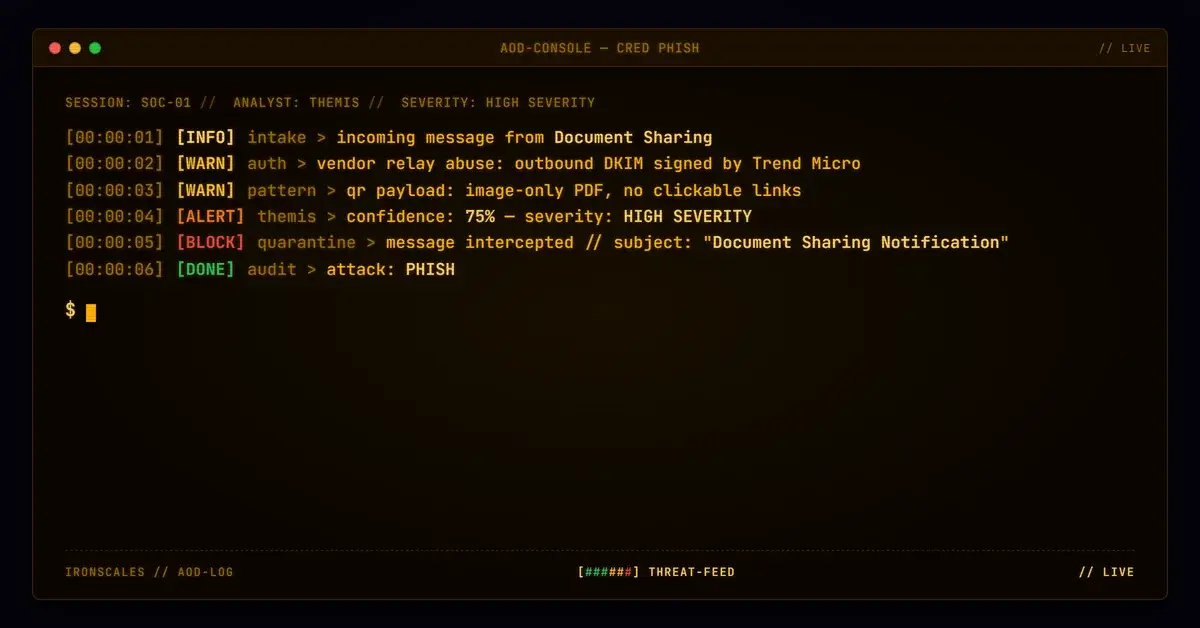
TL;DR A compromised mailbox at a third-party senior living services vendor sent a home care services provider a notification styled as a Zix secure email message, complete with an approved pay application reference and a short expiry window. SPF, DKIM, and DMARC all passed because the account genuinely belonged to the vendor, and the sender had prior history with the recipient, so first-time-sender and impersonation heuristics never fired. The Open Message button routed to a credential form hosted on ClickUp, a legitimate no-code platform that URL reputation scored clean. The only tell was the platform mismatch itself.
Severity: High Credential Harvesting Vendor Email Compromise Brand Impersonation MITRE: T1566.002 MITRE: T1078
The email announced itself as a secure message. A banner across the top read New Zix secure email message, the line under it named a company the recipient already did business with, the subject referenced an approved pay application invoice, and a single button sat in the middle of the body: Open Message. A footer note added pressure, warning that the secure message would expire, with the deadline set a few days out.
The recipient worked at a national home care services provider. The sender was a named contact at a third-party senior living services vendor, and the two organizations had traded mail before. So a secure-message notification carrying an approved pay application reference did not read as unusual. Vendors send payment documents, and they send them through encryption portals.
The one detail that did not hold up was the destination. The Open Message button did not point at Zix, or at any secure-message platform. It pointed at a form hosted on ClickUp.
Vendor Account Compromise, Not Domain Impersonation
Start with what this attack did not do, because the absence of the usual tells is the whole story. There was no lookalike domain, no unicode homoglyph, no hyphenated near-miss, no throwaway registration standing in for a trusted brand. The message came from the vendor's real domain, left through that organization's own outbound Mimecast gateway, and carried a DKIM signature generated with that organization's own key. SPF passed. DKIM passed and aligned. DMARC passed under a published quarantine policy.
Every one of those checks answered truthfully. That is the point: authentication confirms a message traveled from infrastructure the domain owner authorizes, not that the human who owns the mailbox is the one pressing send. When an attacker is operating inside a legitimate account, vendor email compromise turns the entire authentication stack into a credibility engine working for the wrong side.
The message structure confirmed compromise rather than forgery. Both the From and To headers carried the same vendor mailbox, a self-addressed send with onward delivery to the recipient, the signature of somebody working through a mailbox they control rather than spoofing a header they do not. Two mailboxes at the recipient organization received it.
A Secure-Message Brand the Sender Never Used
The lure's cleverness was the brand it borrowed. Zix is a real encrypted-email service, and a genuine Zix notification behaves exactly the way this message imitated: a placeholder body, no readable content, and a retrieval button that sends you elsewhere to authenticate. The pretext explains away its own strangeness: a vague subject line is expected, an extra sign-in is expected, and the expiry warning that manufactures urgency is not even a lie in the original, since real secure messages do lapse.
The vendor, however, does not use Zix. The overlay was a costume pulled over a mailbox that already had all the trust it needed, and it existed for one reason: to make an unexplained credential prompt feel procedural.
The Credential Form Lived on a Project Management Platform
Clicking Open Message resolved to forms[.]clickup[.]com, a form builder on ClickUp's own production infrastructure. The credential collection happened on a page the attacker built with a no-code tool, served over a valid certificate from a domain carrying years of legitimate business traffic.
Both links in the message were scanned and both came back Clean. The secondary footer link, framed as a place to review support documentation, pointed at Microsoft's genuine support site and did nothing malicious at all, existing purely to make the footer look like a real product notification.
This is what breaks reputation-first filtering. A URL scanner asks whether the host is known bad. forms[.]clickup[.]com is emphatically known good, and blocking it wholesale would break a tool legitimate teams use every day. The attacker did not evade the reputation check. They satisfied it. According to the 2024 Verizon Data Breach Investigations Report, stolen credentials were involved in 38 percent of breaches and phishing appeared in 15 percent, and campaigns that hand scanners nothing but trusted hosts are why those numbers stay stubborn.
See Your Risk: Calculate how many threats your SEG is missing
What Themis Weighed Instead
The platform's own sender heuristics had nothing to work with. The first-time-sender flag did not fire, because the vendor had legitimate sending history with this organization. The impersonation flag did not fire, because nobody was impersonating anybody at the header level. Strip out authentication, sender history, and link reputation, and a conventional gateway is out of arguments.
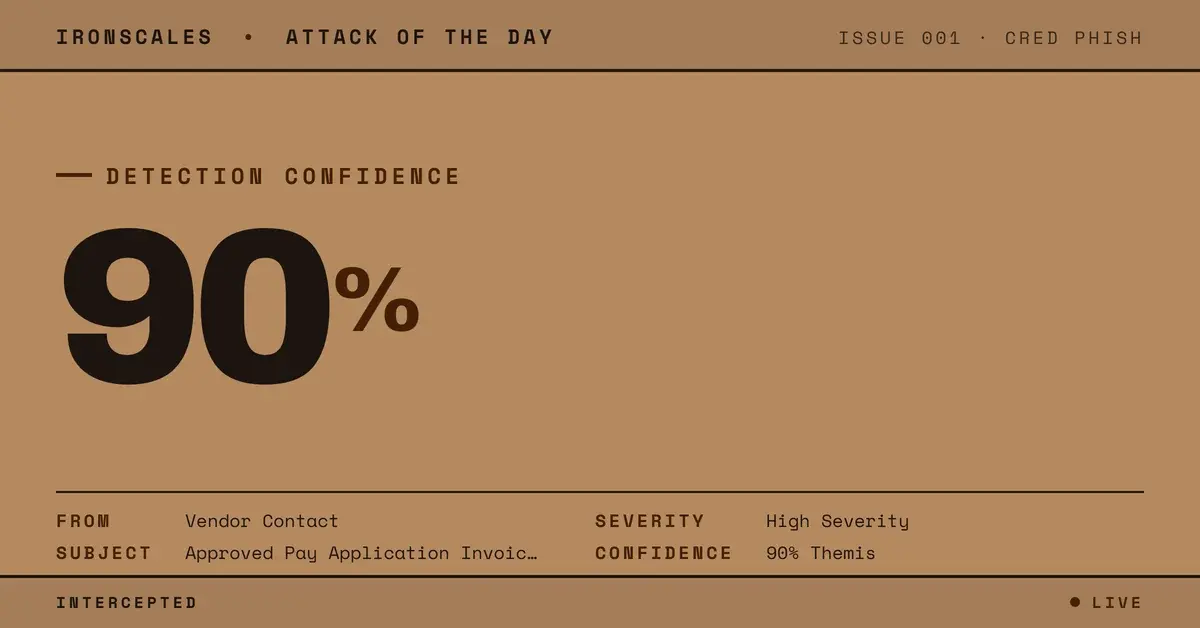
What remained was a contradiction. A notification wearing one platform's secure-delivery branding, whose only call to action resolved to an unrelated platform's form builder, sent from an account that had never used the claimed service, with an expiry clock attached to an invoice approval. The Adaptive AI behind Themis scored that combination as credential theft at 90 percent confidence and the incident resolved automatically as phishing. No indicator in the message was individually suspicious. The relationship between them was.
MITRE ATT&CK Mapping
Indicators of Compromise
| Type | Indicator | Context |
|---|
| URL | hxxps://forms[.]clickup[.]com/90121911313/f/2kxuyf0h-512/JWZOIKEW4PFUYK7S8N | Credential-collection form behind the Open Message button, scanned Clean |
| Domain | forms[.]clickup[.]com | Legitimate no-code form platform used as the phishing host |
| URL | hxxps://support[.]microsoft[.]com/en-us/ | Benign footer decoy link, present to imitate a real product notification |
| Sender | Compromised vendor mailbox on a real organizational domain (withheld) | Not spoofed and not newly registered, an account under attacker control |
| Structure | From and To headers both set to the vendor mailbox | Self-addressed send consistent with mailbox compromise, not header forgery |
| Auth | SPF pass, DKIM pass (vendor key, vendor gateway), DMARC pass under a quarantine policy | Full alignment, delivered without an authentication downgrade |
| Subject | [Vendor contact] @ [Vendor] shared -Approved Pay App Inv-#[redacted] with you. | Document-share pretext naming a real vendor relationship |
| Brand | New Zix secure email message banner with expiry countdown | Secure-message overlay for a platform the sender does not use |
What This Attack Should Change
Three shifts follow from a case with no bad domain and no bad link.
First, validate the claim against the destination. If a message says it is a secure-message notification, the retrieval link should belong to that platform, and a mismatch between claimed brand and resolved host deserves to be treated as hostile on its own. The CISA phishing guidance makes the broader version of this point: technical controls have to be paired with detection that reads context, because the definition of phishing in the NIST glossary turns on deception, not on infrastructure quality.
Second, stop treating trusted SaaS hosts as inherently safe link destinations. Form builders, document platforms, and no-code app hosts are now standard credential-page real estate precisely because their reputation is unimpeachable. Credential-harvesting protection has to reason about what a page asks for and how the message framed it, not just where it is hosted.
Third, plan for compromised partners, not only for impostors. A vendor with real history and clean authentication is the highest-trust delivery channel an attacker can obtain, and every control keyed to spotting outsiders will wave it straight through. Payment-instruction and document-retrieval requests from established vendors need verification through a channel that does not run over email.
Email Attack of the Day is a daily series from
IRONSCALES spotlighting real phishing attacks caught by Adaptive AI and our community of 36,000+ security professionals. Each post breaks down a real attack. What it looked like, why it worked, and what to do about it.







/Blue%20Feature%20Flower%20Icons/gear%20head%20icon.svg)
/Misc%20Icons/icon-nav-credential-theft.svg)










/Leadership%20Headshots/Audian%20Paxson%20Headshot%201000x1000%20032026.webp?width=100&height=100&name=Audian%20Paxson%20Headshot%201000x1000%20032026.webp)



.png?width=50&height=50&name=Untitled%20-%20July%2030%2c%202026%20at%2014.53.38%20(3).png)



/Misc%20Icons/icon-red-teaming-agent-gradient-simple.svg)
/Misc%20Icons/icon-phishing-soc-agent-gradient-simple.webp?width=158&height=167&name=icon-phishing-soc-agent-gradient-simple.webp)
/Misc%20Icons/icon-phishing-simulation-agent-gradient-simple.svg)


/Misc%20Icons/icon-nav-encryption.svg)