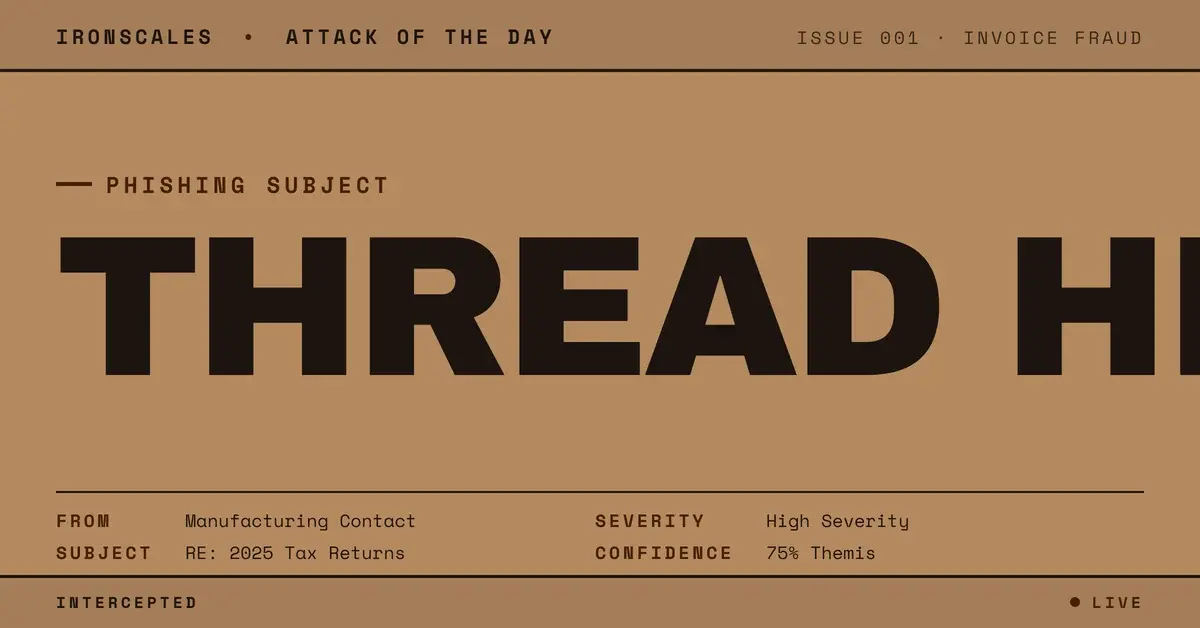
TL;DR Attackers compromised the Microsoft 365 account of a legitimate U.S. manufacturing company and used it to send invoice-themed phishing emails referencing Toyota Financial Services. Every authentication protocol passed: SPF, DKIM, DMARC, and ARC. The emails included real PDF statements with account numbers, VINs, and payment instructions. Because the sending infrastructure was fully legitimate, only behavioral analysis and malicious URL detection caught the threat before recipients acted on fraudulent payment details.
Severity: High Invoice Fraud Account Compromise Credential Harvesting MITRE: T1586.002 MITRE: T1566.001 MITRE: T1204.002
A senior accountant at a professional services firm opened her inbox to find a familiar thread. The subject line read "RE: 2025 Tax Returns," and the sender was a known contact at a longtime client, a small manufacturing company in the Midwest. Attached were three PDF statements referencing Toyota Financial Services, complete with account numbers, VINs, and payment instructions. The email was part of an extended conversation thread with over a dozen prior replies. Nothing about it looked unusual.
Every authentication check agreed. SPF passed. DKIM verified. DMARC returned a clean result with p=reject enforcement. ARC validated the full relay chain. Microsoft's own composite authentication scored a perfect compauth=pass reason=100. By every measurable standard, this email was exactly what it claimed to be.
It was also malicious.
A 25-Year-Old Domain, Fully Weaponized
The sending domain, abdeburr[.]com, belongs to a legitimate deburring and metal finishing company that has been in business for decades. WHOIS records show the domain was registered in November 2000 through GoDaddy, with DNS currently routed through Cloudflare. The domain's DKIM selector (selector1) and SPF records are configured through Microsoft 365, confirming the company uses Microsoft's cloud email infrastructure.
This is what makes the attack so dangerous. The attacker did not register a lookalike domain. They did not spoof headers. They gained access to a real person's real mailbox at a real company, and used it to inject malicious content into an existing conversation thread. The long message history (over 20 prior exchanges visible in the headers) gave the phishing email an authenticity that no newly crafted lure could replicate.
According to the Microsoft Digital Defense Report 2024, compromised legitimate accounts now represent one of the fastest-growing vectors for Business Email Compromise (BEC). The FBI IC3 2024 Annual Report confirmed BEC losses exceeded $2.9 billion, with invoice and payment redirection schemes accounting for a significant share.
What the Recipient Saw
The email body discussed year-end tax statements and interest rates on vehicle financing notes. It referenced specific Toyota and Ford Credit accounts, quoted interest rates (0% versus 4.99%), and asked the accountant to review attached statements. The tone was conversational, professional, and specific to the business relationship.
Three PDF attachments accompanied the message, each named with a statement_ prefix and a Unix timestamp. Analysis of these files found no embedded JavaScript, no active exploit code, and no credential harvesting forms. They contained plain-text account identifiers, partial VIN numbers, and payment instructions referencing toyotafinancial[.]com. One PDF (sha256: 3670ec...) contained an /OpenAction reference in its object structure, though initial string scans did not surface any external URI tokens.
The attachments were technically clean. That was the point. The real weapon was the context: legitimate-looking financial documents delivered from a trusted sender, designed to manipulate the recipient into acting on fraudulent payment instructions through a separate channel.
A single embedded link pointed back to the sender's domain: hxxps://abdeburr[.]com/. URL scanning flagged this link as malicious (element_id 601383183), indicating the domain's web hosting environment had also been compromised, possibly serving as a secondary payload delivery mechanism or a redirect to a credential harvesting page.
Behind the Curtain: The Attacker's Playbook
This attack maps cleanly to several MITRE ATT&CK techniques. The compromise of a legitimate email account falls under T1586.002 (Compromise Accounts: Email Accounts). The phishing delivery itself aligns with T1566.001 (Phishing: Spearphishing Attachment). The reliance on the recipient opening and acting on attached PDFs maps to T1204.002 (User Execution: Malicious File).
The attacker's infrastructure checklist was thorough:
- Compromised a Microsoft 365 account with full SPF/DKIM/DMARC configuration
- Hijacked an existing conversation thread with over 20 prior exchanges to build trust
- Attached technically clean PDFs containing real financial data to avoid sandbox detection
- Embedded a link to the compromised domain for potential secondary payload delivery
- Targeted an accounting professional whose daily workflow involves processing exactly these types of documents
The Verizon 2024 Data Breach Investigations Report found that 68% of breaches involved a human element, and attacks like this one are precisely why. The email was designed to fit seamlessly into the recipient's normal business operations.
Where Detection Happened
Traditional Secure Email Gateways (SEGs) evaluate authentication results, sender reputation, and attachment signatures. This email passed on all three counts. The sender was a known contact with a clean domain history. Authentication was perfect. The attachments contained no malware signatures.
See Your Risk: Calculate how many threats your SEG is missing
Themis, the IRONSCALES agentic AI analyst, flagged the message based on a convergence of behavioral signals that no single authentication check could catch. The sender's risk profile had been elevated. The embedded URL returned a malicious verdict. And the combination of invoice-themed attachments with a high-risk sender triggered automated quarantine across all affected mailboxes within seconds of delivery. Four mailboxes were impacted, and all four were remediated automatically, two at the moment of delivery and two within 24 hours when additional analysis confirmed the threat.
This is the core limitation of authentication-based defenses. SPF, DKIM, and DMARC answer one question: "Did this email come from where it claims?" When the answer is yes, but the account behind that identity has been compromised, authentication provides a false sense of security. The IBM Cost of a Data Breach 2024 report found the average breach costs $4.88 million. For organizations relying solely on authentication to filter threats, that is the price of a green checkmark on a compromised email.
What This Attack Teaches Us
Authentication is necessary but not sufficient. Full SPF/DKIM/DMARC/ARC pass does not mean an email is safe. It means the sending infrastructure is legitimate. When that infrastructure is compromised, every check returns a false negative.
Invoice phishing does not require malicious attachments. The PDFs in this attack were technically clean. The threat was the social engineering context: real financial data, a trusted sender, and an active business conversation designed to prompt the recipient to act on fraudulent payment instructions.
Thread hijacking amplifies trust. An email embedded in a long conversation history with a known contact bypasses the instinctive skepticism that a cold outreach would trigger. Security awareness training should emphasize that even familiar threads can be weaponized.
Behavioral detection fills the gap. When authentication, reputation, and signatures all return clean results, the only remaining defense is behavioral analysis that evaluates the full context of a message, including URL verdicts, sender risk patterns, and anomalies invisible to legacy gateways. IRONSCALES platform data shows that SEGs miss an average of 67.5 phishing emails per 100 mailboxes per month. Attacks like this one are a significant reason why.
Email Attack of the Day is a daily series from
IRONSCALES spotlighting real phishing attacks caught by Adaptive AI and our community of 36,000+ security professionals. Each post breaks down a real attack. What it looked like, why it worked, and what to do about it.



/case_study_thumb_telit.webp?width=1136&height=639&name=case_study_thumb_telit.webp)











/Leadership%20Headshots/Audian%20Paxson%20Headshot%201000x1000%20032026.webp?width=100&height=100&name=Audian%20Paxson%20Headshot%201000x1000%20032026.webp)



.png?width=50&height=50&name=Untitled%20-%20July%2030%2c%202026%20at%2014.53.38%20(3).png)



/Misc%20Icons/icon-red-teaming-agent-gradient-simple.svg)
/Misc%20Icons/icon-phishing-soc-agent-gradient-simple.webp?width=158&height=167&name=icon-phishing-soc-agent-gradient-simple.webp)
/Misc%20Icons/icon-phishing-simulation-agent-gradient-simple.svg)


/Misc%20Icons/icon-nav-encryption.svg)