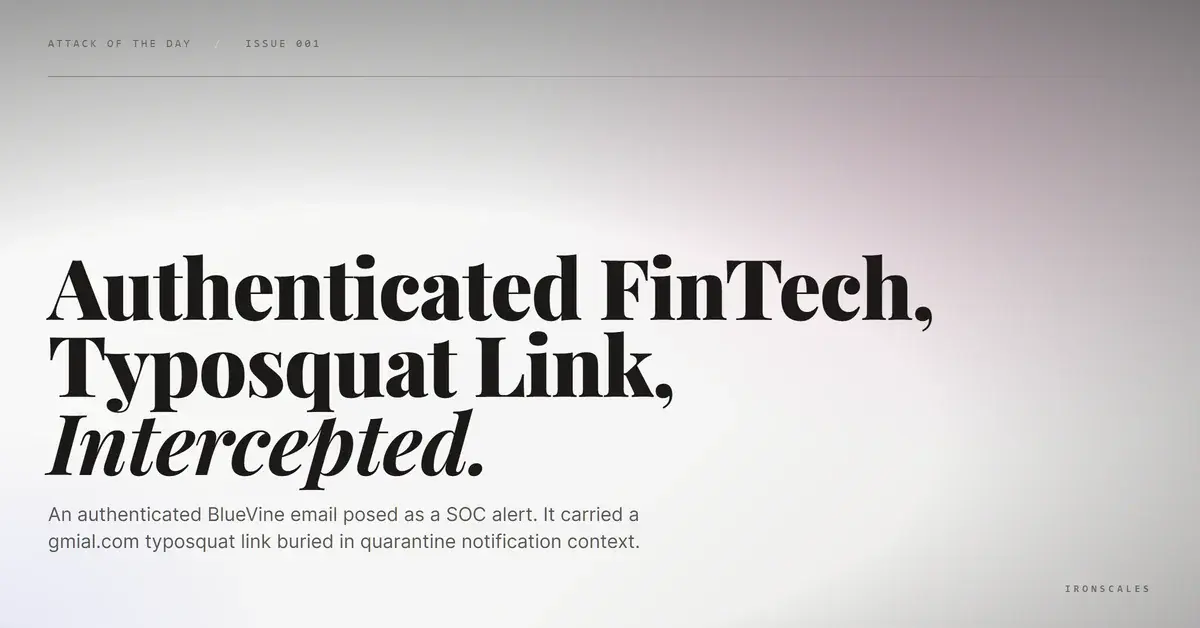
TL;DR A phishing email was sent from security.soc@a-financial-services-company[.]example with Return-Path mamatha.manyam@a-financial-services-company[.]example. The message passed full SPF, DKIM, and DMARC authentication for a-financial-services-company[.]example and was routed from Google mail servers through Microsoft protection infrastructure. The email body was formatted as a legitimate SOC team notification about internal mail quarantines. Embedded in the message was a link to http://gmial[.]com/, a single-letter transposition of gmail[.]com (typosquat). The domain gmial[.]com was flagged malicious with a risk score of approximately 0.80. DNS resolution failed at the time of analysis, indicating ephemeral or sinkholed infrastructure. WHOIS records show gmial[.]com was registered on 2003-05-12 through GoDaddy with DNSSEC unsigned. Recipients included multiple BlueVine internal addresses and an external IRONSCALES ticket address. The email was quarantined. No attachments were present. The attack leveraged a compromised or abused authenticated FinTech sender to deliver a credential harvesting typosquat link disguised as routine security operations content.
Severity: High Credential Harvesting Compromised Account MITRE: {'id': 'T1583.001', 'name': 'Acquire Infrastructure: Domains'} MITRE: {'id': 'T1566.002', 'name': 'Phishing: Spearphishing Link'} MITRE: {'id': 'T1078', 'name': 'Valid Accounts'}
The email came from security.soc@a-financial-services-company[.]example. It read like an internal SOC team notification, the kind that security operations centers send dozens of times a day: quarantine summaries, flagged URLs, remediation context. The sender domain passed SPF, DKIM, and DMARC. The mail path showed Google servers handing off to Microsoft protection infrastructure. Everything about the envelope said "trust this."
Buried in the body was a link to hxxp://gmial[.]com/. One transposed letter. That was the entire payload.
Authenticated Delivery From a FinTech Domain
The message originated from a-financial-services-company[.]example with a Return-Path of mamatha.manyam@a-financial-services-company[.]example. BlueVine is a legitimate FinTech company. Its domain authentication was properly configured, and the email passed every check: SPF aligned, DKIM signatures validated, DMARC returned a pass verdict. The routing path showed the message traversing Google Workspace mail servers before entering Microsoft's email protection layer.
This authentication posture is consistent with either a compromised account or an abused internal mailbox. The attacker did not need to register a domain, configure DNS records, or build sending infrastructure. They operated from inside a trusted organization's mail environment, inheriting every reputation signal that domain had earned.
A 23-Year-Old Typosquat With No Live Infrastructure
The domain gmial[.]com was registered on 2003-05-12 through GoDaddy. It is a single-letter transposition of gmail[.]com, swapping the positions of "a" and "i." Despite being over two decades old, the domain had no live DNS resolution at the time of analysis. It was either parked, sinkholed, or operating on ephemeral infrastructure that had already rotated. DNSSEC was unsigned.
Threat intelligence flagged gmial[.]com with a risk score of approximately 0.80, well above the threshold for known malicious domains. The combination of a decades-old registration, active malicious flagging, and failed DNS resolution points to a domain that has cycled through multiple abuse campaigns over its lifetime.
Operational Context as Camouflage
The email body was structured as a SOC quarantine notification. It referenced internal mail quarantine actions, listed affected addresses (multiple BlueVine employees and an external ticket address), and presented the gmial[.]com URL as an example of flagged content. The formatting created a context where seeing a URL in the message body felt expected, not suspicious.
This is the sophistication of the attack. The typosquat link was not presented as a call to action. It was embedded in what appeared to be operational security documentation. A recipient scanning the email to understand what had been quarantined would encounter the link as a reference, not a lure. The impulse to click comes from investigating the threat, not from following a button.
Themis, the Adaptive AI engine from IRONSCALES, evaluated the embedded URL against domain intelligence, flagged the DNS resolution failure and the 0.80 risk score, and quarantined the message for review. The authentication pass on the sender domain did not override the behavioral signals from the payload.
See Your Risk: Calculate how many threats your SEG is missing
Indicators of Compromise
| Type | Indicator | Context |
|---|
| Sender Address | security.soc@a-financial-services-company[.]example | Display name "Security SOC Team," full SPF/DKIM/DMARC pass |
| Return-Path | mamatha.manyam@a-financial-services-company[.]example | Authenticated BlueVine mailbox |
| Sending Domain | a-financial-services-company[.]example | Legitimate FinTech domain, likely compromised or abused |
| Embedded URL | hxxp://gmial[.]com/ | Single-letter typosquat of gmail.com, risk score ~0.80 |
| Domain Age | gmial[.]com registered 2003-05-12 | GoDaddy registrar, DNSSEC unsigned |
| DNS Status | Resolution failed | Ephemeral or sinkholed infrastructure at time of analysis |
| Mail Path | Google servers to Microsoft protection | Cross-platform routing consistent with BlueVine infrastructure |
| Attachments | None | Payload delivered entirely via embedded link |
MITRE ATT&CK Mapping
| Technique | ID | Relevance |
|---|
| Acquire Infrastructure: Domains | T1583.001 | Typosquat domain gmial.com (registered 2003) used as credential harvesting destination |
| Phishing: Spearphishing Link | T1566.002 | Malicious link embedded in SOC notification pretext |
| Valid Accounts | T1078 | Compromised or abused BlueVine account used for authenticated delivery |
Email Attack of the Day is a daily series from
IRONSCALES spotlighting real phishing attacks caught by Adaptive AI and our community of 36,000+ security professionals. Each post breaks down a real attack. What it looked like, why it worked, and what to do about it.







/Blue%20Feature%20Flower%20Icons/gear%20head%20icon.svg)
/Misc%20Icons/icon-nav-credential-theft.svg)










/Leadership%20Headshots/Audian%20Paxson%20Headshot%201000x1000%20032026.webp?width=100&height=100&name=Audian%20Paxson%20Headshot%201000x1000%20032026.webp)



.png?width=50&height=50&name=Untitled%20-%20July%2030%2c%202026%20at%2014.53.38%20(3).png)



/Misc%20Icons/icon-red-teaming-agent-gradient-simple.svg)
/Misc%20Icons/icon-phishing-soc-agent-gradient-simple.webp?width=158&height=167&name=icon-phishing-soc-agent-gradient-simple.webp)
/Misc%20Icons/icon-phishing-simulation-agent-gradient-simple.svg)


/Misc%20Icons/icon-nav-encryption.svg)