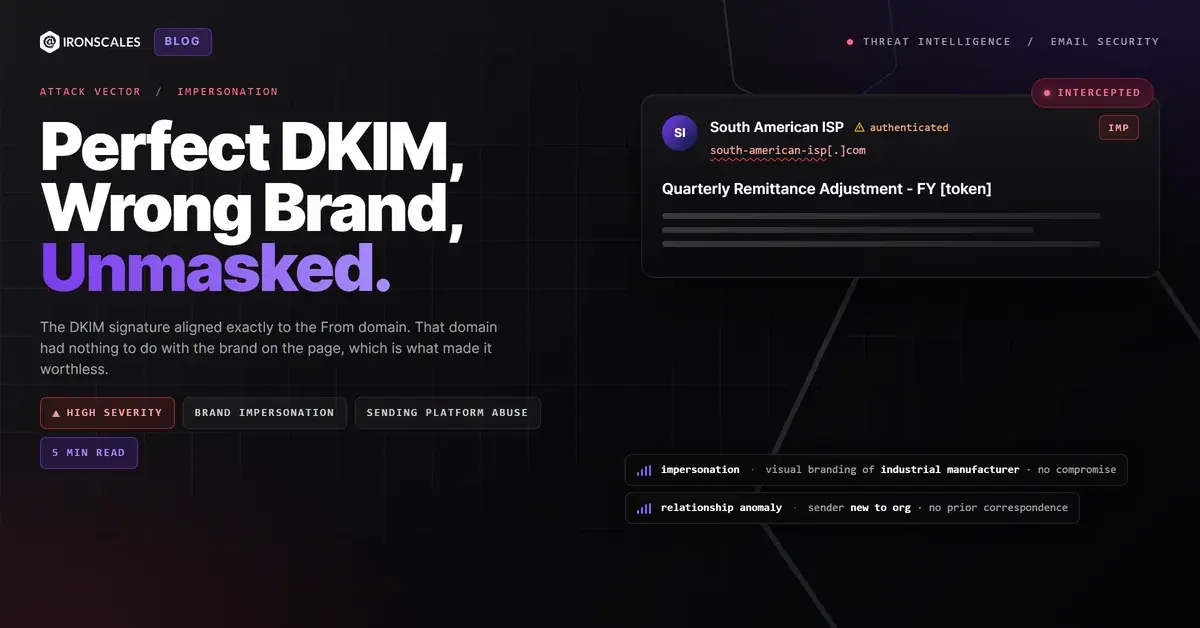
TL;DR A document-signature lure reached a manager in the audit practice of a mid-sized US accounting and advisory firm in a single hop from an Amazon SES region. Two DKIM signatures verified, and one aligned exactly to the domain in the From header, so nothing was spoofed and no lookalike domain was involved. That domain belonged to a small South American internet service provider with no relationship at all to the long-established American instrument manufacturer whose title, palette and hotlinked logo the message was wearing. The alignment proved only that an unrelated third party really had sent the mail.
Severity: High Credential Phishing Brand Impersonation Sending Platform Abuse Compromised Web Host MITRE: T1566.002 MITRE: T1204.001 MITRE: T1584.006 MITRE: T1684.001
The page wore the document title, house palette and footer block of a long-established American manufacturer of industrial measurement instruments. The domain that cryptographically signed the message belonged to a small South American internet service provider. Both things were true at once, and only one of them was visible to anything checking at the edge.
One mailbox took delivery: a manager in the audit practice of a mid-sized US accounting and advisory firm. The message reached Microsoft's edge in a single hop out of an Amazon SES region in Europe, with no gateway and no relay in the Received chain. SPF passed. Two DKIM signatures verified, one of them aligned exactly to the domain in the From header. Microsoft scored the mail at spam confidence level 1, filter verdict not spam, and delivered it carrying nothing but a first-contact safety banner.
The alignment was flawless. It was also worthless.
What The Alignment Actually Proved
Two valid signatures rode with the message. One covered the sending platform's own domain, routine for anything leaving that service. The other covered the domain in the From header, applied through the platform's managed signing feature under a selector published beneath that domain, and it verified cleanly. That is genuine DKIM alignment. Nothing was spoofed, and no lookalike domain was involved anywhere in this attack.
That domain belonged to a small South American internet service provider: a real operating business, registered years before the attack, with a named human contact at a street address and its national host's nameservers. It is a bystander here, which is why both the domain and the alias it sent from stay withheld. The convention of masking a local part while keeping the domain visible applies to genuinely attacker-owned infrastructure, and this is not that.
So the signature established that the mail really did leave an authorized sending identity for an internet service provider on another continent. It established nothing whatsoever about the manufacturer whose branding filled the body. Alignment tells you who owns the sending domain. It does not tell you who the brand on the page is, and no amount of cryptographic rigour will make it answer that second question.
The DMARC line offers no help either. It reads bestguesspass action=none, the value Microsoft records when the From domain gives it no policy to evaluate, so the receiver inferred an outcome from the SPF and DKIM results it already held. Publish a record for your own domains so nobody has to infer, watch what comes back through DMARC monitoring, and read that verdict on inbound mail as no record found rather than as a policy decision.
The Brand On The Page Belonged To Someone Else
The impersonation was purely visual and cost the attacker nothing to build. The footer pulled the manufacturer's logo live off the manufacturer's own website, straight out of its public media library. The company sent nothing, hosted nothing and was never compromised, and every link in the message pointing at its real site scanned clean. It is the third bystander in a case where no piece of named infrastructure belongs to the attacker.
The personalization was machine work. The greeting was the title-cased local part of the recipient's own mailbox address, and the party said to be assigning the document was the title-cased stem of the recipient's own domain. At a glance it reads as a system notice from a colleague. Read twice, it is the recipient's email address shredded into two fields.
See Your Risk: Calculate how many threats your SEG is missing
Below the branding sat a document box showing a quarterly remittance-adjustment file name, a bare fiscal-year line, and a date several days after the message that delivered it. A remittance advice cannot be dated in its own future, which is a template generator giving itself away. There was also no file: the whole box was text painted inside the HTML body, and the attachment array in the record is empty. The subject line, meanwhile, ended in a forty-character hex token serving as a per-recipient tracking identifier.
A Link That Arrived Already Wrapped
The single actionable button carried the only real object in the message. Before Microsoft's own link protection touched it, that anchor's address was already a security vendor's URL-rewriter link wrapping a path on a small Brazilian company's website. The two decorative links to the manufacturer's real site were plain, unwrapped addresses.
Both DKIM signatures verified, so the body was not altered after signing, which places the wrapper in the content as sent rather than in anything the recipient's stack did. Beyond that, restraint is warranted. An attacker pasting a harvested wrapper to borrow a reputable string, and a policy-based outbound rewriter that wraps unfamiliar domains while skipping known ones, both produce exactly this pattern. The message never crossed that vendor's gateway, and no product failure is implied.
The landing host is a small Brazilian business site, online for well over a decade on shared hosting, with attacker content dropped on a subpath. Scanner verdicts on that path were mixed rather than a clean malicious confirmation, and a later look found it serving no kit at all and redirecting offsite to a mainstream social network's public signup page. That is a snapshot taken well after the send, not what the recipient would have seen, and no credential form was ever captured.
What Actually Flagged It
Nothing in the authentication or reputation layer objected, because nothing in that layer is built to compare a signing domain against a brand. What caught it was relationship data. The sender was new to the organization, with no prior correspondence in any direction, and the platform rated it high risk on that basis. Themis, our Adaptive AI, returned a confidence of 90 under labels for credential theft and VIP recipient, citing a link flagged as malicious. Those labels describe predicted intent, not an observed login page. The incident was raised by automated detection rather than a human reporter and closed as automatically resolved as phishing.
Both CISA phishing guidance and the NIST definition of phishing frame the threat as deception and elicited action rather than as files and signatures, which is the only framing that survives a case like this. The 2024 Verizon Data Breach Investigations Report found the human element present in 68 percent of breaches, and the 2023 FBI IC3 Internet Crime Report put reported business email compromise losses near $2.9 billion.
The operator came back the next day. Four more mailboxes at the same firm, spanning a second firm domain and including a shared firm-wide address, received a harder finance-specific lure. Each was mitigated a second or two after receipt.
What Alignment Can And Cannot Tell You
Verify the signature, then ask the question the signature cannot answer: which domain did it cover, and does that domain have any relationship to the brand, the document or the request on the page? A perfectly aligned signature from a party with no connection to the content is not authentication working. It is authentication being asked the wrong question and answering it correctly. The mismatch is the finding, and spotting it is a content and relationship judgement rather than a cryptographic one.
Indicators of Compromise
| Type | Indicator | Context |
|---|
| Auth result | spf=pass smtp.mailfrom=eu-west-1[.]amazonses[.]com; dkim=pass (sending domain, withheld); dkim=pass header.d=amazonses[.]com; dmarc=bestguesspass action=none; compauth=pass reason=109 | The full verdict at the recipient edge. SPF passes on the platform envelope domain, so DKIM is what carries alignment, and DMARC was inferred rather than enforced |
| Header | SCL:1; SFV:NSPM; CAT:NONE; SFTY:9.25; BCL:0; DIR:INB | Delivered as non-spam. The only Microsoft intervention rendered into the body was the first-contact banner |
| Header | X-MS-Exchange-AtpMessageProperties listing both Safe Attachments and Safe Links | Both controls ran and both passed the message. There was no attachment for the first one to inspect |
| Sending IP | 24[.]110[.]76[.]194 | Amazon SES shared outbound address in the eu-west-1 region. Shared platform, no block value |
| Host | i76-194[.]smtp-out[.]eu-west-1[.]amazonses[.]com | PTR and HELO of the sending host, and the only hop between the sender and Microsoft's edge |
| DKIM selector | zqfuo5ogezjgoaqv6tj4u52p5jlo646g | Managed-signing selector published under the From domain. Evidence of a verified sending identity rather than a spoof, which is precisely why the alignment proved so little |
| Message-ID | 0102019aa1cbf7be-55fd4ad0-d83d-48a4-b32c-8c7336cb6dcb-000000@eu-west-1[.]amazonses[.]com | Also the Return-Path bounce address, identifying the individual platform send |
| Feedback-ID | ::1.eu-west-1.tQWWqGiQJF+z9RFltnEKKOdVXHaFJDrLx2yFY+93K6k=:AmazonSES | Fingerprints the sending account behind the message. The most useful artifact for an abuse report to the platform |
| Subject token | 5a9ef97ee38010383eb7eb0bdf0b68e83e0a4b08 | Forty hex characters appended to a readable signature-request subject, functioning as a per-recipient campaign identifier |
| Sender | Withheld (a sales alias at a small South American internet service provider) | Bystander. A real operating ISP whose verified sending identity was abused; both domain and local part withheld because the domain is not attacker-owned |
| Payload URL | Withheld (a subpath on a small Brazilian company's website) | Attacker-placed content on a compromised legitimate host that has been online for well over a decade. The path is the attacker's, the domain is not |
| Wrapped link | hxxps://secure-web[.]cisco[.]com/ followed by an opaque token and a url-encoded copy of the payload link (both withheld) | The button's address as authored, before Microsoft's own link protection rewrote it. The message never transited that vendor's gateway. Attacker intent is not established; a selective outbound rewriter explains it equally well |
| Decoy file | A quarterly remittance-adjustment PDF name, post-dated several days after the send | Rendered as text inside an HTML document box. No attachment exists in the message at all |
| Brand asset | The impersonated manufacturer's logo, hotlinked from its own public website (URL withheld) | Bystander asset pulled live from the real company's media library. The company was never compromised and hosted nothing malicious |
| Lure template | Greeting and assigning party both generated from the recipient's own mailbox address | The local part title-cased into the greeting, the domain stem title-cased into the requesting party. Neither is a real person |
| Delivery pattern | One audit-practice mailbox, then four more across a second firm domain about a day later | The follow-on wave was finance-specific and included a shared firm-wide mailbox. Each was mitigated within a second or two of receipt |
MITRE ATT&CK Mapping
| Technique | ID | Application |
|---|
| Phishing: Spearphishing Link | T1566.002 | A single actionable link under a document-signature pretext, with no attachment anywhere in the message |
| User Execution: Malicious Link | T1204.001 | The attack requires a deliberate click on the one button that does not point at the impersonated brand's real site |
| Compromise Infrastructure: Web Services | T1584.006 | A third party's verified sending identity on a mail platform for delivery, and a long-standing small-business website for the payload path |
| Impersonation | T1684.001 | Title, palette, footer and hotlinked logo of a manufacturer with no relationship to the sending domain, plus personalization synthesized from the recipient's own address |
Email Attack of the Day is a daily series from
IRONSCALES spotlighting real phishing attacks caught by Adaptive AI and our community of 35,000+ security professionals. Each post breaks down a real attack. What it looked like, why it worked, and what to do about it.






/Blue%20Feature%20Flower%20Icons/gear%20head%20icon.svg)
/Misc%20Icons/icon-nav-credential-theft.svg)










/Leadership%20Headshots/Audian%20Paxson%20Headshot%201000x1000%20032026.webp?width=100&height=100&name=Audian%20Paxson%20Headshot%201000x1000%20032026.webp)



.png?width=50&height=50&name=Untitled%20-%20July%2030%2c%202026%20at%2014.53.38%20(3).png)



/Misc%20Icons/icon-red-teaming-agent-gradient-simple.svg)
/Misc%20Icons/icon-phishing-soc-agent-gradient-simple.webp?width=158&height=167&name=icon-phishing-soc-agent-gradient-simple.webp)
/Misc%20Icons/icon-phishing-simulation-agent-gradient-simple.svg)


/Misc%20Icons/icon-nav-encryption.svg)