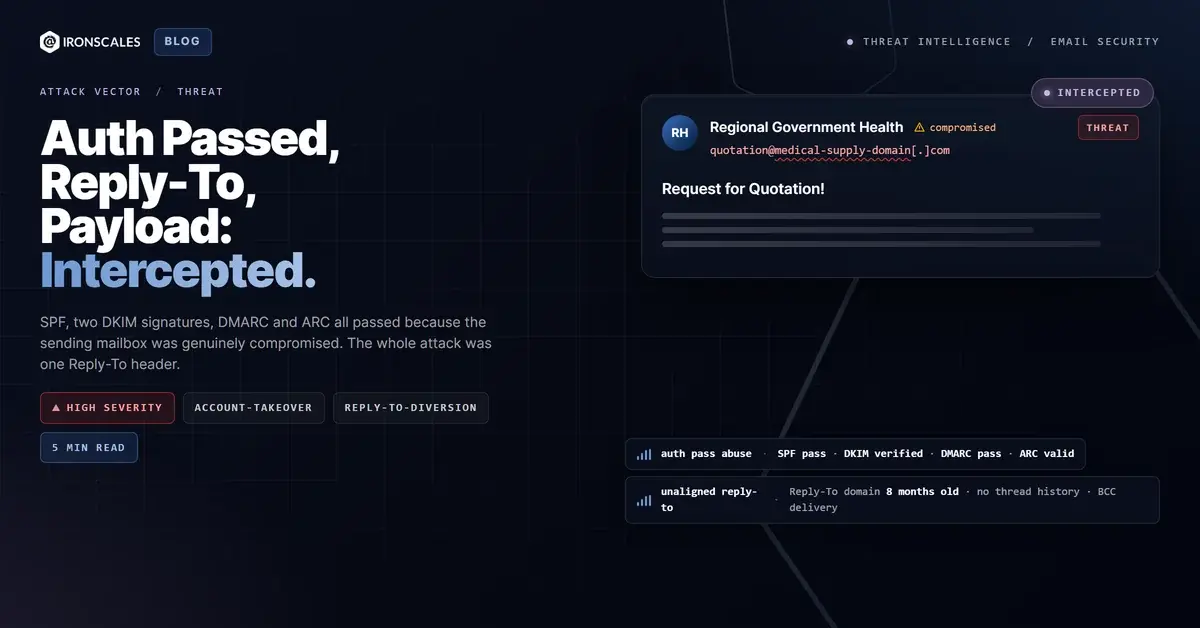
TL;DR A customer service mailbox received a one paragraph note asking it to confirm receipt of a quotation that was never sent. The message carried no link and no attachment, so there was nothing for a sandbox or a link rewriter to examine. It authenticated perfectly because it was genuinely composed inside a regional government health service's Microsoft 365 tenant from an authenticated mailbox session. The only unaligned identifier in the whole header set was Reply-To, pointing at a privacy shielded reply capture domain. Adaptive AI resolved it as phishing at 90 percent confidence.
Severity: High Business-Email-Compromise Account-Takeover Reply-To-Diversion Zero-Payload-Phishing Authenticated-Phishing MITRE: T1598 MITRE: T1684.001 MITRE: T1078 MITRE: T1585.002
A message with the subject Request for Quotation! arrived in a customer service mailbox at a North American business that fields inbound quotation requests. Four lines, no attachment, and not one of the links in the delivered copy had been placed there by the attacker.
That removes most of an email security stack from the conversation. No landing page to sandbox, no attachment to detonate, no URL to rewrite, no domain to block.
The header block, meanwhile, was immaculate. SPF pass. Two DKIM signatures, both verified. DMARC pass. Microsoft's composite authentication returning a pass with reason code 100. A valid ARC chain. None of it was forged. The message really was composed inside a legitimate Microsoft 365 tenant belonging to a regional government health service, by someone operating an authenticated session to a mailbox that was not theirs.
The entire attack was one header field.
The Weapon Was the Reply Path
Reply-To carried a sales alias on a medical supply themed domain with no relationship to the authenticated sending organization. Registration ran through a mass market registrar on a single year term, DNS sat behind a large content delivery provider, and every registrant contact field was privacy shielded. It was not a same day burner either: the domain had been registered roughly eight months before the message was sent, long enough to clear the reputation heuristics that treat fresh domains as inherently suspect. Age was part of the setup.
Set that against the rest of the identity set. The header From aligned with the sending domain, Return-Path aligned with the header From, and the two DKIM signatures aligned with the sending domain and its Microsoft tenant domain. Reply-To was the only unaligned identifier anywhere in the message, and it is the one field the authentication layer has no opinion about. DMARC aligns the From domain against a validated SPF or DKIM identifier. Reply-To sits outside that scope, so it can point anywhere without moving the result.
Four Lines and a Thread That Never Existed
The body was a short follow up, quoted here in full apart from the greeting and sign off: "I am following up to confirm that you've received the quotation I sent on Monday. Kindly confirm receipt. If you did not receive it, please let me know and I will promptly resend it."
No signature block. No company name. No personalization. And no earlier message: the header set contains no In-Reply-To and no References, while Thread-Topic mirrors the subject. The quotation supposedly sent on Monday has no thread behind it in the message's own metadata.
Notice what is being asked for. Not a payment, not credentials, not a click. Just confirmation of receipt. The reply itself is the conversion event, which is why MITRE files this behavior under phishing for information rather than under any technique involving a payload. It is also the most reply provoking pretext available against a mailbox whose job is answering inbound quote requests. Being helpful is the vulnerability.
Two Signatures and an Enforced Policy
Most authenticated phishing passes under a permissive DMARC policy. This one did not. The ARC authentication results record the published policy as quarantine, subdomain policy quarantine, at 100 percent coverage. The pass was earned against enforcement.
Both DKIM signatures verified against the same body hash: one under the organization's own domain and selector, one under its Microsoft tenant domain. The Received chain then explains where the message was born. It contains an internal MAPI submission from one tenant mailbox server to itself, the fingerprint of a message handed to the service by an authenticated client rather than injected by an external host, alongside a Thread-Index consistent with an Outlook send. From there it left through the organization's own outbound email security gateway, whose address is legitimately listed in the domain's SPF record.
Signed on the Way Out, Not at the Desk
One more field settles provenance. Alongside the final authentication results sits the evaluation taken while the message was still inside the originating tenant, before egress processing. It reads dkim=none (message not signed) and dmarc=none.
The message was therefore unsigned at composition, and the signatures were applied on the way out by the sending organization's own infrastructure. Nothing outside that tenant can reproduce that sequence. This was not domain spoofing, not a lookalike, not a shared relay abusing an SPF include. It was account takeover, and every green result in the header block is the sending organization's controls working as designed on behalf of whoever held the session. To be precise about the evidence: the record proves an authenticated mailbox session and nothing more, not how that session was obtained.
Addressed to Someone Else Entirely
The From and To addresses are identical, both the compromised mailbox. The actual recipient appears in neither, so delivery was by blind copy, and the person who opened it was reading mail visibly addressed to a stranger. That hides the distribution, and it removes any legitimate correspondent who might have noticed the redirected reply path.
The receiving tenant, to its credit, did flag the message, surfacing a first contact notice and an external sender caution bar. Both were injected by the recipient's own platform rather than by the attacker, as were the three Microsoft support links in the delivered copy. Two user facing warnings, and it still needed a detection engine to resolve it.
See Your Risk: Calculate how many threats your SEG is missing
Nothing Wrong With the Sender to Find
Adaptive AI scored the message at 90 percent confidence and the case was automatically resolved as phishing within seconds of arrival, with no human reporter involved. The recorded reasoning combined content pattern analysis with two community reputation signals drawn from how similar incidents resolved elsewhere.
The detail that matters most is an empty field. The sender analysis insight list came back with nothing in it, because there was nothing wrong with the sender to find. A domain in good standing, correct records, valid signatures, an authorized gateway. The case was carried entirely by relational signals: a first time sender, no prior correspondence in either direction, a high sender risk score, a recipient absent from both From and To, and one misaligned reply address.
Microsoft's content filtering, incidentally, disagreed with Microsoft's own authentication verdict, drawing a spam confidence level of 5, a spam category classification, the safety classification reserved for phishing, and delivery to Junk. Two verdicts inside one platform pointed opposite ways, and the one most humans read is the header block.
Three Changes Worth Making
The 2024 Verizon Data Breach Investigations Report puts the human element in 68% of breaches and pretexting, mostly business email compromise, at the top of the social engineering category, with a median transaction around $50,000. The 2023 FBI IC3 report puts reported BEC losses near $2.9 billion. Messages like this are how those numbers get made, without one blockable indicator in the delivery path.
Three practices follow. Score the reply path as an identity in its own right, independently of the DMARC result, since a misaligned Reply-To on an otherwise aligned message is deliberate configuration rather than accident. Treat zero payload mail as a category to be analyzed rather than as an absence of evidence. And treat authenticated mail from a partner mailbox as capable of hostility, verifying requests through a channel that does not run back through that mailbox. As CISA's phishing guidance and the NIST definition of phishing both frame it, the test is deception and objective, neither of which authentication measures.
Indicators of Compromise
| Type | Indicator | Context |
|---|
| Email | sales1@utako-medcare[.]org | The Reply-To address. The only attacker controlled artifact in the message and the entire mechanism of the attack. |
| Domain | utako-medcare[.]org | Attacker registered reply capture domain. Mass market registrar, content delivery provider nameservers, one year term, DNSSEC unsigned, all registrant contacts privacy shielded. Registered roughly eight months before the send. |
| Subject | Request for Quotation! | Reply provoking pretext aimed at a mailbox that fields inbound quote requests. |
| Body | Four line follow up asking the recipient to confirm receipt of a quotation sent on Monday | No signature, no company name, no personalization, and no thread. |
| Header anomaly | No In-Reply-To and no References, Thread-Topic mirroring the subject | The referenced earlier quotation does not exist in the message metadata. |
| Header anomaly | From and To identical, both the compromised mailbox; recipient present in neither | Delivery by blind copy. Recipient reads mail addressed to a stranger. |
| Header anomaly | Reply-To domain unaligned against an otherwise fully aligned From, Return-Path and DKIM set | The single unaligned identifier in the entire header block. |
| Auth result | SPF pass, two verified DKIM signatures sharing one body hash, DMARC pass, composite authentication pass reason code 100, ARC chain valid | Genuine alignment, because the send was genuine. |
| Auth result | Published DMARC policy quarantine, subdomain quarantine, 100 percent coverage | The pass was earned against an enforced policy, not a monitoring one. |
| Provenance | Pre egress evaluation reads dkim=none (message not signed), dmarc=none | The message was unsigned at composition and signed on the way out by the sending organization's own infrastructure. |
| Provenance | Internal MAPI mailbox server hop, Thread-Index present | An authenticated client session inside the tenant, not external injection. |
| Payload | None. Zero attachments, zero attacker supplied URLs | Nothing to detonate, rewrite or block. |
| Client metadata | Accept language and content language set to a language other than the one the message was written in (specific locale withheld) | Consistent with the mailbox's real owner rather than with the author of the lure. |
| Filtering verdict | Spam confidence level 5, spam category, phishing safety classification, routed to Junk | Content filtering dissented from the platform's own authentication result. |
| Detection signal | Adaptive AI, 90 percent confidence, sender analysis insight list empty | Behavioral and relational scoring only. Nothing was wrong with the sender. |
| Disposition | Automatically resolved as phishing, one mailbox affected | No analyst action required. |
MITRE ATT&CK Mapping
| Technique | ID | How it appeared |
|---|
| Phishing for Information | T1598 | The objective was a reply, not a click or a credential. The message asked only for confirmation of receipt, with the reply path redirected to attacker infrastructure. |
| Impersonation | T1684.001 | The message presented a genuine employee of a real organization as its author, using that organization's own mailbox, signatures and gateway. |
| Valid Accounts | T1078 | Sending was performed through an authenticated session to a legitimate mailbox, which is why every authentication check returned a pass. |
| Establish Accounts: Email Accounts | T1585.002 | A privacy shielded domain and sales alias were registered roughly eight months in advance purely to receive replies. |
Email Attack of the Day is a daily series from
IRONSCALES spotlighting real phishing attacks caught by Adaptive AI and our community of 35,000+ security professionals. Each post breaks down a real attack. What it looked like, why it worked, and what to do about it.







/Blue%20Feature%20Flower%20Icons/gear%20head%20icon.svg)
/Misc%20Icons/icon-nav-credential-theft.svg)










/Leadership%20Headshots/Audian%20Paxson%20Headshot%201000x1000%20032026.webp?width=100&height=100&name=Audian%20Paxson%20Headshot%201000x1000%20032026.webp)



.png?width=50&height=50&name=Untitled%20-%20July%2030%2c%202026%20at%2014.53.38%20(3).png)



/Misc%20Icons/icon-red-teaming-agent-gradient-simple.svg)
/Misc%20Icons/icon-phishing-soc-agent-gradient-simple.webp?width=158&height=167&name=icon-phishing-soc-agent-gradient-simple.webp)
/Misc%20Icons/icon-phishing-simulation-agent-gradient-simple.svg)


/Misc%20Icons/icon-nav-encryption.svg)