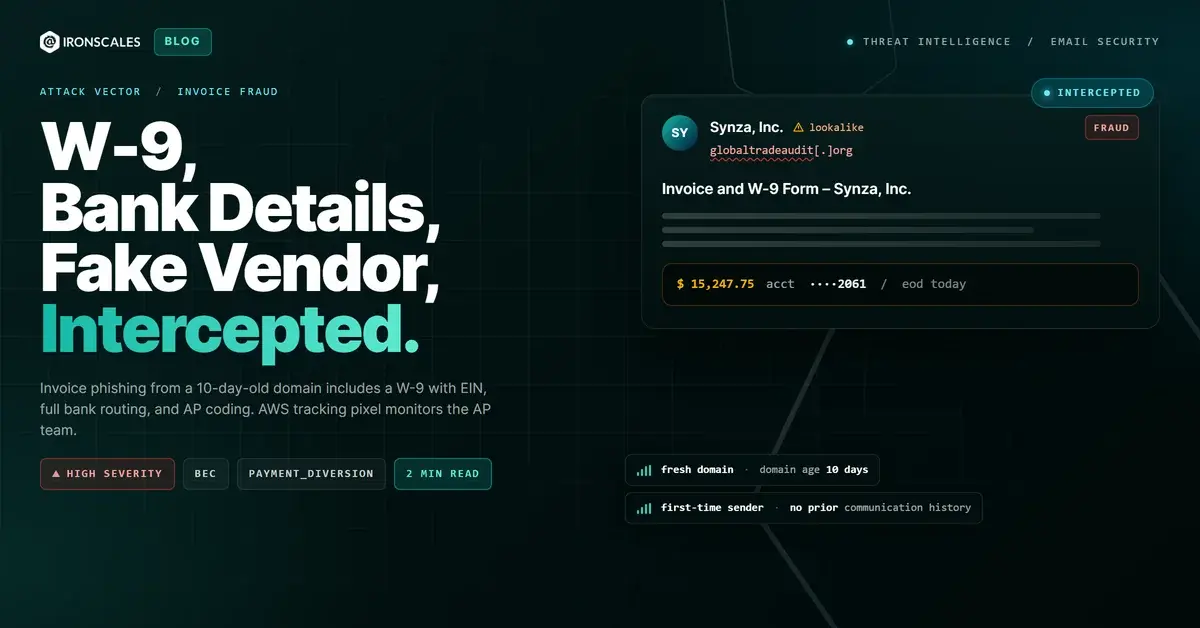
TL;DR Attackers sent a $15,247.75 invoice from globaltradeaudit[.]org, a domain registered just ten days before the attack with no public registrant information. The email included a W-9 PDF with EIN 38-4378893 for a company called 'Synza, Inc.' along with full bank routing details (account, ABA, SWIFT). AP coding references (GL 742000, Cost Center Enterprise Operations) were embedded to mimic internal financial workflows. An AWS tracking pixel at awstrack[.]me monitored recipient engagement. The message passed SPF and DKIM via Amazon SES and relayed through Mimecast without triggering impersonation protections.
Severity: Critical Invoice Fraud Bec Payment Diversion MITRE: {'id': 'T1566.001', 'name': 'Phishing: Spearphishing Attachment'} MITRE: {'id': 'T1036.005', 'name': 'Masquerading: Match Legitimate Name or Location'} MITRE: {'id': 'T1589.001', 'name': 'Gather Victim Identity Information: Credentials'}
The invoice was for $15,247.75. The email included a completed W-9 tax form with an Employer Identification Number. Bank routing details were listed in the body: account number, ABA routing number, SWIFT code. AP coding references matched internal financial formatting. For an accounts payable clerk processing vendor invoices, this was a complete payment package.
The domain that sent it, globaltradeaudit[.]org, had been registered ten days earlier. No public registrant. No website. No history. The company named on the W-9, "Synza, Inc.," had no verifiable presence outside the documents attached to this email.
This is invoice fraud built to survive the verification checklist, not to bypass email filters. Every document an AP team would request was already included.
The Documentation Package That Answered Every Question
The email arrived via Amazon SES from IP 54[.]240[.]8[.]242 with SPF and DKIM passing cleanly. It relayed through Mimecast infrastructure at 170[.]10[.]128[.]131 without triggering impersonation protections. The sending domain had no DMARC policy, which meant authentication results reflected the ESP's authorization, not the domain's intent.
The attachments did the heavy lifting. The W-9 listed Synza, Inc. with EIN 38-4378893 and a mailing address. The invoice referenced a specific engagement with a well-known energy research organization. Bank details in the body directed payment to Account 977923968802061, ABA 121145433, SWIFT CLNOUS66MER. Internal AP coding (GL 742000, Cost Center Enterprise Operations) mimicked the target organization's own financial formatting.
An AWS tracking pixel embedded in the email body loaded from awstrack[.]me when the message was opened. This gave the attacker real-time confirmation that the AP team had engaged with the invoice, enabling timed follow-up pressure if the initial payment was not processed.
Why the Age of the Domain Tells the Story
The most reliable signal in this attack was the domain registration date. globaltradeaudit[.]org was created on March 12, 2026. The phishing email was sent ten days later. Domains with no email history, no web presence, and privacy-shielded registration records that immediately begin sending invoices with bank routing details are a textbook pattern in business email compromise.
Adaptive AI flagged the convergence of signals: first-time sender, newly registered domain, financial request with embedded bank details, and the absence of any prior communication between the sender and the target organization. The message was quarantined before the AP team could initiate a payment.
See Your Risk: Calculate how many threats your SEG is missing
Indicators of Compromise
| Type | Indicator | Context |
|---|
| Sender Domain | globaltradeaudit[.]org | Registered Mar 12, 2026, no public registrant |
| Sending IP | 54[.]240[.]8[.]242 | Amazon SES infrastructure |
| Relay IP | 170[.]10[.]128[.]131 | Mimecast relay |
| Bank Account | 977923968802061 | Attacker-controlled mule account |
| ABA Routing | 121145433 | Bank routing number in payment instructions |
| SWIFT Code | CLNOUS66MER | Wire transfer routing |
| W-9 Entity | Synza, Inc. (EIN 38-4378893) | Fictitious or shell company on W-9 |
| Tracking Pixel | awstrack[.]me | AWS engagement tracking pixel |
| AP Coding | GL 742000, Cost Center Enterprise Operations | Mimicked internal financial formatting |
MITRE ATT&CK Mapping
Email Attack of the Day is a daily series from
IRONSCALES spotlighting real phishing attacks caught by Adaptive AI and our community of 36,000+ security professionals. Each post breaks down a real attack. What it looked like, why it worked, and what to do about it.







/Blue%20Feature%20Flower%20Icons/gear%20head%20icon.svg)
/Misc%20Icons/icon-nav-credential-theft.svg)










/Leadership%20Headshots/Audian%20Paxson%20Headshot%201000x1000%20032026.webp?width=100&height=100&name=Audian%20Paxson%20Headshot%201000x1000%20032026.webp)



.png?width=50&height=50&name=Untitled%20-%20July%2030%2c%202026%20at%2014.53.38%20(3).png)



/Misc%20Icons/icon-red-teaming-agent-gradient-simple.svg)
/Misc%20Icons/icon-phishing-soc-agent-gradient-simple.webp?width=158&height=167&name=icon-phishing-soc-agent-gradient-simple.webp)
/Misc%20Icons/icon-phishing-simulation-agent-gradient-simple.svg)


/Misc%20Icons/icon-nav-encryption.svg)