TL;DR A large U.S. regional healthcare system received an ACH enrolment notice from what looked like a medical-device manufacturer it already did business with. The sending domain was a one-character typosquat with SPF, DKIM and DMARC configured properly by the attacker, so every authentication check passed under the attacker's own name. The request for banking details was plain text, not a link. The attached memo promised the real account number would follow as a separate encrypted file with the PIN sent out of band. Adaptive AI scored it 84 percent on domain age.
Severity: High Business-Email-Compromise Vendor-Email-Compromise Payment-Diversion Typosquatting Brand-Impersonation MITRE: T1566.001 MITRE: T1585.002 MITRE: T1684.001
An accounts-payable notice reached a large U.S. regional healthcare system announcing that a medical-device manufacturer it already bought from was ending check and credit-card payments and moving everything to ACH. The message passed SPF. It passed DKIM. It passed DMARC. Microsoft's composite authentication returned a full pass with reason code 100, and the ARC chain preserved that verdict intact across both handoffs on the way in. Every hyperlink in the message resolved to the manufacturer's genuine website and social channels, and all of them scanned clean. The attached PDF carried no JavaScript, no form fields and no embedded executable, and it hashed clean too.
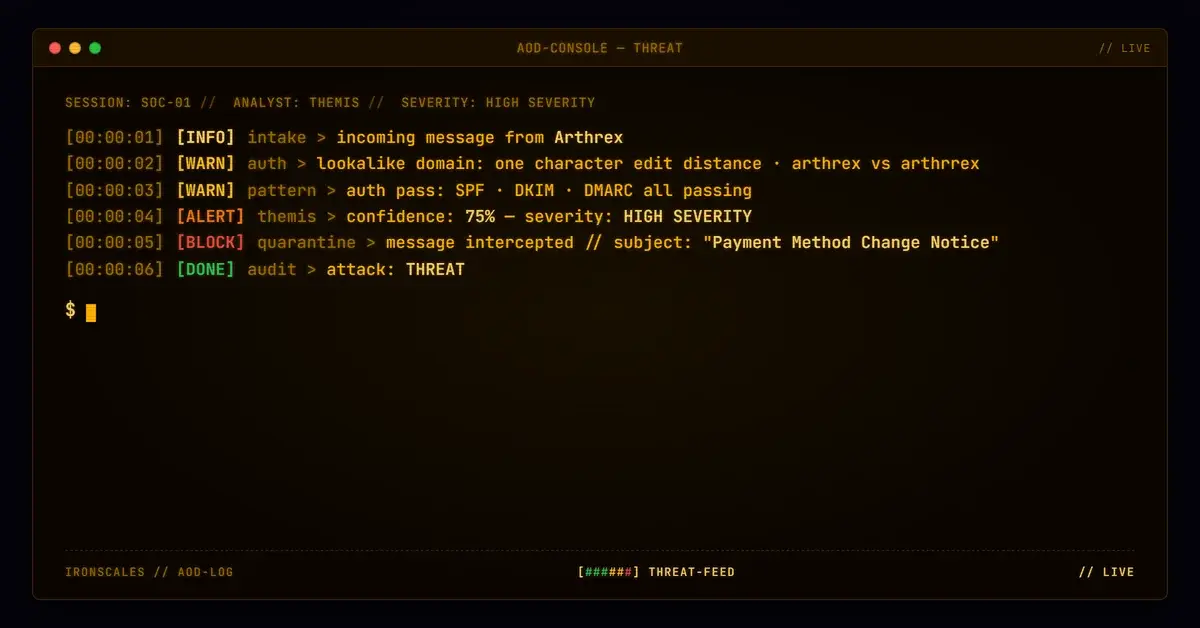
The sending domain was arthrrex[.]com. The manufacturer's real domain is arthrex[.]com. The difference is a doubled r, sitting in the middle of a word most accounts-payable clerks have never had reason to spell.
The Doubled R Was the Only Thing Wrong With the Sender
The legitimate domain has been registered since December 1997 through a registrar that predates most of the internet, on nameservers it has held for years. The lookalike went up in mid-February 2026 through a mass-market registrar, parked on that registrar's default DNS. One character of edit distance, twenty-eight years of registration history apart.
Everything downstream of that registration was done properly. The attacker published an SPF record that authorized the commercial relay they had bought sending capacity on, so SPF passed against the envelope sender. They configured DKIM signing, so the signature verified under the sending domain's own key. They published a DMARC record, and because the visible sender aligned with both the envelope and the signature, DMARC passed as well.
Worth being precise about what that pass means. Under RFC 9989, a DMARC pass is a statement that the message is aligned and authenticated, nothing more. The attacker's published policy was quarantine rather than reject, so the pass came from alignment holding, not from an aggressive posture they had adopted to look serious. Three green checks in a row, and all three of them are true. They certify that whoever operates arthrrex[.]com sent this mail. That was never in doubt, and it was exactly the problem.
The Memo Was Manufactured the Day the Domain Was, Then Backdated
The attachment was a PDF styled as an executive memo, presented as an internal notice that had been forwarded outward to customers. It was signed by a president of the manufacturer, a persona that does not exist, and its distribution list was a row of other mailboxes on the same lookalike domain, several more fabricated recipients invented to make the forward look like it had circulated internally first.
Parsing the file directly rather than trusting the narrative around it produced the detail that dates the whole operation. The PDF's own creation and modification timestamps, written by Microsoft Word, land on the same calendar day the lookalike domain was registered, at a quarter past three in the afternoon. The date printed inside the memo's text reads three days earlier.
So the sequence is not a compromised vendor forwarding an authentic notice. The infrastructure and the document were built together in a single afternoon, and the document was then given a date three days in the past so it would read as something already in motion. The memo's stated pretext is the standard one, in the attacker's own wording: the manufacturer had "recently learned that we have several unhonored checks," would "no longer accept checks and credit card payments," and needed all payments routed "through ACH to our subsidiary company that's domiciled in another name." That last clause is doing real work. It pre-explains why the account about to be nominated will not carry the vendor's name.
Nothing Actionable Was Ever Placed Where a Gateway Could Read It
The email's instruction was to write back. The exact ask, "please email apinquiry@arthrrex[.]com with your banking detail or for further information," sits in the HTML body as plain text with no anchor tag wrapped around it. It is not a link and was never meant to be one. The links that were present padded the signature block with the real manufacturer's real properties, which is why link analysis returned clean verdicts across the board.
The PDF then closes the other half of the loop. Its operative line, verbatim, is that "the subsidiary ACH information is sent as an encrypted file and a pin to that file has been sent separately to you all." No account number appears in the email. None appears in the attachment. The routing detail that would make this fraud actionable was promised on a channel that does not exist yet, gated behind a PIN promised on a third one. There is no URL to reputation-check, no attachment to detonate, and no bank detail to pattern-match, because the attacker put none of it in the mail path.
This is the structure NIST describes when it defines phishing by deception rather than by payload. It combines attachment-based delivery, tracked by MITRE ATT&CK as spearphishing attachment, with infrastructure the adversary stood up in advance under MITRE ATT&CK and brand impersonation of a real supplier. The 2026 Verizon Data Breach Investigations Report now tracks pretexting separately as 6 percent of initial access vectors, alongside the 62 percent of breaches that involve a human element, and the money follows: the 2025 FBI IC3 Annual Report puts business email compromise losses at $3,046,598,558.
See Your Risk: Calculate how many threats your SEG is missing
One more thing suppressed the obvious heuristic. This message was not cold contact. It arrived as a reply inside an existing thread, carrying a valid in-reply-to reference, and the platform recorded the sender as not a first-time sender to that organization. Controls that weight first contact from an unknown domain had already been quieted before anyone read a word of it.
What the Adaptive AI Had Left to Weigh
Strip out authentication failure, malicious URLs, hostile attachments and first-contact novelty, and very little remains. Themis, the IRONSCALES Adaptive AI analyst, scored the message at 84 percent confidence, and the reasoning it recorded was blunt: the return-path domain was newly registered, a pattern typically associated with suspicious activity. Domain age was the lever, because domain age was the only clean signal the attacker had not controlled. Four mailboxes across two waves in mid-July were quarantined and mitigated, and the incident auto-resolved as phishing.
What To Change After a Case Like This
Three adjustments generalize past this one message. Treat a full authentication pass as an identity claim rather than a verdict, since business email compromise increasingly arrives from domains the attacker owns outright rather than ones they had to break into. Run edit-distance scoring against your own vendor master list, because a one-character variant of a domain you already pay is a far stronger signal than a newly registered domain in isolation. And make any change to payment instructions unverifiable by email, on principle, which is the practical form of the CISA phishing guidance: confirm on a number from the contract, not a number from the request.
Indicators of Compromise
| Type | Indicator | Context |
|---|
| Domain | arthrrex[.]com | Attacker-registered typosquat of the manufacturer's real domain, doubled r, registered mid-February 2026 through a mass-market registrar on default nameservers, with SPF, DKIM and DMARC all configured correctly by the attacker |
| Email | apinquiry@arthrrex[.]com | Harvest address for the requested banking details, rendered as plain text in the body with no anchor tag, the message's only real call to action |
| Email | *@arthrrex[.]com | Sender address, local-part masked, presented under a fabricated accounts-receivable manager persona |
| Email | *@arthrrex[.]com | Two further masked local-parts on the same attacker domain, copied on the live message as fabricated colleagues, one of them the persona that signed the attached memo as president |
| IP | 205[.]220[.]189[.]69 | Sending address, the outbound relay of a mainstream commercial mail platform the attacker had legitimately bought sending capacity on |
| File | Arthrex External Memo.pdf, 98,108 bytes | Attached lure document, scanner-clean, no JavaScript, no form fields, no embedded executable, containing the out-of-band encrypted-file and PIN instruction |
| Hash | MD5 2fbbca8fb05d6bfce43587043b55f9f6 | Hash of the attached memo PDF |
| Artifact | PDF creation and modification timestamp, 15:15 local on the day of domain registration, producer Microsoft Word for Microsoft 365 | Document was authored the same day the lookalike domain went up, extracted from the file's own metadata rather than from the incident narrative |
| Artifact | Memo text dated three days before the file was created | Backdating intended to present a freshly built document as an internal notice already in circulation |
| Subject | "[External] Arthrex ACH/EFT Enrolment" | Vendor-enrolment pretext, delivered as a reply inside an existing thread |
| Auth | spf=pass, dkim=pass with selector1 under the sending domain, dmarc=pass, published policy quarantine with subdomain quarantine at full percentage, compauth=pass reason=100, arc=pass at both hops | Every check passed honestly because the attacker owned and correctly configured the domain being authenticated |
| Behavior | Banking-detail request as unlinked plain text, account and routing numbers deferred to a separate encrypted file with a PIN promised out of band | No URL, no payload and no bank detail anywhere in the mail path, leaving reputation, detonation and content matching with nothing to evaluate |
MITRE ATT&CK Mapping
| Technique | ID | Application |
|---|
| Phishing: Spearphishing Attachment | T1566.001 | A PDF memo carrying the payment-change pretext, delivered as the message's substantive content with the body reduced to a reply instruction |
| Establish Accounts, Email Accounts | T1585.002 | A typosquat domain registered months in advance and fully provisioned with SPF, DKIM, DMARC and commercial sending capacity before use |
| Impersonation | T1684.001 | A real medical-device manufacturer impersonated end to end, with fabricated executive and accounts-receivable personas and a genuine signature block of the brand's own public links |
See You Next Time
Authentication told the truth about this message and the truth was useless. Check back tomorrow.
Email Attack of the Day is a daily series from
IRONSCALES spotlighting real phishing attacks caught by Adaptive AI and our community of 35,000+ security professionals. Each post breaks down a real attack. What it looked like, why it worked, and what to do about it.







/Blue%20Feature%20Flower%20Icons/gear%20head%20icon.svg)
/Misc%20Icons/icon-nav-credential-theft.svg)










/Leadership%20Headshots/Audian%20Paxson%20Headshot%201000x1000%20032026.webp?width=100&height=100&name=Audian%20Paxson%20Headshot%201000x1000%20032026.webp)



.png?width=50&height=50&name=Untitled%20-%20July%2030%2c%202026%20at%2014.53.38%20(3).png)



/Misc%20Icons/icon-red-teaming-agent-gradient-simple.svg)
/Misc%20Icons/icon-phishing-soc-agent-gradient-simple.webp?width=158&height=167&name=icon-phishing-soc-agent-gradient-simple.webp)
/Misc%20Icons/icon-phishing-simulation-agent-gradient-simple.svg)


/Misc%20Icons/icon-nav-encryption.svg)