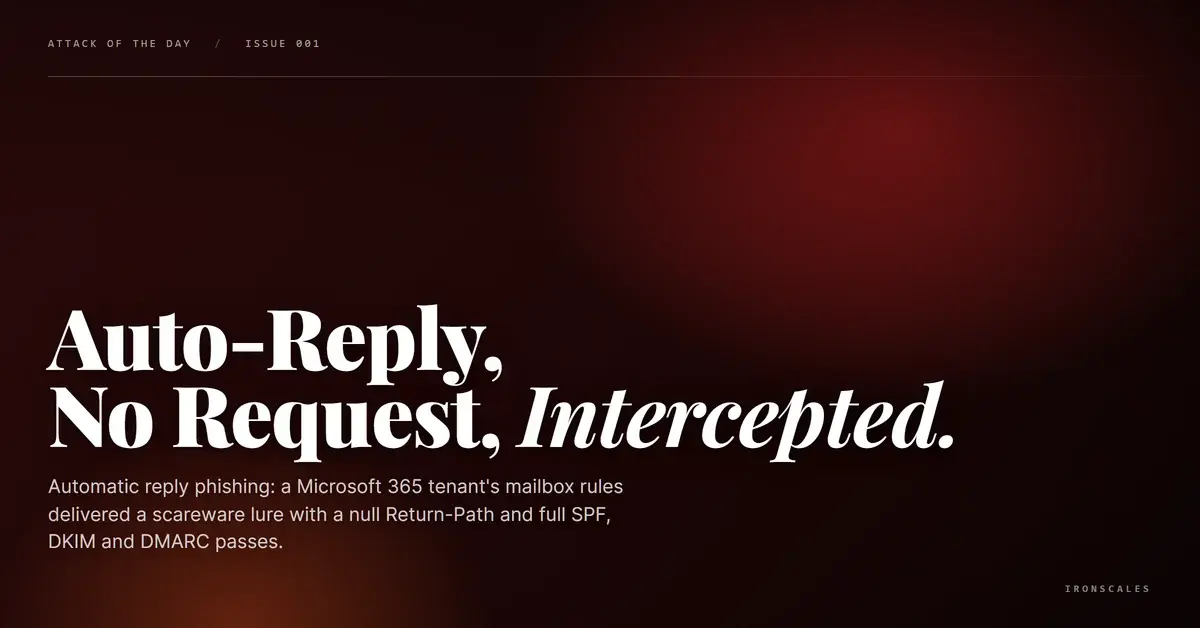
TL;DR A single corporate mailbox received a counterfeit payment-provider order confirmation for an $893.65 handgun the recipient never bought. The From display name and the To display name were both set to his own mailbox name, so the message presented as self-sent. It carried no links and no attachments, and even the unsubscribe line was inert text with no destination, leaving two unrelated phone numbers under a fake help-desk heading as the only actionable content. DMARC passed on SPF alignment while the DKIM signature for the same domain failed.
Severity: High Callback Phishing Vishing Brand Impersonation Zero Payload Social Engineering MITRE: T1566.004 MITRE: T1684.001 MITRE: T1585.002 MITRE: T1598
A counterfeit PayPal order confirmation landed in a single corporate mailbox: an $893.65 handgun purchase had gone through. The recipient had bought nothing. The receipt itself was competent but unremarkable. What made the message worth taking apart sat in the headers above it. The From display name and the To display name were both set to the recipient's own mailbox name, so in any client that shows display names and hides addresses, the message rendered as though the reader had emailed himself a receipt.
The sending address was a free-webmail account. No PayPal domain, link, or account appears anywhere in the message, so the impersonation is purely typographic: no lookalike domain, no compromised business mailbox, no attacker-registered domain at all. There was also nothing to click. The links array on the analyzed message was empty, the attachments array was empty, and the one element that looked interactive, a footer line inviting the reader to unsubscribe, was styled text with no anchor behind it and no list-unsubscribe header to match. The whole actionable surface was a signature block offering two phone numbers under a heading presenting itself as PayPal's help desk.
The Cheapest Trust Signal in Email
Display-name impersonation is normally described as wearing borrowed authority: a chief executive, a controller, a vendor's billing contact. This message inverted the pattern. The name it wore was the recipient's own mailbox name, set as the visible sender, the visible recipient, and the body greeting, which addressed the reader by his mailbox local-part instead of a first name.
Self-addressing requires no domain registration, no account takeover, and no header spoofing: the addresses were never disguised, and the free-webmail sender is plainly visible the moment anyone expands the From header. The trick lives entirely on the rendered surface, which is what most people read on a phone. It also explains the greeting: the attacker had one harvested string and spent it four times, twice in the headers, once in the salutation, and once in a delivery panel that also printed the recipient's real corporate address and a residential-format delivery address. That panel is what made an invented charge feel like it had already happened.
A Fuzzy Identity Match Reached for the Wrong Person
The stack did flag identity, and how it flagged it deserves scrutiny. The alert tag read as a similar display-name impersonation, and the engine resolved that mailbox-name token against the organization's own VIP list, landing on a different executive on the same corporate domain who happens to share the recipient's surname. That executive was uninvolved. The attacker never used his name or his address.
The tag said similar, not exact, and the distinction matters. Read from the alert summary alone, this looks like an executive-impersonation attempt. It is not one. It is a target being shown his own name. Fuzzy identity matching earns its keep on verdicts, but its explanations can point at the wrong human, and a triage note written from the explanation will describe an attack that never happened.
See Your Risk: Calculate how many threats your SEG is missing
Object-Centric Controls Had Nothing to Open
Strip out the link and the attachment and most of a modern inspection pipeline goes quiet. URL rewriting needs a URL. Sandboxing needs a file. Domain reputation needs infrastructure to score, and the only infrastructure here belonged to a global webmail provider and a phone carrier.
That is the structural point about telephone-oriented delivery, the email-to-vishing handoff. The 2024 Verizon Data Breach Investigations Report puts phishing in fifteen percent of breaches and the human element in sixty-eight percent, and this message is what the second figure looks like without the first one's usual artifacts. The 2023 FBI IC3 report recorded roughly $2.9 billion in reported business email compromise losses, much of it negotiated by voice.
The Only Check That Failed Was the One Nobody Enforces Alone
Authentication came back mixed, and the failing half is the instructive half. SPF passed, because the sending host was one of the provider's authorized outbound relays. DKIM failed with a signature that did not verify, for that same provider domain. DMARC then returned a pass with an action of none, and composite authentication passed at the maximum reason code.
That is not a bug. RFC 7489 requires one aligned passing mechanism, not two, and SPF supplied it because the envelope domain and the header From domain were the same webmail domain. The broken signature cost the attacker nothing. Why it broke is not recoverable from the record, so the cause stays unknown and the outcome is the lesson: the only cryptographic check that failed is the one almost nobody enforces alone. Teams running DMARC monitoring see this shape constantly, and a green verdict on a free-webmail domain says nothing about intent.
The earliest received line adds one detail: authenticated SMTP submission from an external client that asserted an RFC 1918 private address for itself and a timestamp two hours off the provider's. A configured mail client, not a browser session.
The Message Argued With Itself
The copy contradicted its own advice. One panel told the reader to contact customer service using the official contact information provided by PayPal. Twenty lines below, the signature supplied two numbers in two different area codes, presented as a single PayPal help desk.
The rest were craft errors: a payment gateway subtitle PayPal does not use, that same phrasing in the payment method and signature rather than PayPal's transactional wording, a hero line missing a space around its dash, a tax row printing a double-zero dollar figure no receipt generator emits, and an order dated the same day it arrived. The merchant on the line item was a major US firearms manufacturer, named only because an unexpected firearm charge is alarming, with no involvement of any kind.
Where the Verdict Actually Came From
Microsoft caught part of it, scoring a spam confidence level of five with a matching filter verdict and category, then routing the message to the junk folder rather than blocking or quarantining it. Junk is not a decision a targeted user reliably respects when the subject line names a purchase they want cancelled.
Themis returned a confidence of ninety with labels covering VIP impersonation, a vishing attempt, and a VIP recipient, citing language and conversational cues that matched voice-based phishing. The message was quarantined roughly five seconds after delivery, on an incident opened by automated detection with no human report, one mailbox affected. Neither CISA's phishing guidance nor the NIST definition depends on a payload, and neither should a detection strategy.
Indicators of Compromise
| Type | Indicator | Context |
|---|
| Email address | sulemansirajo4@gmail[.]com | Sending account. Attacker-registered or a compromised free-webmail account; the record does not distinguish. |
| Phone | +1 (628) 502-6284 | Attacker-controlled. First number in the fake help-desk signature block, and the actual payload. |
| Phone | +1 (806) 471-4360 | Attacker-controlled. Second number, a different area code, presented as the same help desk. |
| IP | 49[.]51[.]163[.]162 | Submitting client address in the earliest received line. Closest attacker-side network artifact available. |
| IP | 172[.]28[.]17[.]139 | RFC 1918 address the client asserted for itself. Evidence of a configured mail client, not a webmail session. |
| Subject | Your recent Order 09716740 confirmation | Subject line as delivered. |
| Kit artifact | Order Number 09716740 / Reference ID 227L45UGJQNW56 / $893.65 | Fabricated transaction identifiers and amount, the kit's fingerprint. |
| Kit artifact | Payment gateway subtitle, gateway signature block, double-zero tax row, unsubscribe line with no destination | Template tells for this counterfeit receipt kit. |
| Auth pattern | spf=pass with dkim=fail and dmarc=pass action=none | Alignment satisfied by SPF alone while the signature for the same domain did not verify. |
MITRE ATT&CK Mapping
| Technique | ID | How it appeared |
|---|
| Phishing: Spearphishing Voice | T1566.004 | Two phone numbers under a counterfeit help-desk heading were the only actionable content. |
| Impersonation | T1684.001 | A payment provider's receipt reproduced typographically, with the recipient's own mailbox name as both display names. |
| Establish Accounts: Email Accounts | T1585.002 | Delivery from a free-webmail account, inheriting the provider's SPF pass and DMARC alignment. |
| Phishing for Information | T1598 | The intended callback would move information gathering onto a voice channel outside email telemetry. |
What This Should Change
The only control that generalizes here is an identity check, not a payload check. The display name did not match the sending address, and the visible recipient name did not match the mailbox it was delivered to. Both are computable on every inbound message without opening a single object, and a display name reproducing the recipient's own mailbox name has no legitimate explanation in external mail.
Two habits follow. Treat a message whose only call to action is a telephone number as a category of its own rather than as an absence of findings, and score it on language and identity. And when a fuzzy identity match names an executive, read the message before repeating the name: the engine may be right that identity was abused and wrong about whose. No telemetry exists on whether the recipient saw either number, and the quarantine landed in about five seconds.
Email Attack of the Day is a daily series from
IRONSCALES spotlighting real phishing attacks caught by Adaptive AI and our community of 35,000+ security professionals. Each post breaks down a real attack. What it looked like, why it worked, and what to do about it.







/Blue%20Feature%20Flower%20Icons/gear%20head%20icon.svg)
/Misc%20Icons/icon-nav-credential-theft.svg)










/Leadership%20Headshots/Audian%20Paxson%20Headshot%201000x1000%20032026.webp?width=100&height=100&name=Audian%20Paxson%20Headshot%201000x1000%20032026.webp)



.png?width=50&height=50&name=Untitled%20-%20July%2030%2c%202026%20at%2014.53.38%20(3).png)



/Misc%20Icons/icon-red-teaming-agent-gradient-simple.svg)
/Misc%20Icons/icon-phishing-soc-agent-gradient-simple.webp?width=158&height=167&name=icon-phishing-soc-agent-gradient-simple.webp)
/Misc%20Icons/icon-phishing-simulation-agent-gradient-simple.svg)


/Misc%20Icons/icon-nav-encryption.svg)