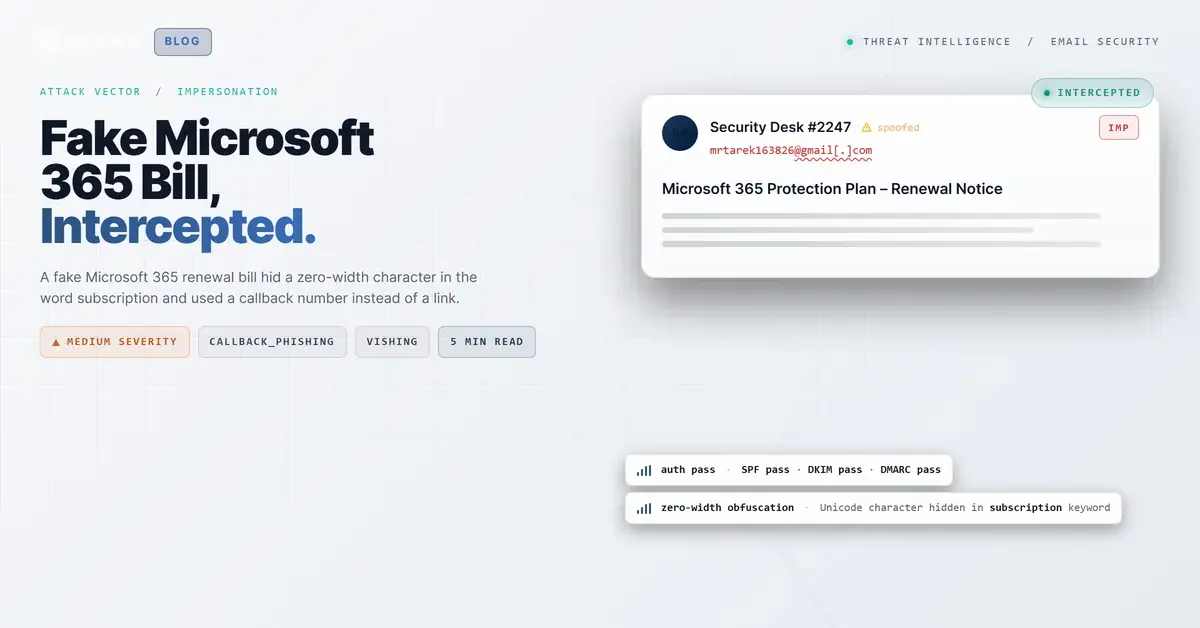
TL;DR A Gmail-originated message impersonated an internal Security Desk and warned of an imminent $422.99 charge for a fabricated Microsoft 365 Protection plan on an invented Four Year term. There was no clickable link. The only calls to action were a callback phone number and a Reply-To and List-Unsubscribe pair pointing to domains with no resolving DNS. A zero-width character was embedded inside the word subscription to evade keyword filters. Authentication passed cleanly because the mail genuinely came from Google, so the entire deception lived in the display name and the body.
Severity: Medium Brand Impersonation Callback Phishing Vishing MITRE: T1566.004 MITRE: T1036.005 MITRE: T1598
The message landed in the inbox of an engineering group manager in a vehicle-safety division at a Fortune 500 automotive manufacturer. It looked like a billing alert from the company's own security team, and it warned that a charge of $422.99 was about to hit for a Microsoft 365 protection plan. A 12-hour countdown pushed the reader to act before the renewal processed.
There was no link to click. There was no attachment to open. The only way forward was a phone number.
That is the whole point. This was a callback phishing operation, the kind of telephone-oriented attack delivery that trades a clickable payload for a live human on the other end of a call. And to get the bait through content filters in the first place, the sender hid a zero-width character inside the word subscription, an invisible Unicode mark that reads normally to a person but shatters the keyword matching that filters lean on.
A Bill From Nobody
The display name read "Security Desk #2247," dressed up to look like an internal alert. The platform's impersonation detection went further and flagged the message as spoofing a real internal security-team alias, borrowing the recipient organization's own authority to sell the story. But the actual sending address was a personal Gmail account, mrtarek163826@gmail[.]com. No corporate mail system, no vendor billing platform, just a free webmail account wearing a security team's name.
The product being renewed did not exist. There is no Microsoft 365 protection plan sold on a "Four Year" term, which is exactly the sort of detail that a fabricated invoice invents to look official while quietly failing any sanity check. The $422.99 figure and the countdown clock were there to short-circuit that check, converting a moment of billing anxiety into a phone call before the reader thought to question the math.
Why the Attacker Removed the Link
Most phishing we tear down here hinges on a link or an attachment, because that is where the payload lives. This campaign deliberately removed both. When there is no URL, there is nothing for a link scanner to detonate, nothing to reputation-check, and nothing to rewrite at the gateway. The attack surface a modern mail filter is tuned to inspect simply is not present.
What replaced it was a callback number, 1-(805) 228-9899, with no authoritative Microsoft association. A victim who dials it reaches a live operator who walks them through "cancelling" the phantom charge, a script that typically ends in a remote-access install, a payment-card capture, or a wire. This is the mechanics of vishing: the email is only the doorway, and the real theft happens on the voice channel where no email control can see it.
The reply path was built the same way. Both the Reply-To and the List-Unsubscribe header pointed at domains that resolve to nothing at all: mxgridcenter[.]com for replies and deliverymxrouter[.]com for the unsubscribe contact. Neither has working DNS, MX, or WHOIS records. They exist only to look like plausible mail infrastructure in a header a human might skim, another prop in a message engineered to be answered by phone, not inspected.
See Your Risk: Calculate how many threats your SEG is missing
The Authentication Was Perfect, Which Is the Problem
Here is the part that defeats a checkbox approach to email security. SPF passed. DKIM passed, signed by gmail.com. DMARC passed. Compound authentication came back compauth=pass reason=100. Every server-level signal was green, because the message genuinely originated from Google's infrastructure. It really was sent from a real Gmail account.
Authentication answers "did this server have permission to send for this domain," and the honest answer was yes. It does not answer "is a personal Gmail account claiming to be your internal security desk telling you the truth." The deception lived entirely in the display name, the impersonated internal alias, and the body copy, none of which SPF, DKIM, or DMARC evaluates. The 2024 Verizon Data Breach Investigations Report puts the human element in 68 percent of breaches, and this message was aimed squarely at that layer, well above anything transport-layer checks can reach.
Mapping to MITRE ATT&CK
The tradecraft maps cleanly to the MITRE ATT&CK framework:
- T1566.004 Spearphishing Voice is the core delivery: a message that funnels the target toward a callback rather than a link, the defining shape of a TOAD attack.
- T1036.005 Masquerading: Match Legitimate Name or Location covers the display name and the impersonated internal security alias standing in for the organization's real team.
- T1598 Phishing for Information covers the callback funnel itself, the goal of extracting credentials, payment details, or access once the victim is on the line.
Indicators of Compromise
| Type | Indicator | Context |
|---|
| Sender email | mrtarek163826@gmail[.]com | Personal Gmail account, display name "Security Desk #2247" |
| Callback phone | 1-(805) 228-9899 | Vishing number, no authoritative Microsoft association |
| Reply-To domain | mxgridcenter[.]com | Reply target, no resolving DNS, MX, or WHOIS |
| Reply-To address | reply@mxgridcenter[.]com | Off-platform reply capture |
| Unsubscribe domain | deliverymxrouter[.]com | List-Unsubscribe contact domain, unverifiable |
| Unsubscribe address | optcount@deliverymxrouter[.]com | List-Unsubscribe contact |
| Fabricated amount | USD 422.99 | Invented Microsoft 365 protection renewal charge |
Detection and What to Watch For
Signature and link-reputation tooling was never going to catch this, because there was no link and the sender authenticated flawlessly. Detection has to move to behavior and intent. The signals that matter are a first-contact Gmail account claiming to be an internal team, a billing product and term that do not exist, reply and unsubscribe domains that resolve to nothing, a phone number as the sole call to action, and a zero-width character buried inside a common billing word. Individually each is minor. Together they describe a callback scam.
This is where IRONSCALES adds a layer static gateways miss. Themis, the Adaptive AI analyst on the IRONSCALES platform, weighs the relationship between the claimed identity, the actual sending account, and the absence of a normal payload the way a trained analyst would, flagging the impersonation even when every authentication check is green. That behavioral read is informed by patterns seen across 36,000+ security professionals in 18,000+ organizations. The Microsoft Digital Defense Report 2024 documents the same shift toward abusing trusted services rather than breaking them, and the FBI's 2023 Internet Crime Report ranks callback and tech-support fraud among the most damaging schemes reported.
The Takeaway
The most dangerous phishing is increasingly the phishing with nothing to scan. Strip the link, pass authentication from a real mailbox, and route the victim to a phone, and the classic controls have no purchase. The defense is to treat identity and intent as first-class signals: a billing alert that arrives from personal webmail, invents a product, and offers only a phone number is a callback scam no matter how clean the headers look. Pairing that instinct with behavioral detection is what closes the gap. See where impersonation and business email compromise risk hides in your own mail flow, because the next fake bill will not bother with a link at all.
CISA's guidance on recognizing and stopping phishing early is a solid reference for building that reflex across a team: https://www.cisa.gov/resources-tools/resources/phishing-guidance-stopping-attack-cycle-phase-one
Email Attack of the Day is a daily series from
IRONSCALES spotlighting real phishing attacks caught by Adaptive AI and our community of 36,000+ security professionals. Each post breaks down a real attack. What it looked like, why it worked, and what to do about it.





/Blue%20Feature%20Flower%20Icons/gear%20head%20icon.svg)
/Misc%20Icons/icon-nav-credential-theft.svg)





/Leadership%20Headshots/Audian%20Paxson%20Headshot%201000x1000%20032026.webp?width=100&height=100&name=Audian%20Paxson%20Headshot%201000x1000%20032026.webp)



.png?width=50&height=50&name=Untitled%20-%20July%2030%2c%202026%20at%2014.53.38%20(3).png)



/Misc%20Icons/icon-red-teaming-agent-gradient-simple.svg)
/Misc%20Icons/icon-phishing-soc-agent-gradient-simple.webp?width=158&height=167&name=icon-phishing-soc-agent-gradient-simple.webp)
/Misc%20Icons/icon-phishing-simulation-agent-gradient-simple.svg)


/Misc%20Icons/icon-nav-encryption.svg)