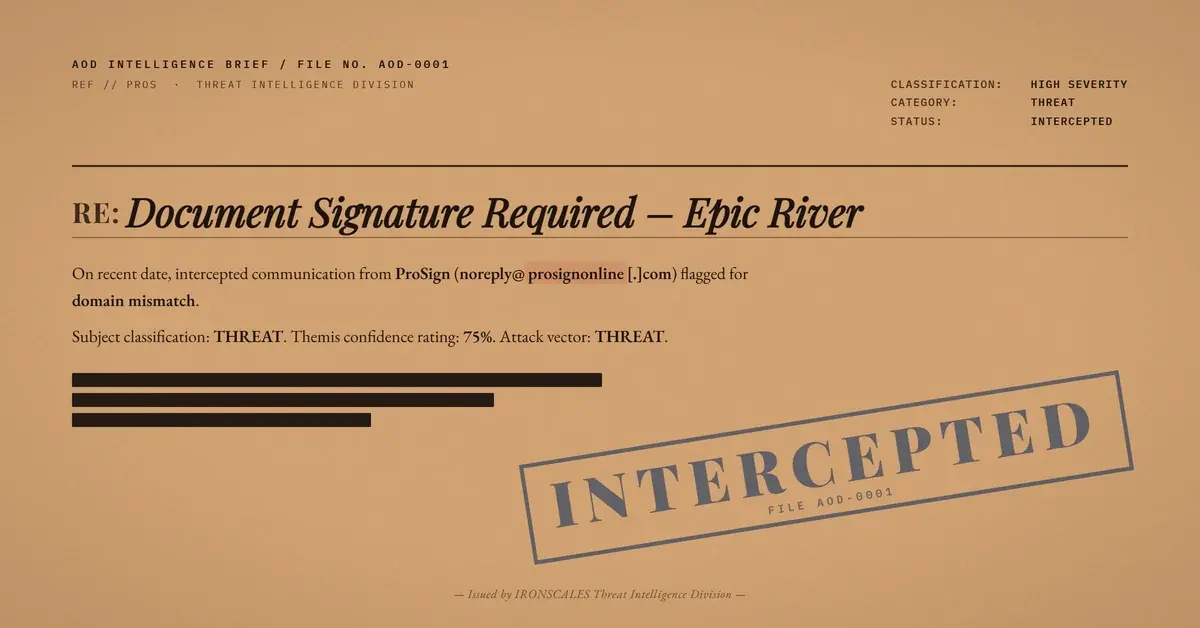
TL;DR An e-sign phishing email combined three brand identities to build trust: Epic River as the document sender, Home State Bank as the financial institution, and ProSign as the signing platform. Sent from prosignonline[.]com (registered 2017, hosted on AWS), the message passed DKIM and DMARC but soft-failed SPF via a mxthunder[.]net relay at 208[.]53[.]48[.]218. The credential harvest page at prosign[.]online returned mixed verdicts across URL scanners.
What Happened
An email presented as an e-signature notification arrived from prosignonline[.]com, a domain registered in 2017 and hosted on AWS infrastructure. The message wove together three brand identities: Epic River appeared as the document originator, Home State Bank as the financial institution involved in the transaction, and ProSign as the electronic signing platform facilitating the process.
DKIM passed. DMARC passed. SPF returned a softfail because the message was relayed through mxthunder[.]net at 208[.]53[.]48[.]218, an IP not included in the prosignonline[.]com SPF record. The softfail disposition meant most gateways treated the message as suspicious but deliverable rather than rejecting it outright.
The call-to-action directed recipients to prosign[.]online, a separate domain from the sender address. URL scanners returned mixed verdicts: some flagged it as suspicious, others marked it clean. The page was designed to harvest credentials under the guise of a document signing login.
Why It Matters
Multi-brand phishing represents an evolution in social engineering sophistication. Rather than impersonating a single entity, the attacker constructed a plausible multi-party transaction scenario. In legitimate business, e-signature workflows routinely involve a document sender (Epic River), a financial counterparty (Home State Bank), and a signing platform (ProSign). A recipient who recognizes even one of these brands may extend trust to the entire chain.
The SPF softfail is a deliberate choice. Attackers who route through relays like mxthunder[.]net accept the softfail because they know most gateway configurations will still deliver the message. The DKIM and DMARC passes provide enough authentication cover to offset the SPF result in most scoring algorithms.
The mixed scanner verdicts on prosign[.]online highlight a persistent gap in URL-based detection. When a phishing page is hosted on AWS and the domain is relatively new without negative reputation history, scanners that rely on infrastructure reputation and feed-based blocklists will return clean results. Only scanners performing real-time content analysis of the landing page would identify the credential harvest form.
How IRONSCALES Caught It
Adaptive AI email security evaluated the full behavioral context of the message: a multi-brand e-signature notification, SPF softfail through a third-party relay, and a CTA pointing to a domain different from the sender domain. Community intelligence confirmed the pattern across multiple organizations, with the prosign[.]online domain appearing in credential harvest reports from other tenants.
The sender-to-link domain mismatch (prosignonline[.]com sending, prosign[.]online harvesting) is a signal that static gateway rules frequently miss because both domains share the prosign brand name, making the discrepancy appear intentional rather than suspicious.
See Your Risk. Run a free phishing simulation to test whether multi-brand credential harvesting emails bypass your current defenses.
Indicators of Compromise
| Indicator | Type | Value |
|---|
| Case ID | Internal | b7f13fe9f763896e8a98c49be8c213f7 |
| Sender Domain | Domain | prosignonline[.]com |
| Harvest Domain | Domain | prosign[.]online |
| Relay Service | Infrastructure | mxthunder[.]net |
| Relay IP | IP Address | 208[.]53[.]48[.]218 |
| Hosting | Infrastructure | AWS |
| Domain Created | WHOIS | 2017 |
| SPF | Authentication | softfail |
| DKIM | Authentication | pass |
| DMARC | Authentication | pass |
| Scanner Verdicts | Detection | Mixed (clean/suspicious) |
MITRE ATT&CK Mapping
| Tactic | Technique | ID | Notes |
|---|
| Initial Access | Phishing: Spearphishing Link | T1566.002 | CTA link to credential harvest page |
| Credential Access | Input Capture: Web Portal Capture | T1056.003 | Fake e-signature login page |
| Defense Evasion | Masquerading | T1036 | Three legitimate brands chained for trust |
| Resource Development | Acquire Infrastructure: Domains | T1583.001 | prosign[.]online registered for harvesting |
Email Attack of the Day is a daily series from
IRONSCALES spotlighting real phishing attacks caught by Adaptive AI and our community of 36,000+ security professionals. Each post breaks down a real attack. What it looked like, why it worked, and what to do about it.







/Blue%20Feature%20Flower%20Icons/gear%20head%20icon.svg)
/Misc%20Icons/icon-nav-credential-theft.svg)










/Leadership%20Headshots/Audian%20Paxson%20Headshot%201000x1000%20032026.webp?width=100&height=100&name=Audian%20Paxson%20Headshot%201000x1000%20032026.webp)



.png?width=50&height=50&name=Untitled%20-%20July%2030%2c%202026%20at%2014.53.38%20(3).png)



/Misc%20Icons/icon-red-teaming-agent-gradient-simple.svg)
/Misc%20Icons/icon-phishing-soc-agent-gradient-simple.webp?width=158&height=167&name=icon-phishing-soc-agent-gradient-simple.webp)
/Misc%20Icons/icon-phishing-simulation-agent-gradient-simple.svg)


/Misc%20Icons/icon-nav-encryption.svg)