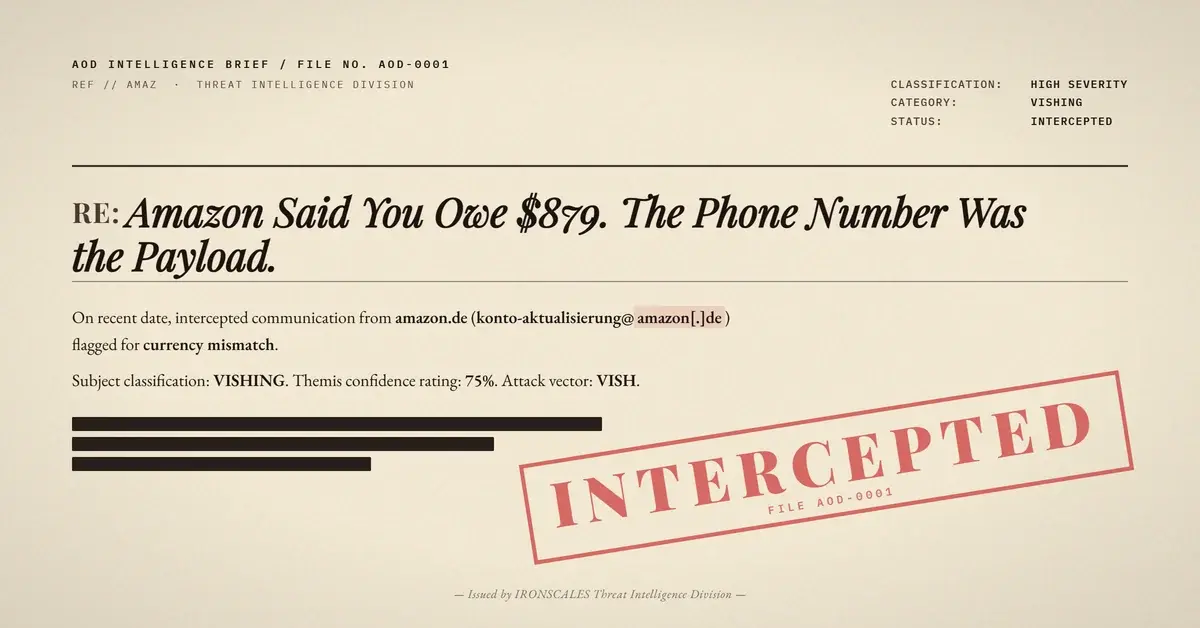
TL;DR An email purporting to be from Amazon.de passed DKIM and DMARC authentication. The initial sending hop through Amazon SES (54.240.1.30) passed SPF. Every link in the message resolved to legitimate Amazon domains via gp/r.html redirect endpoints, and all scanned clean. The message body claimed an $879 charge with no order details, no personalization, and a U.S. phone number as the sole call-to-action. The currency mismatch (USD in an Amazon.de message), the lack of transactional details standard in Amazon communications, and the phone-number-as-payload pattern classify this as a TOAD (Telephone-Oriented Attack Delivery) vishing campaign that exploits authenticated Amazon infrastructure to bypass email security.
Severity: High Vishing Brand Impersonation MITRE: T1566.003 MITRE: T1204.001 MITRE: T1036.005
A charge notification from amazon[.]de landed in an English-speaking recipient's inbox. The sender address was konto-aktualisierung@amazon[.]de. DKIM passed for both amazon[.]de and amazonses[.]com. DMARC passed. Every link in the message pointed to legitimate Amazon gp/r.html redirect endpoints and scanned clean. There were no attachments.
The body claimed an $879 charge. No order ID, no itemization, no recipient name. The only action item was a phone number: (865) 292-7594. That number is the entire attack.
Authenticated From End to End
The message originated from Amazon SES infrastructure at 54[.]240[.]1[.]30 (a1-30[.]smtp-out[.]eu-west-1[.]amazonses[.]com), passing SPF at the initial hop. DKIM signatures validated for both amazon[.]de and amazonses[.]com. DMARC aligned and passed for header.from=amazon[.]de.
A downstream Votiro relay at 44[.]206[.]222[.]91 caused an SPF failure for the return-path domain driftpulse[.]de, but by that point the message had already cleared authentication at the sending origin. SRS bounce handling in the return-path (bounces+SRS=sIDxa=C5@driftpulse[.]de) confirms the message was relayed through intermediary infrastructure after leaving Amazon's servers.
The result: an email that presents a clean authentication record from Amazon itself. Secure email gateways that rely on sender reputation and domain authentication had no signal to act on. The sending IP is Amazon's. The DKIM signature is Amazon's. The links resolve to Amazon's domains.
See Your Risk: Calculate how many threats your SEG is missing
The Content Tells a Different Story
The email claimed to be from amazon[.]de, the German marketplace. The charge was stated in USD. That mismatch alone is a strong signal. Amazon.de transactional emails display amounts in euros. An $879 charge denominated in U.S. dollars from a German storefront indicates a campaign targeting English-speaking recipients without localizing the financial details.
Beyond the currency, the message lacked every element standard in a real Amazon transaction notification: no order number, no item description, no shipping address, no personalized greeting. The grammar was unprofessional. Amazon logos and a German-language footer were present, but the content read like a template built for volume, not precision.
This is the behavioral surface that Adaptive AI and community-driven threat intelligence evaluate. Authentication says the email came from Amazon's infrastructure. Content analysis says the message does not match how Amazon actually communicates.
Why Link Scanning Cannot Catch This
Every URL in the message used Amazon's own gp/r.html redirect endpoints. SafeLinks rewrites were applied. All links scanned clean. There were no attachments. There was no credential harvesting page, no malware, no redirect chain to an attacker-controlled domain.
The payload is the phone number. TOAD (Telephone-Oriented Attack Delivery) campaigns are built to operate in the gap between what scanners can evaluate and what actually harms the recipient. Once the call connects, the attacker controls the conversation: fake refund flows, remote access requests, credential verification pretexts.
Link scanners, sandboxes, and URL reputation engines have nothing to flag here. Detection depends on recognizing that the content of the message is inconsistent with the identity of the sender, a judgment that requires behavioral context, not signature matching.
Indicators of Compromise
| Type | Indicator | Context |
|---|
| Sender | konto-aktualisierung@amazon[.]de | From address (authenticated via Amazon SES) |
| Return-Path Domain | driftpulse[.]de | SRS bounce-handling domain in return-path |
| IP | 54[.]240[.]1[.]30 | Amazon SES sending IP (SPF pass at initial hop) |
| IP | 44[.]206[.]222[.]91 | Votiro relay (caused SPF fail for driftpulse[.]de at downstream hop) |
| Phone | (865) 292-7594 | Vishing callback number (sole payload) |
| Fake Charge | $879 USD | Fraudulent charge amount (no order ID, no itemization) |
Email Attack of the Day is a daily series from
IRONSCALES spotlighting real phishing attacks caught by Adaptive AI and our community of 36,000+ security professionals. Each post breaks down a real attack. What it looked like, why it worked, and what to do about it.







/Blue%20Feature%20Flower%20Icons/gear%20head%20icon.svg)
/Misc%20Icons/icon-nav-credential-theft.svg)










/Leadership%20Headshots/Audian%20Paxson%20Headshot%201000x1000%20032026.webp?width=100&height=100&name=Audian%20Paxson%20Headshot%201000x1000%20032026.webp)



.png?width=50&height=50&name=Untitled%20-%20July%2030%2c%202026%20at%2014.53.38%20(3).png)



/Misc%20Icons/icon-red-teaming-agent-gradient-simple.svg)
/Misc%20Icons/icon-phishing-soc-agent-gradient-simple.webp?width=158&height=167&name=icon-phishing-soc-agent-gradient-simple.webp)
/Misc%20Icons/icon-phishing-simulation-agent-gradient-simple.svg)


/Misc%20Icons/icon-nav-encryption.svg)