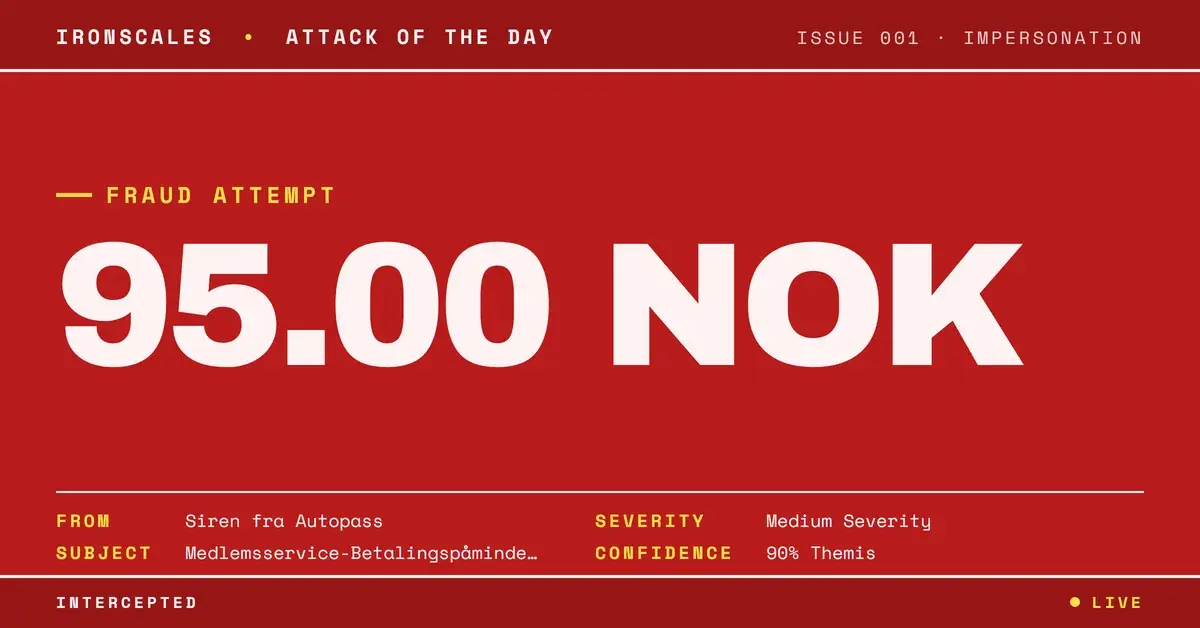
TL;DR An email from a retail analytics vendor asked the recipient to update payment records with new ACH and wire routing details included directly in the body. The sender domain passed SPF and DMARC with a p=reject policy, and the message was delivered through Oracle Cloud Email Delivery infrastructure. The attached PDF, generated by Oracle Analytics Publisher, was a single-page image with no extractable text, preventing automated content analysis. No invoice number, no amount, and no prior context accompanied the request. IRONSCALES Themis flagged the behavioral anomaly of an unsolicited remittance change containing full bank account details with no transactional reference.
Severity: High Payment Diversion Invoice Fraud Scanner Evasion MITRE: {'id': 'T1566.001', 'name': 'Phishing: Spearphishing Attachment'} MITRE: {'id': 'T1036.005', 'name': 'Masquerading: Match Legitimate Name or Location'}
The email asked the recipient to update their payment records. It provided ACH routing, wire routing, a full account number, and a SWIFT code, all directly in the body. No invoice number. No dollar amount. No prior thread. Just: "Please update your records with the payment information below."
The sender domain belonged to a retail analytics vendor. SPF and DMARC both passed under a p=reject policy, the strictest configuration available. The message was transmitted through Oracle Cloud Email Delivery infrastructure at 147[.]154[.]189[.]195. Nothing about the authentication chain raised a flag.
The Body Carried the Payload
The most unusual aspect of this attack is the placement of financial details. ACH routing, wire routing, and a full account number sat in plain text in the email body. Most invoice fraud campaigns embed payment instructions in PDF attachments to evade body-content scanning. This one did both: the details appeared in the message and in the attachment, ensuring the recipient saw them regardless of whether they opened the PDF.
The absence of context is the behavioral tell. Legitimate remittance updates reference a specific invoice, contract, or purchase order. They arrive within an existing thread or through an established payment portal. This message provided full banking coordinates with no transactional anchor, a pattern consistent with business email compromise payment diversion campaigns where the attacker needs the recipient to update records before the next payment cycle.
The PDF That Scanners Could Not Read
The attached PDF, 9125PANDR000059_71017945_12072020.pdf, was 22 KB and a single page. It was generated by Oracle Analytics Publisher and rendered its entire content as an image. No text layer. No selectable characters. No embedded URLs or JavaScript.
For automated scanners, this PDF was effectively blank. Text extraction returned nothing because there was nothing to extract. The file was technically clean: no macros, no links, no executable code. Every scanner that inspected it returned a clean verdict because the threat surface it was designed for (text analysis, link inspection, macro detection) simply did not exist in this file. The only way to analyze the content was OCR, and most email security gateways do not apply OCR to PDF attachments by default.
See Your Risk: Calculate how many threats your SEG is missing
Where Authentication Ended and Behavior Began
DMARC p=reject passed. SPF passed. The sending infrastructure was legitimate Oracle Cloud infrastructure. Every technical gate gave this message a green light.
Themis flagged the behavioral pattern: an unsolicited email from a vendor domain with no prior communication history, containing full banking coordinates, referencing no specific transaction, and carrying an image-based PDF with no extractable content. The combination of signals, not any single indicator, triggered the detection.
Indicators of Compromise
| Type | Indicator | Context |
|---|
| Sending IP | 147[.]154[.]189[.]195 | Oracle Cloud Email Delivery infrastructure |
| Attachment | 9125PANDR000059_71017945_12072020.pdf | Image-based Oracle Analytics Publisher PDF (22,092 bytes) |
| Hash (MD5) | d5f524252054b170410e1507dfe44707 | PDF attachment hash |
| PDF Generator | Oracle Analytics Publisher | Single-page image, no text layer |
MITRE ATT&CK Mapping
Email Attack of the Day is a daily series from
IRONSCALES spotlighting real phishing attacks caught by Adaptive AI and our community of 36,000+ security professionals. Each post breaks down a real attack. What it looked like, why it worked, and what to do about it.







/Blue%20Feature%20Flower%20Icons/gear%20head%20icon.svg)
/Misc%20Icons/icon-nav-credential-theft.svg)










/Leadership%20Headshots/Audian%20Paxson%20Headshot%201000x1000%20032026.webp?width=100&height=100&name=Audian%20Paxson%20Headshot%201000x1000%20032026.webp)



.png?width=50&height=50&name=Untitled%20-%20July%2030%2c%202026%20at%2014.53.38%20(3).png)



/Misc%20Icons/icon-red-teaming-agent-gradient-simple.svg)
/Misc%20Icons/icon-phishing-soc-agent-gradient-simple.webp?width=158&height=167&name=icon-phishing-soc-agent-gradient-simple.webp)
/Misc%20Icons/icon-phishing-simulation-agent-gradient-simple.svg)


/Misc%20Icons/icon-nav-encryption.svg)