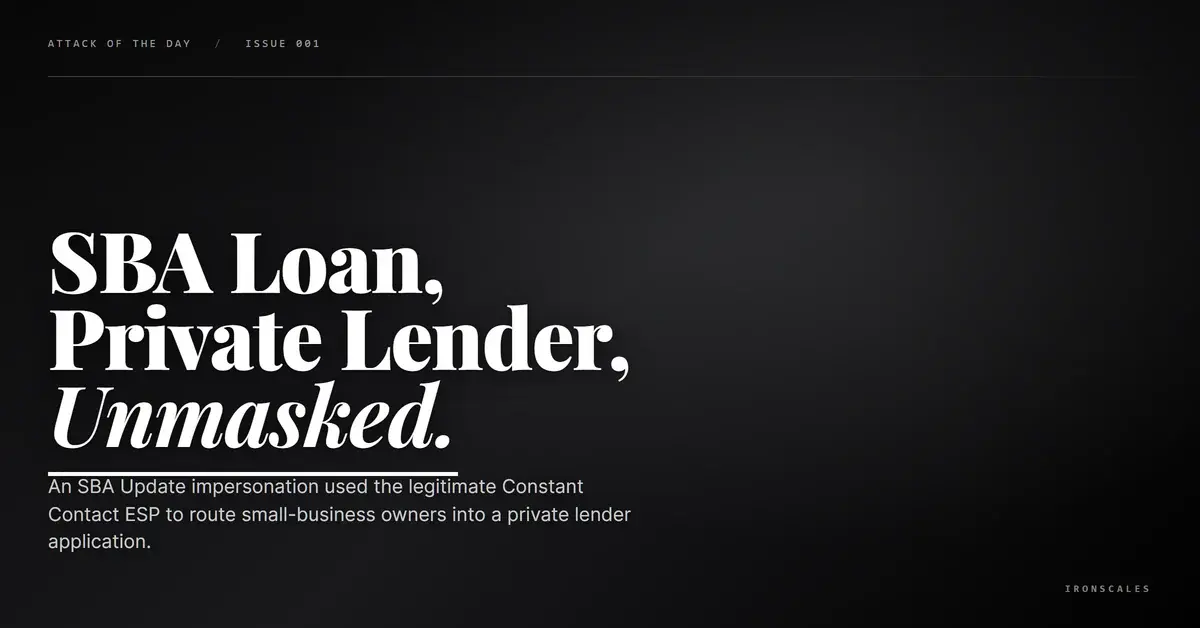
TL;DR An email carrying the display name SBA Update impersonated the U.S. Small Business Administration while its From and Reply-To resolved to non-government domains. Delivered through the legitimate Constant Contact marketing platform, its Apply Now button routed through tracking and a shortener to a private lender, not any real SBA program. Auth signals were mixed: SPF passed on the ESP address while DKIM and DMARC failed under a reject policy, yet the message still reached at least four mailboxes.
Severity: Medium Brand Impersonation Lead Generation Fraud Credential Harvesting MITRE: T1566 MITRE: T1566.002 MITRE: T1684.001
A message arrived in several inboxes at a financial-services firm carrying a display name that read SBA Update. To any small-business owner, that string reads as the U.S. Small Business Administration, the federal agency that backs loans and grants. The subject and the branding leaned hard on that association, and a single button invited the reader to Complete My Application Now.
The button did not lead to a government program. It led to a private lender.
This was not a credential-stealing kit or a malware dropper. It was a lead-generation funnel dressed in federal clothing, engineered to convert the trust attached to a government name into applications for a commercial loan product. What makes the case worth studying is that every layer of the delivery chain looked compliant, and the pieces that did not pass authentication still reached the inbox.
How the Funnel Worked
The email was sent through Constant Contact, a legitimate email marketing platform, from the sending host ccm27.constantcontact[.]com, and relayed onward through a Mimecast gateway. Nothing about that path is inherently malicious. Thousands of real newsletters travel the same rails every day, which is exactly why it works as cover.
The Complete My Application Now call to action did not point straight at a destination. It first passed through Constant Contact's own rs6[.]net click-tracking wrapper, then through a tinyurl[.]com shortener, and finally landed on apply.1west[.]com. That final page is the application portal for a private small-business lender, not an SBA site and not a government domain of any kind. The layered redirect chain hid the true destination from a casual hover and stripped the government context that the branding had promised.
The Reply-To told its own story. Instead of an agency mailbox, replies were addressed to a recently registered domain, corebizsolutionsinc[.]com, which carried no DMARC record at all. Any recipient who hit reply with a question would have their message captured off-platform, on infrastructure the sender controlled, well away from the marketing tool that carried the original blast.
When a Reject Policy Still Lands
The authentication picture on this message was mixed, and the mix is the interesting part. SPF passed, because the message genuinely originated from a Constant Contact IP that is authorized to send for the platform's shared infrastructure. Sender Policy Framework (SPF) only validates the sending server, not the brand a reader sees, so a pass here proves nothing about the SBA.
Domain Keys Identified Mail (DKIM) failed on a body-hash mismatch tied to the shared shared1[.]ccsend[.]com signing domain. Because neither SPF nor DKIM aligned to the header From, Domain-based Message Authentication, Reporting and Conformance (DMARC) failed as well. The header From resolved to shared1[.]ccsend[.]com under a policy of p=reject, and the Microsoft 365 edge logged the outcome as action=oreject with compauth=none reason=460.
On paper, a reject policy should have bounced this message. It did not. The campaign had already cleared a Mimecast hop, where it passed, before reaching the Microsoft 365 boundary, and the reputation attached to a mainstream marketing ESP kept it moving. This is the practical lesson that authentication alone keeps teaching: a p=reject verdict at one edge is only as strong as the weakest hop in front of it, and shared ESP infrastructure blurs the line between the platform's reputation and the sender's intent.
Mapping to MITRE ATT&CK
The tradecraft maps cleanly to a few techniques in the MITRE ATT&CK framework:
- T1566 Phishing and T1566.002 Spearphishing Link cover the core delivery: a socially engineered message whose payload is a link, routed through wrappers to a lender's application page.
- T1684.001 Impersonation covers the government-brand deception, the display name SBA Update standing in for a federal agency it has no connection to.
Indicators of Compromise
| Indicator | Type | Notes |
|---|
corebizsolutionsinc[.]com | Reply-To domain | Recently registered, no DMARC record, captures replies off-platform |
apply.1west[.]com | Landing page | Private small-business lender application, not an SBA or government site |
tinyurl[.]com/yc8828nk | URL shortener | Hides the true redirect destination in the call to action |
help-corebizsolutionsinc.com@shared1[.]ccsend[.]com | Sender identity | Delivered via Constant Contact shared bulk ESP infrastructure |
ccm27.constantcontact[.]com | Sending host | Legitimate marketing platform used as delivery cover |
rs6[.]net | Tracking redirect | Constant Contact click wrapper in the CTA chain |
Detection and What to Watch For
Signature and reputation checks were always going to struggle here, because most of the infrastructure is legitimate and the message carries no attachment or malware. Detection has to shift to behavior and intent. The signals that matter are the mismatch between a government display name and non-government reply and link domains, a freshly registered Reply-To with no DMARC on a message that otherwise rides an established ESP, and a call to action that redirects through a shortener before resolving to a commercial destination.
This is where IRONSCALES adds a layer that static gateways miss. Themis, the Adaptive AI analyst on the IRONSCALES platform, reads the relationship between the claimed brand, the actual sending and reply domains, and the redirect chain the way a trained analyst would, flagging the impersonation even when every server-level check comes back clean. The 2024 Verizon Data Breach Investigations Report puts the human element in 68 percent of breaches, and the Microsoft Digital Defense Report 2024 documents the same shift toward abusing trusted services rather than breaking them. The FBI's 2023 Internet Crime Report shows government and business-identity impersonation among the costliest categories, which is exactly the lever this campaign pulled.
The Takeaway
Government branding is a trust shortcut, and attackers know it. When a name like the SBA appears in a display field, the reflex is to comply, not to inspect the reply domain or trace the redirect. The defense is to treat display names as decoration and verify the destination: real government programs live on government domains, and a legitimate agency does not funnel applicants through a URL shortener into a private lender's portal. Pairing that habit with behavioral detection is what closes the gap this campaign exploited. See where impersonation and business email compromise risk hides in your own mail flow, because the next government-branded funnel is already in someone's inbox.
CISA's guidance on recognizing and stopping phishing early is a solid reference for building that reflex across a team: https://www.cisa.gov/resources-tools/resources/phishing-guidance-stopping-attack-cycle-phase-one
Email Attack of the Day is a daily series from
IRONSCALES spotlighting real phishing attacks caught by Adaptive AI and our community of 36,000+ security professionals. Each post breaks down a real attack. What it looked like, why it worked, and what to do about it.







/Blue%20Feature%20Flower%20Icons/gear%20head%20icon.svg)
/Misc%20Icons/icon-nav-credential-theft.svg)










/Leadership%20Headshots/Audian%20Paxson%20Headshot%201000x1000%20032026.webp?width=100&height=100&name=Audian%20Paxson%20Headshot%201000x1000%20032026.webp)



.png?width=50&height=50&name=Untitled%20-%20July%2030%2c%202026%20at%2014.53.38%20(3).png)



/Misc%20Icons/icon-red-teaming-agent-gradient-simple.svg)
/Misc%20Icons/icon-phishing-soc-agent-gradient-simple.webp?width=158&height=167&name=icon-phishing-soc-agent-gradient-simple.webp)
/Misc%20Icons/icon-phishing-simulation-agent-gradient-simple.svg)


/Misc%20Icons/icon-nav-encryption.svg)