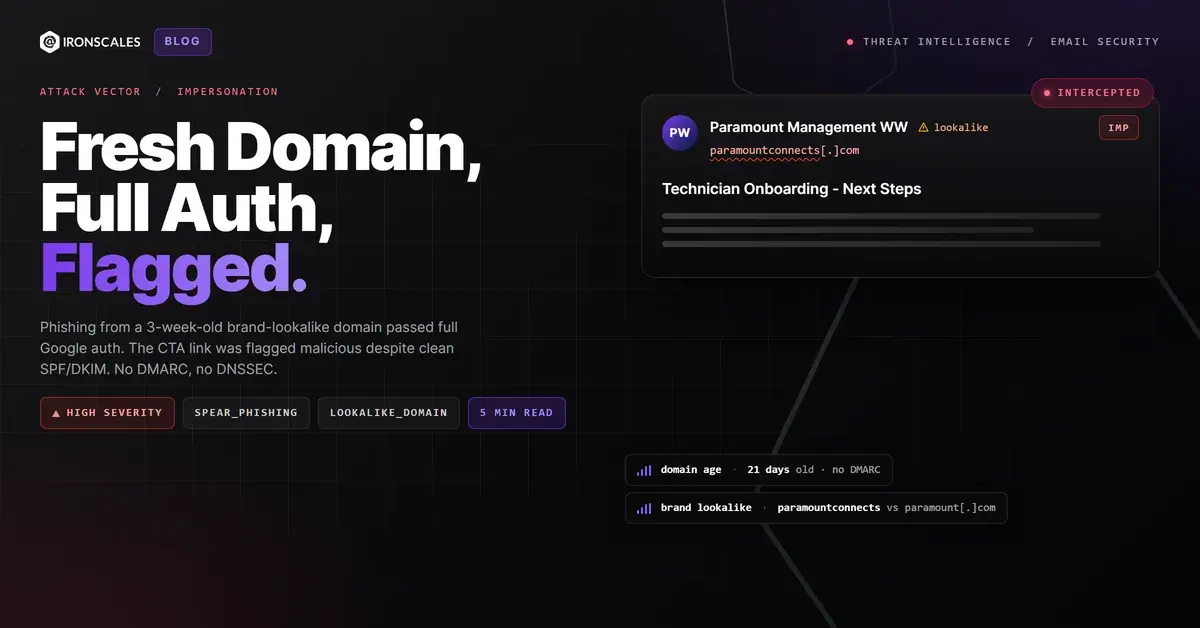
TL;DR A phishing email arrived from a domain created just three weeks before delivery, routed through Google's mail infrastructure with full SPF, DKIM, and ARC authentication. The sender presented as a management consulting company with a professional signature block including a name, title, and phone number. The attached link resolved to the same domain and was flagged malicious. The domain name closely resembled a well-known entertainment brand, and no DMARC record or DNSSEC was configured. The recipient organization was a regional broadband provider. Themis flagged the message based on domain age, authentication posture gaps, and the malicious link signal.
Severity: High Brand Impersonation Spear Phishing Lookalike Domain MITRE: {'id': 'T1566.002', 'name': 'Phishing: Spearphishing Link'} MITRE: {'id': 'T1583.001', 'name': 'Acquire Infrastructure: Domains'} MITRE: {'id': 'T1684.001', 'name': 'Impersonation'}
The email had a professional signature block: name, title, company, and a direct phone number. The subject referenced technician onboarding, with language about coordinating "next steps." It read like a routine business development or vendor introduction message.
The sending domain was three weeks old.
What Full Authentication Looks Like When It Is Not Enough
The message passed every check in the authentication chain. SPF passed via Google's sending infrastructure. DKIM was signed correctly with Google's keys. ARC seals were intact through the relay chain. The originating mail server was mail-yx1-xb144.google.com, a known Google Workspace mail host.
The sending domain, paramountconnects[.]com, was registered on May 28, 2025, through Network Solutions, using HostGator nameservers. At the time of delivery, it was approximately three weeks old. There was no DMARC record. DNSSEC was not enabled.
SPF and DKIM verify that the sending infrastructure is authorized to send for the domain they claim. They do not verify how long that domain has existed, whether it has any legitimate business history, or whether the domain name was chosen to resemble a well-known brand. Those are questions that authentication cannot answer.
The domain name paramountconnects[.]com is visually and phonetically adjacent to paramount[.]com, one of the most recognized entertainment brands in the world. The tenant name "Paramount Management Worldwide" amplifies the association. An organization receiving a message from a "Paramount Management" contact about staffing or technician coordination might reasonably infer a connection to a familiar corporate name.
A Signature Block as Social Engineering Infrastructure
The message body was framed as a professional introduction, asking about onboarding next steps for a technician. The signature block included a full name presented as an executive, the title President, the company name Paramount Management Worldwide, and a direct phone number.
This signature block pattern is deliberate. Including a phone number implies accountability. It signals that the sender is a real person operating in a professional context, not an anonymous attacker. It is also a classic social engineering technique for callback phishing: if the recipient is uncertain, the natural next step is to call the number in the email, which routes directly to the attacker.
The recipient organization was a regional broadband provider. Technician coordination, contractor onboarding, and vendor introductions are routine operational workflows in that sector. The email's premise was not implausible for the target's business context. That targeting specificity is a marker of spear phishing rather than mass-distribution spam.
The Link and the Domain Registration Pattern
The single actionable link in the message pointed to www[.]paramountconnects[.]com, the attacker's own domain. At the time of analysis, that URL was flagged malicious in threat intelligence feeds.
This is the domain age signal in action. A three-week-old domain with no prior activity, no established web presence, and a malicious URL classification is a pattern that threat intelligence systems are specifically designed to surface. The registrar (Network Solutions) and nameserver provider (HostGator) are legitimate infrastructure providers; their involvement carries no inherent suspicion, but the combination of their use with a brand-adjacent name and a fresh registration date is a recognizable attacker profile.
The domain's DNS configuration reinforced the picture. No DMARC record means there is no mechanism to receive reports about authentication failures or to enforce policy on messages sent from the domain. No DNSSEC means the domain's DNS records are not cryptographically signed against tampering. These are not neutral findings. They describe a domain configured with minimal overhead and no accountability infrastructure.
See Your Risk: Calculate how many threats your SEG is missing
Detection Without a Payload Match
Themis, the Adaptive AI engine, flagged this message based on a combination of signals that static authentication analysis does not reach. Domain age was the anchor: paramountconnects[.]com was three weeks old at delivery, with no prior correspondence to or from the recipient organization. The authentication posture gaps (no DMARC, no DNSSEC) were consistent with an attacker-registered domain built for this campaign rather than a legitimate business. The malicious URL classification provided a direct threat signal.
No content-based payload was required to detect this attack. The attack's structure, a new brand-adjacent domain with clean Google authentication, a professional signature block, a specific industry target, and a link to attacker-controlled infrastructure, was itself the detection surface.
For defenders: domain age combined with DMARC absence is a high-signal combination for first-time sender analysis. A message from a domain registered in the past 30 days with no DMARC record and no prior relationship with the recipient warrants additional scrutiny regardless of how clean the authentication headers appear.
Indicators of Compromise
| Type | Indicator | Context |
|---|
| Sending Domain | paramountconnects[.]com | Registered May 28, 2025; three weeks before delivery |
| Malicious URL | www[.]paramountconnects[.]com | Flagged malicious in threat intelligence feeds |
| Sending Infrastructure | mail-yx1-xb144[.]google[.]com | Legitimate Google Workspace mail host |
| Registrar | Network Solutions | Domain registrar |
| Nameservers | HostGator | Hosting provider |
| Domain Age at Delivery | ~21 days | High-risk freshness signal |
| DMARC | Not configured | No enforcement policy or reporting |
| DNSSEC | Not enabled | No cryptographic DNS verification |
MITRE ATT&CK Mapping
| Technique | ID | Relevance |
|---|
| Phishing: Spearphishing Link | T1566.002 | Targeted email to broadband sector with malicious domain link |
| Acquire Infrastructure: Domains | T1583.001 | Fresh domain registration mimicking known brand |
Email Attack of the Day is a daily series from
IRONSCALES spotlighting real phishing attacks caught by Adaptive AI and our community of 36,000+ security professionals. Each post breaks down a real attack. What it looked like, why it worked, and what to do about it.







/Blue%20Feature%20Flower%20Icons/gear%20head%20icon.svg)
/Misc%20Icons/icon-nav-credential-theft.svg)










/Leadership%20Headshots/Audian%20Paxson%20Headshot%201000x1000%20032026.webp?width=100&height=100&name=Audian%20Paxson%20Headshot%201000x1000%20032026.webp)



.png?width=50&height=50&name=Untitled%20-%20July%2030%2c%202026%20at%2014.53.38%20(3).png)



/Misc%20Icons/icon-red-teaming-agent-gradient-simple.svg)
/Misc%20Icons/icon-phishing-soc-agent-gradient-simple.webp?width=158&height=167&name=icon-phishing-soc-agent-gradient-simple.webp)
/Misc%20Icons/icon-phishing-simulation-agent-gradient-simple.svg)


/Misc%20Icons/icon-nav-encryption.svg)