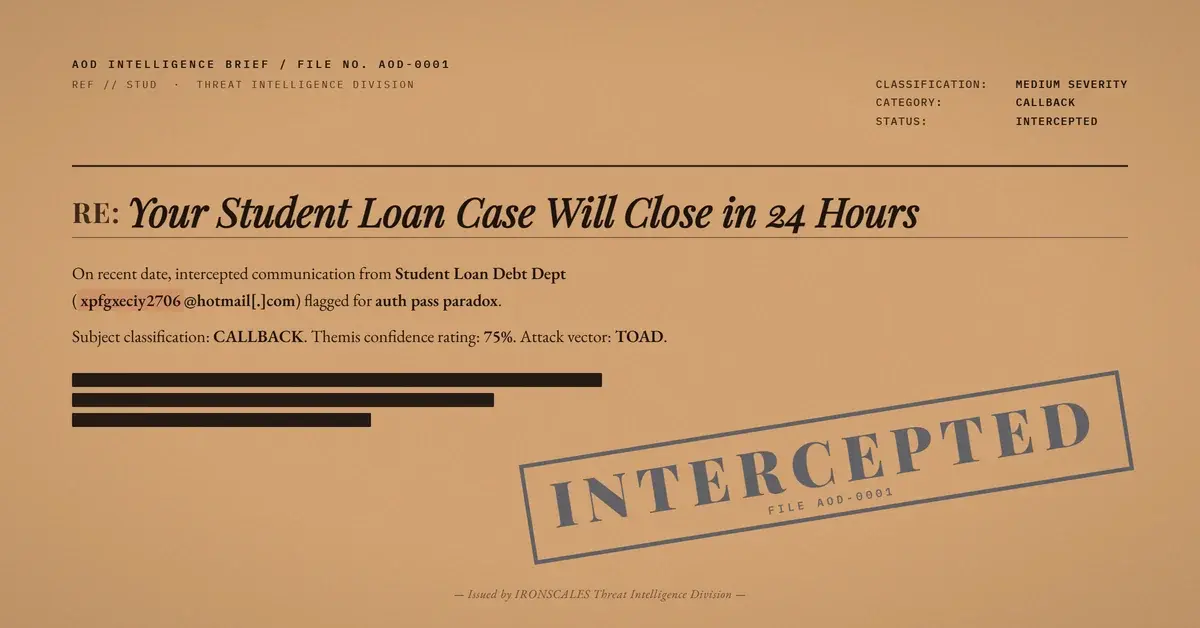
TL;DR A message from a free Hotmail account claimed to represent a Student Loan Debt Department and threatened case closure within 24 hours unless the recipient called a toll-free number. The email carried no links and no attachments, so URL and file scanners had nothing to inspect. SPF, DKIM, and DMARC all passed because the mail genuinely came from Hotmail, but that only proves the mailbox is real, not that any government department stands behind it. The number matched no official Federal Student Aid contact. Themis flagged it at 90 percent as an advance-fee scam.
Severity: Medium Callback Phishing Brand Impersonation Social Engineering MITRE: T1566.004 MITRE: T1598 MITRE: T1684.001
Strip a phishing email of its links and attachments and most gateways lose interest. There is nothing to detonate in a sandbox, no URL to reputation-check, no file hash to match. That is precisely the point of the message that landed in the inbox of a senior marketing executive at a live-auction and collectibles company. It carried no link and no attachment. The entire attack surface was ten digits and a countdown.
The email addressed the recipient by name and claimed to come from a Student Loan Debt Department. It warned that her case would close and her eligibility would be forfeited within 24 hours unless she called 866-249-4080. No form to fill out, no button to click. Just a phone number and a clock.
There is no federal body called the Student Loan Debt Department, and that toll-free number appears in no official Federal Student Aid or U.S. Department of Education contact directory. This was a callback scam, the kind of thing the industry has taken to calling a telephone-oriented attack delivery, and it was built specifically to route around everything a scanner knows how to do.
The Payload You Cannot Scan
Most phishing detection assumes there is something to detect: a credential-harvesting page behind a link, a macro in a document, a redirect chain to trace. This message offered none of that. By moving the malicious action entirely off the wire and onto a voice call, the sender turned the email into little more than a business card. The real attack happens later, on the phone, where the victim is walked through an advance-fee pitch or coaxed into handing over bank details, a Social Security number, or a payment to "reinstate" a loan that never existed.
That design choice is not accidental. It is a deliberate answer to a decade of investment in URL sandboxing and attachment analysis. When the only instruction is "call this number," the content-inspection layer has nothing to bite on, and the message sails through on the strength of a clean technical profile.
Green Lights That Prove Nothing
Here is the part that unsettles people. This message passed authentication cleanly. SPF passed, with the mail arriving from a legitimate Hotmail sending address. DKIM passed, signed by hotmail.com. DMARC passed, aligned to a header From of hotmail.com. ARC passed, and Microsoft's composite authentication logged compauth=pass reason=100. Every light was green.
None of it matters. Those checks confirm that the message genuinely came from a real Hotmail mailbox. They say nothing about whether a government student loan office stands behind that mailbox, because no such relationship exists to validate. Anyone can register a free webmail account in minutes, and that account will authenticate perfectly on the way out the door. As NIST frames it, phishing is about deceiving the recipient into believing a false source, and authentication was never designed to catch a lie told in the display name and the body. A pass here is a statement about infrastructure, not identity.
The display name read as an ordinary personal name, with a random-looking address of xpfgxeciy2706@hotmail[.]com behind it. That mismatch, a supposed government department represented by a consumer webmail account with a machine-generated local part, is the whole tell. A scanner reading only the auth results would never see it.
See Your Risk: Calculate how many threats your SEG is missing
Why the Pressure Works
The 24-hour deadline is doing the heavy lifting. Manufactured urgency is designed to short-circuit the pause where a rational person would ask why the Department of Education is emailing from Hotmail. The 2024 Verizon Data Breach Investigations Report found the human element present in 68 percent of breaches, and it measured the median time to click a phishing link at 21 seconds, with data submitted 28 seconds later. People react fast under pressure, and a threat to close a financial "case" targets exactly the anxiety that produces a fast, unconsidered reaction. The Microsoft Digital Defense Report 2024 documents the same trend toward social-engineering plays that abuse trusted services rather than breaking through technical controls. The FBI's 2023 Internet Crime Report likewise ranks impersonation and advance-fee schemes among the most persistent and costly complaint categories year after year.
Mapping to MITRE ATT&CK
The tradecraft lines up with a short chain in the MITRE ATT&CK framework:
- T1566.004 Spearphishing Voice is the core move: an email whose only purpose is to drive the target to a phone call where the actual attack unfolds.
- T1598 Phishing for Information covers the presumed goal of the call, harvesting financial or personal details under the cover of loan servicing.
- T1684.001 Impersonation covers the invented authority, a fictitious Student Loan Debt Department standing in for a federal agency it has no tie to.
Indicators of Compromise
| Type | Indicator | Context |
|---|
| Email | xpfgxeciy2706@hotmail[.]com | Free webmail sender, personal display name, claims government department affiliation |
| Phone | 866-249-4080 | Callback number, not listed in any official Federal Student Aid contact directory |
| Pretext | "Student Loan Debt Department" | Fictitious authority, no matching U.S. Department of Education or Federal Student Aid body |
Detecting an Attack With Nothing to Scan
The one move you cannot make here is reputation-checking your way out. The infrastructure is a clean, authenticated Hotmail account, and there is no payload to analyze. Detection has to move to intent: a free consumer webmail account claiming to speak for a government program, a hard deadline measured in hours, and a lone phone number as the only call to action. Read together, those three signals describe an attack even when every server-level check comes back clean.
That is the layer static gateways cannot supply. Themis, the Adaptive AI analyst on the IRONSCALES platform, weighs the relationship between the claimed identity, the sender, and the demand the way a trained analyst would, and here it flagged the message at 90 percent confidence as an advance-fee scam. Just as important, the reporting network gives the human element a fast path to flag a suspicious call-me email so the next recipient of the same campaign never has to make the judgment alone.
The Takeaway
The most dangerous phishing email of the day may be the one with nothing in it. No government agency gives you 24 hours to call a Hotmail-hosted "department" or forfeit your eligibility. When the entire message is a phone number and a threat, treat the number as the threat. Verify any debt or eligibility claim through the servicer's official site or a statement you already have, never the contact details the message hands you. CISA's guidance on recognizing and stopping phishing early is a good anchor for that habit: https://www.cisa.gov/resources-tools/resources/phishing-guidance-stopping-attack-cycle-phase-one
Email Attack of the Day is a daily series from
IRONSCALES spotlighting real phishing attacks caught by Adaptive AI and our community of 36,000+ security professionals. Each post breaks down a real attack. What it looked like, why it worked, and what to do about it.







/Blue%20Feature%20Flower%20Icons/gear%20head%20icon.svg)
/Misc%20Icons/icon-nav-credential-theft.svg)










/Leadership%20Headshots/Audian%20Paxson%20Headshot%201000x1000%20032026.webp?width=100&height=100&name=Audian%20Paxson%20Headshot%201000x1000%20032026.webp)



.png?width=50&height=50&name=Untitled%20-%20July%2030%2c%202026%20at%2014.53.38%20(3).png)



/Misc%20Icons/icon-red-teaming-agent-gradient-simple.svg)
/Misc%20Icons/icon-phishing-soc-agent-gradient-simple.webp?width=158&height=167&name=icon-phishing-soc-agent-gradient-simple.webp)
/Misc%20Icons/icon-phishing-simulation-agent-gradient-simple.svg)


/Misc%20Icons/icon-nav-encryption.svg)