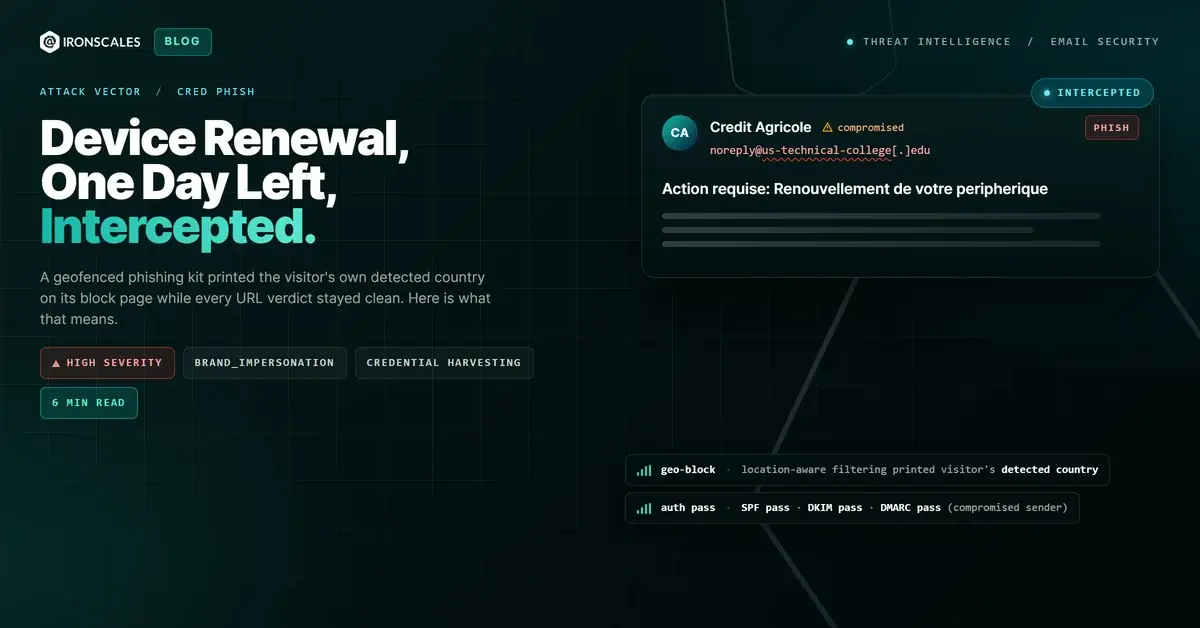
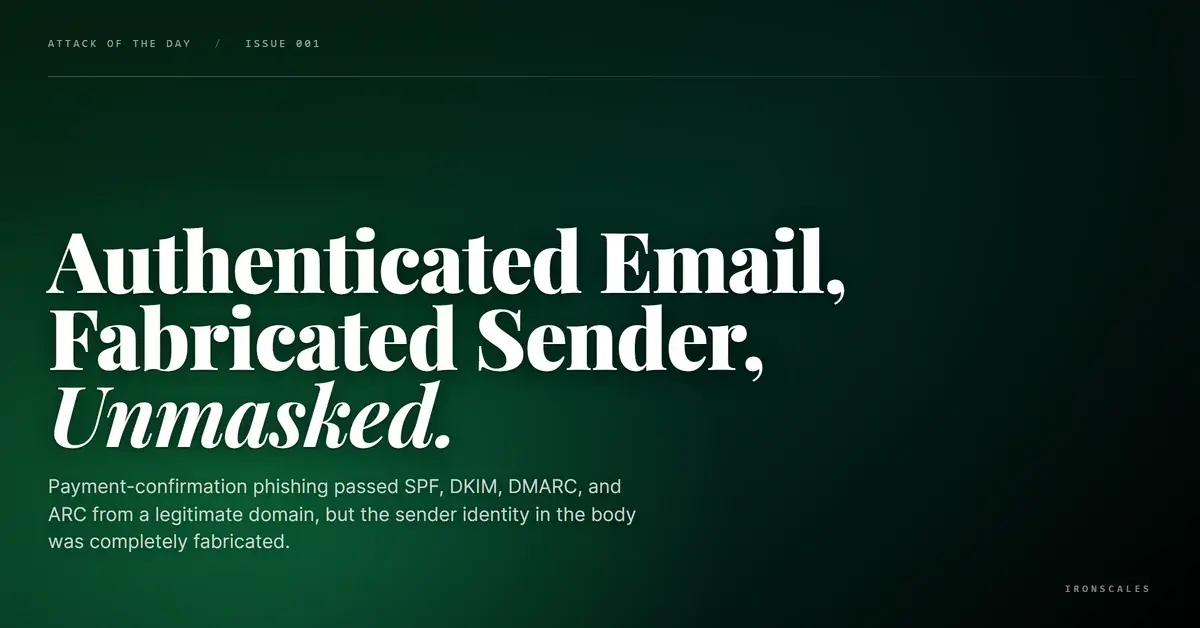
TL;DR A payment-confirmation email reached a chief executive's mailbox after passing every authentication check: SPF, DKIM, DMARC under a p=none policy, and ARC across three relay hops. The message came from a legitimate, long-registered domain, but the signature in the body claimed an unrelated financial company, a fabricated identity layered on top of a trusted sending stream. The single call to action carried a tracking pixel and pointed to a recently registered domain hidden behind an anti-bot checkpoint that blocked automated inspection. IRONSCALES flagged the content anomaly and quarantined the mailbox.
Severity: High Credential Harvesting Business Email Compromise MITRE: T1566.002 MITRE: T1497
Every Authentication Check Passed. The Sender Was Fiction.
A sports-data and betting-technology company received a short payment-confirmation email addressed to its CEO. The message offered a single action: a button labeled "Download Payment Confirmation," referencing a generic confirmation number with no dollar amount attached. Nothing about the headers looked wrong. Everything about the claimed identity was invented.
The email passed Sender Policy Framework (SPF). It passed DomainKeys Identified Mail (DKIM). It passed Domain-based Message Authentication, Reporting and Conformance (DMARC), evaluated to a pass under a p=none policy. It even passed Authenticated Received Chain (ARC), the mechanism that preserves authentication results across forwarding hops, cleanly across three relays: Zoho, Zeptomail, and Google. By every signal a gateway checks at the protocol layer, this was a legitimate message.
It was sent from uburx.com, a real US prescription-discount service registered in 2021. That domain has a genuine history and valid authentication records. The signature in the body, however, claimed the message came from "BILL Financial Holdings, Inc.", a company with no relationship to the sending domain. The authentication stack verified the envelope. It said nothing about the story the body was telling.
Protocol Trust Versus Content Trust
Email authentication answers one question: did this message actually originate from infrastructure authorized to send for the domain in the From header? Here the answer was yes. The sending path was authorized for uburx.com, DKIM signed with d=uburx.com, and DMARC aligned. The problem is that none of those checks read the body.
This is the difference between protocol trust and content trust. SPF, DKIM, DMARC, and ARC establish that a domain vouched for the transport of a message. They do not establish that the claimed sender identity, the branding, or the intent inside the message is real. An authenticated email service provider (ESP) stream was abused at the content layer rather than spoofed at the protocol layer. The attacker did not need to forge a header or crack a mail server's keys. They needed a trusted, authenticated sending stream and the freedom to write whatever identity they wanted into the visible content.
That freedom is what produced a message signed "BILL Financial Holdings, Inc." arriving under full authentication for an unrelated prescription-discount domain. To a busy executive, the signature and the payment framing are the message. The header alignment is something they will never see.
The Payload Behind an Anti-Bot Wall
The single call to action, "Download Payment Confirmation," did two things. First, it embedded a 1x1 tracking pixel, a one-pixel transparent image that silently reports back when the email is opened, confirming the mailbox is live and monitored. For an attacker working a named CEO, that confirmation alone has value.
Second, the link resolved through a Canonical Name (CNAME) DNS record to a domain registered recently behind privacy-protected WHOIS. When IRONSCALES attempted to fetch the destination for analysis, the anti-bot gate blocked our own automated investigation. The endpoint sat behind a Vercel anti-bot checkpoint that returned an HTTP 404 with the message "Failed to verify your browser."
That is a factual observation about scanner-blocking behavior, and it is worth stating precisely. The checkpoint prevented automated inspection of the page. It does not, on its own, prove that a human visitor was served a working credential-harvesting page, because no human-view artifact was captured. What it does demonstrate is that the destination was configured to resist automated analysis, a property that frustrates the reputation and detonation checks many security tools rely on.
Mapping the Technique
The delivery maps to MITRE ATT&CK T1566.002, Phishing: Spearphishing Link. The payload was a single link, the lure was a payment confirmation, and the target was a specific high-value individual rather than a broad list.
The destination's behavior maps to T1497, Virtualization/Sandbox Evasion. Environments that block automated browsers and scanners while remaining reachable to ordinary users are a documented evasion pattern. An anti-bot checkpoint that rejects an investigation fetch is a lightweight version of the same idea: keep automated analysis out.
The targeting is the through-line. Themis, the Adaptive AI analyst inside IRONSCALES, scored this message at 88% confidence and applied two labels: Credential Theft and VIP Recipient. The recipient was the chief executive, and the payload and pretext were consistent with credential harvesting. According to the 2024 Verizon Data Breach Investigations Report, phishing was present in 15% of breaches and the human element in 68%, and the same report found a median time of just 21 seconds for a user to fall for a phishing email and 28 seconds to submit data. A payment-confirmation prompt to a CEO is engineered for exactly that window.
What Authentication Could Not See
Every protocol-layer check passed, so a gateway tuned to authentication results had no reason to act. This is the gap the Verizon report and the Microsoft Digital Defense Report 2024 both describe: attackers increasingly send from legitimate, authenticated infrastructure precisely because reputation and authentication checks go quiet when the sending domain is real.
See Your Risk: Calculate how many threats your SEG is missing
IRONSCALES Adaptive AI flagged this message on signals that authentication cannot evaluate: the mismatch between the authenticated sending domain and the fabricated identity in the body signature, the tracking pixel on the sole call to action, the freshly registered privacy-shielded destination behind a CNAME, and the fact that the recipient was a named executive. The mailbox was quarantined. Detection here was not a matter of a better blocklist. It was a matter of reading the content and the behavior, not just the envelope.
Reading Authentication as a Claim, Not a Verdict
For security teams, the lesson is to treat authentication as one input, not a verdict. A full SPF, DKIM, DMARC, and ARC pass tells you a domain vouched for transport. It does not tell you the identity in the body is real, and it does not tell you where a link leads.
Practical steps that would have surfaced this message:
- Compare the authenticated sending domain against the identity claimed in the signature and branding. A body signed for one company arriving under authentication for an unrelated domain is a content-layer anomaly worth flagging. This comparison sits at the heart of credential-harvesting protection and business email compromise protection, because both depend on reading identity, not just transport.
- Weight messages to executives and finance approvers higher. VIP targeting plus a payment pretext is a recognized business email compromise (BEC) pattern. The FBI IC3 2023 Annual Report attributed roughly $2.9 billion in reported losses to BEC that year.
- Treat a destination that blocks automated inspection as suspicious by default. CISA's phishing guidance recommends layered verification rather than trusting any single signal.
- Flag tracking pixels on transactional-looking mail. A one-pixel beacon on a payment confirmation is a reconnaissance signal, not a feature.
The takeaway is not that authentication is broken. It is that authentication proves a narrow claim, and attackers have learned to satisfy that claim while lying about everything the claim does not cover.
Indicators of Compromise
| Type | Indicator | Context |
|---|
| Sending domain | uburx.com | Legitimate US prescription-discount service (registered 2021), authenticated sending domain abused at the content layer; not malicious infrastructure |
| Domain | b.geldstucks[.]com | Attacker-associated infrastructure linked to the payload path |
| Host | cluster99.email-view[.]ca | Attacker-associated infrastructure |
| IP | 199.67.85[.]65 | Attacker-associated address |
| Body signature | "BILL Financial Holdings, Inc." | Fabricated sender identity in the message body, unrelated to the authenticated sending domain |
| Relay path | Zoho -> Zeptomail -> Google | ARC-preserved relay chain; authentication passed across all hops |
| Payload behavior | Vercel anti-bot checkpoint (HTTP 404, "Failed to verify your browser") | Destination blocked automated fetch; CTA carried a 1x1 tracking pixel |
Email Attack of the Day is a daily series from
IRONSCALES spotlighting real phishing attacks caught by Adaptive AI and our community of 36,000+ security professionals. Each post breaks down a real attack. What it looked like, why it worked, and what to do about it.







/Blue%20Feature%20Flower%20Icons/gear%20head%20icon.svg)
/Misc%20Icons/icon-nav-credential-theft.svg)










/Leadership%20Headshots/Audian%20Paxson%20Headshot%201000x1000%20032026.webp?width=100&height=100&name=Audian%20Paxson%20Headshot%201000x1000%20032026.webp)



.png?width=50&height=50&name=Untitled%20-%20July%2030%2c%202026%20at%2014.53.38%20(3).png)



/Misc%20Icons/icon-red-teaming-agent-gradient-simple.svg)
/Misc%20Icons/icon-phishing-soc-agent-gradient-simple.webp?width=158&height=167&name=icon-phishing-soc-agent-gradient-simple.webp)
/Misc%20Icons/icon-phishing-simulation-agent-gradient-simple.svg)


/Misc%20Icons/icon-nav-encryption.svg)