Part 1 of a 4-Part Series: The SEG Breakup Guide for MSPs
Something changed this year.
It might have happened at that partner event in January when you caught yourself comparing notes with another MSP owner. They weren't complaining about their email security. At all. Instead, they were talking about expansion plans and new service tiers and actually having time to focus on business development.
Or it was during that client call two weeks ago when you had to explain why another sophisticated phishing email made it through your defenses. Again. The client was polite about it, but you could hear the question they weren't asking: "Aren't you supposed to be preventing this?"
Or it was last weekend when you spent four hours updating SEG rules and clearing quarantine queues instead of doing literally anything else with your Sunday afternoon.
Whatever the moment was, you felt it. That quiet realization that you've been making excuses for technology that stopped pulling its weight years ago.
And now you can't unsee it.
The Excuses We've Been Making
"Every email security solution has limitations."
True. But there's a difference between reasonable limitations and fundamental architectural problems that leave your clients exposed to the majority of modern phishing attacks.
"We've always used this vendor."
Also true. And there was a time when that loyalty made sense. But technology relationships aren't marriages. They're business partnerships. And when your partner stops delivering value, staying out of habit isn't loyalty. It's inertia.
"Migration would be disruptive."
Possibly. But you know what's actually disruptive? Client breaches. Emergency incident response calls. Explaining to your most important account why that vendor impersonation email requesting a $60,000 wire transfer sailed right through your security stack.
We tell ourselves these things because change is uncomfortable. Because we've invested time learning our current platform. Because "good enough" feels safer than "significantly better but requires effort."
But this year feels different because the gap between "good enough" and "what clients actually need" is getting harder to ignore.
How We Got Here: A Brief History
The Antivirus Era: When Simple Actually Worked
Back in the early days, email security was simple. Viruses came in obvious attachments. Spam looked like spam. Antivirus plus basic filtering stopped most attacks. For MSPs, this was low-maintenance. Deploy it, forget it, move on.
The problem? Attackers evolved. Defenders didn't. What worked against mass-distributed malware and Nigerian prince scams fell apart when threats became more sophisticated and targeted.
The SEG Revolution: The Right Answer for the Wrong Decade
When threats grew more sophisticated in the early 2000s, Secure Email Gateways emerged as the answer. They sat at the perimeter, filtering everything before it reached inboxes using reputation scoring, signature matching, and policy enforcement. For a while, this worked. SEGs caught what antivirus missed. They gave administrators control. MSPs built entire service offerings around SEG deployment and management.
But the threat landscape kept evolving while SEG technology stayed fundamentally the same. Attackers stopped using obvious malicious payloads and weaponized trust through impersonation. They crafted socially engineered attacks that passed every technical check SEGs perform. They started using AI to generate convincing phishing content at scale. SEGs, built on static rules and signature-based detection, couldn't adapt fast enough.
The Cloud Migration: When "Included" Became a Liability
Then businesses migrated to Microsoft 365 and Google Workspace with built-in security features. Many assumed this meant they were covered. Why pay extra for email security when it's included with the productivity suite? MSPs found themselves explaining why native security wasn't enough, why you needed layers.
But here's the uncomfortable truth: a lot of MSPs didn't upgrade their own recommendations. They kept deploying the same SEGs they'd been using for years, even as those SEGs struggled against modern threats. The gap between "protected" and "actually secure" kept growing.
Where We Are Now: The ICES Era
The MSPs who aren't stuck in the same operational cycle have moved to something fundamentally different. Integrated Cloud Email Security platforms work inside M365 and Google Workspace environments, not at the perimeter. These solutions use behavioral analysis instead of just signature matching. They learn communication patterns and spot anomalies. They remediate threats automatically across all mailboxes. They integrate natively with cloud platforms through APIs instead of requiring MX record changes.
They represent a different architectural approach built for how attacks actually work now, not how they worked in 2008. And the MSPs deploying these solutions are seeing operational benefits beyond just better threat detection: reduced manual workload, faster incident response, better client retention, competitive differentiation in new business situations.
Why This Year Is Different
You've probably suspected for a while that your SEG wasn't keeping up. You've ignored it because you were busy. You've rationalized it by telling yourself every solution has gaps. You've just been hoping the next vendor update would fix things.
But something shifted this year.
It's because you're seeing actual data on what SEGs are missing and realizing the gap is bigger than you thought.
It's because you're tired of explaining security failures to clients who trust you to make good technology decisions.
It's because you looked at your operational overhead and realized how much time your team spends managing a security solution that's supposed to be making their lives easier.
Or it's just because you're ready to stop making excuses for technology that isn't earning its place in your service stack anymore.
Whatever the reason, you're here. You're reading this. You're acknowledging that what you have isn't working the way it needs to work.
That's the first step toward actually changing something.
The Breakup Process
We chose the breakup theme for this series deliberately. Your relationship with your email security vendor follows the same patterns as any relationship that's run its course.
There's the honeymoon phase when everything seems great. Then the slow accumulation of small frustrations. Then the moment you start wondering if other options might be better. Then the rationalization and excuse-making to avoid dealing with change. Then the breaking point when you finally admit it's not working.
A lot of MSPs are somewhere between the rationalization stage and the breaking point right now. They know their SEG isn't performing. They know they should evaluate alternatives. But they're stuck in the comfort of familiarity, even when that familiarity is increasingly uncomfortable.
What's Coming Next
Over the next three weeks leading up to Valentine's Day, we're going to lay out the full case for why it's time to upgrade your email security stack.
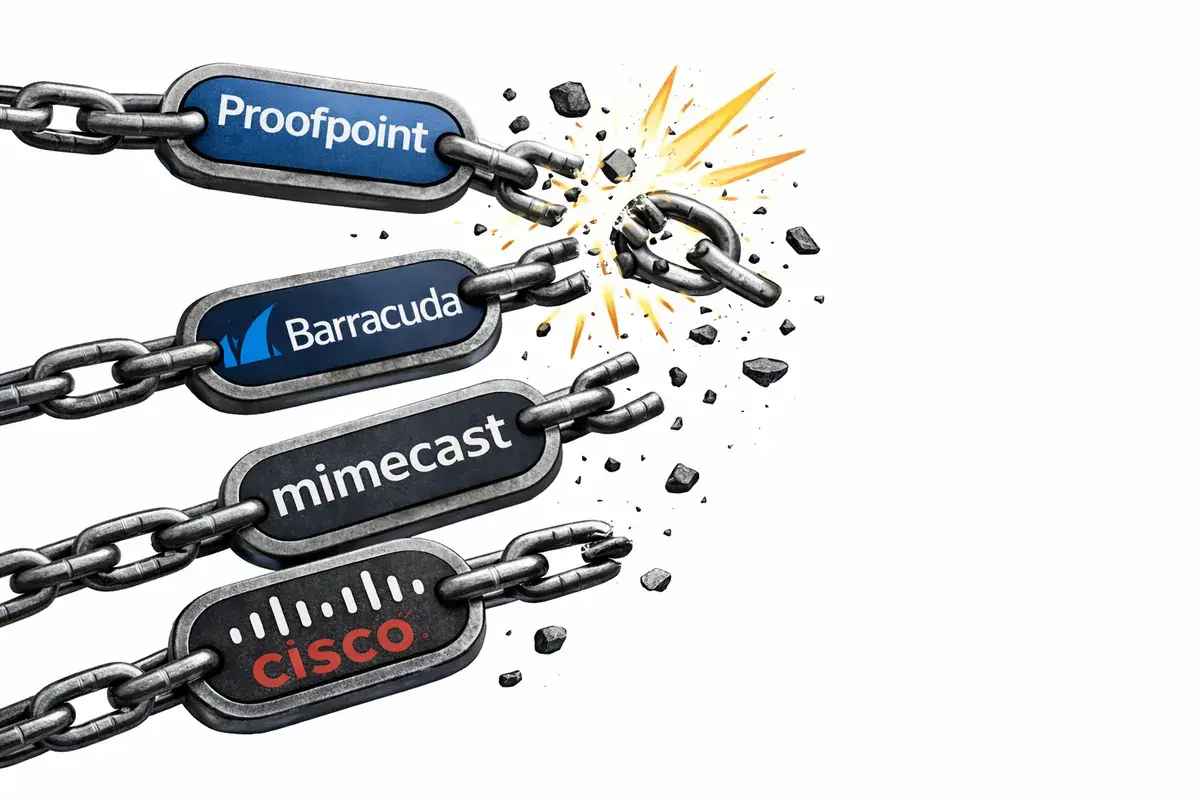
Next, we'll show you the data. Not vague claims, but actual research from analyzing nearly 2,000 organizations using traditional SEGs. You'll see exactly how many phishing emails are bypassing these solutions monthly. You'll see which types of attacks are getting through. You'll see vendor-specific performance data.
Soon to come, we'll talk about what this is costing your MSP. Not just the vendor invoice, but the operational overhead, the client retention risk, the competitive disadvantage, and the margin compression that comes from running a security stack that creates more work than it prevents.
After Valentine's Day, we'll give you a practical framework for evaluating modern alternatives. What to look for in email security solutions built for MSPs. What questions to ask vendors. How to plan migration without disrupting client operations.
By the end of this series, you'll have everything you need to make an informed decision about whether your current email security relationship is worth maintaining.
You Deserve Better
Here's what this really comes down to: you built your MSP by making smart technology decisions that deliver value to your clients. You chose tools that work. You invested in platforms that scale. You deprecated solutions that stopped earning their place in your stack.
Your email security should be held to the same standard.
If your SEG is creating operational overhead instead of reducing it, if it's missing the majority of sophisticated phishing attacks, if it's putting you at a competitive disadvantage, then it's not earning its place anymore.
You deserve technology partners who make your business better, not harder. Your clients deserve protection that actually works against modern threats. Your team deserves tools that let them focus on strategic work instead of constant firefighting.
This isn't about being disloyal to vendors or making impulsive changes. It's about making informed business decisions based on current data and operational reality.
The MSPs who are thriving right now aren't the ones making excuses for legacy technology. They're the ones who made the decision to upgrade and are reaping the operational and competitive benefits.
You can make that same decision.
Want to see where this is going? Download the complete SEG Breakup Guide
Curious about modern email security? Take a self-guided product tour
Ready to talk it through? Speak with one of our MSP experts today





/Blue%20Feature%20Flower%20Icons/gear%20head%20icon.svg)
/Misc%20Icons/icon-nav-credential-theft.svg)











.png?width=50&height=50&name=Untitled%20-%20July%2030%2c%202026%20at%2014.53.38%20(3).png)



/Misc%20Icons/icon-red-teaming-agent-gradient-simple.svg)
/Misc%20Icons/icon-phishing-soc-agent-gradient-simple.webp?width=158&height=167&name=icon-phishing-soc-agent-gradient-simple.webp)
/Misc%20Icons/icon-phishing-simulation-agent-gradient-simple.svg)


/Misc%20Icons/icon-nav-encryption.svg)
/Leadership%20Headshots/Audian%20Paxson%20Headshot%201000x1000%20032026.webp?width=100&height=100&name=Audian%20Paxson%20Headshot%201000x1000%20032026.webp)