.png?width=50&height=50&name=Untitled%20-%20July%2030%2c%202026%20at%2014.53.38%20(3).png)








/Misc%20Icons/icon-red-teaming-agent-gradient-simple.svg)
/Misc%20Icons/icon-phishing-soc-agent-gradient-simple.webp?width=158&height=167&name=icon-phishing-soc-agent-gradient-simple.webp)
/Misc%20Icons/icon-phishing-simulation-agent-gradient-simple.svg)


/Misc%20Icons/icon-nav-encryption.svg)


/Blue%20Feature%20Flower%20Icons/gear%20head%20icon.svg)
/Misc%20Icons/icon-nav-credential-theft.svg)










Text Salting Explained
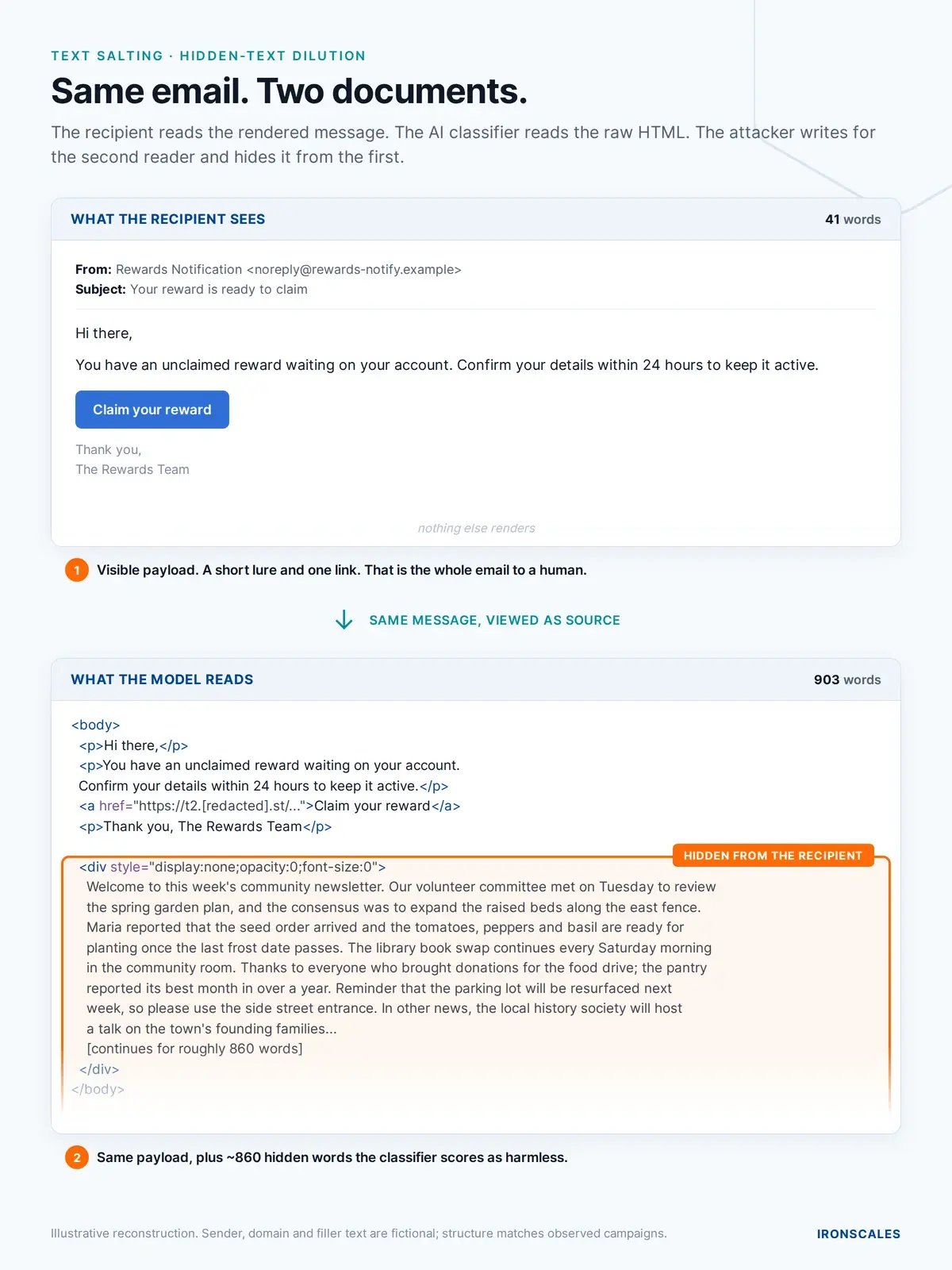
Text salting is an email evasion technique in which an attacker hides a large block of unrelated, harmless text inside a phishing email's HTML so that automated filters read a different document than the recipient sees. The hidden block is wrapped in CSS that prevents it from rendering in any mail client. The recipient sees a short lure and a link. The filter sees the lure plus several hundred words of newsletter copy or chat transcript.
Cisco Talos named the technique hidden text salting in January 2025, documenting its use against keyword, brand-name, and language detection. By 2026 the same mechanics were aimed at the language models that score email intent. The technique is also called CSS evasion or hidden-text dilution and falls under MITRE ATT&CK T1027, Obfuscated Files or Information, applied to the delivery stage of spearphishing links.
How Text Salting Works
- Two readers, two documents. A human reads the rendered email. A large language model or NLP classifier reads the raw HTML text. Text salting exploits the gap between them.
- The payload stays visible. The lure and the link sit in normal text, typically forty words or fewer.
- The filler is hidden. A block of one hundred to several thousand benign words is appended next to the payload and concealed with hard-hiding CSS:
display:none,opacity:0,font-size:0, or positioning far outside the viewport. - The score drops. Against a keyword engine, the filler breaks phrase and brand matching. Against a classifier, the benign volume dilutes the threat score below the flagging threshold.
Text Salting in Current Campaigns
IRONSCALES Research reviewed six months of evasive phishing, the hard cases closed out by user report or analyst review, and found the hidden-text block in roughly 7% of them. Its share grew from about 1% in December 2025 to 11% in June 2026, while the false-positive rate on the pattern stayed flat and near zero.
In 84% of those emails the hidden text traveled with a second evasion: a cloaking redirector that returns a harmless decoy such as a news site to automated scanners and the real destination to people. Two unrelated evasions co-occurring at that rate points to a single toolchain producing both, the way a phishing kit bundles its parts. The observed payloads were fake reward funnels, survey and subscription traps, and credential harvesting pages. The full analysis is in Text Salting: Why Hidden-Text Phishing Grew 9x in Six Months.
Detecting Text Salting
Legitimate email hides text all the time. Preheader preview lines, dark-mode duplicate copies, threading tokens, tracking beacons, and the CSS that collapses a footer on mobile are all hidden text. Flagging hidden text as malicious would bury a SOC in false positives.
The detectable signal is structural. Attack hidden text is bulky (a hundred words or more), contains no links, appears nowhere in the visible message, sits adjacent to the visible payload, and uses at least one hard-hiding technique that renders it invisible in every client. Legitimate hidden text is short or duplicates something already visible, and often uses soft hides (tiny fonts, matching colors) that some clients still render. A detector that separates what renders from what is concealed, then flags a large, foreign, hard-hidden block, catches the campaign without drowning in noise. Any product whose behavioral AI analysis scores the full message text has this exposure, so the check has to be a separate structural step.
Text Salting vs. Related Techniques
Text salting is often confused with prompt injection, which hides instructions for an AI assistant. Salting hides filler to change a score; injection hides commands to change behavior. It also differs from HTML smuggling, which hides a payload for the browser to assemble, and from sandbox evasion, which targets detonation environments rather than content scoring.
Frequently Asked Questions About Text Salting
What is text salting in email security? Text salting hides a large block of unrelated text inside an email's HTML so automated filters process content the recipient never sees. Attackers use it to break keyword matching and to dilute the threat score an AI classifier assigns to a phishing lure.
Why is it called text salting? The name borrows from cryptographic salting, where random data is added to an input to change its output. Cisco Talos applied the term to email in January 2025 to describe attackers seasoning a message with irrelevant hidden text to change how detection engines parse it.
How does text salting evade AI email filters? Classifiers score the raw content of an email; a person reads only the rendered version. Text salting appends hundreds of hidden, benign words next to a short lure, so the model sees a mostly harmless document and returns a lower threat score.
Is text salting the same as prompt injection? No. Prompt injection hides instructions intended to change what an AI assistant does, for example a summarizer that produces a fake security warning. Text salting hides filler intended to change what a classifier concludes about the message. One manipulates behavior; the other manipulates a score.
How is text salting detected? Attack hidden text is bulky (a hundred words or more), contains no links, appears nowhere in the visible body, sits next to the visible payload, and uses a hard-hiding technique. A detector that compares rendered text to concealed text and flags that combination catches the pattern with a false-positive rate near zero.
How common is text salting? IRONSCALES Research found the technique in about 7% of evasive phishing emails (confirmed phish closed out by user report or analyst review) over the six months ending June 2026, with its share growing from about 1% in December 2025 to 11% in June 2026. In 84% of those emails it was paired with a cloaking redirect that shows scanners a decoy destination.
Related Terms
- Prompt Injection
- Phishing Kit
- HTML Smuggling
- Sandbox Evasion
- Large Language Model
- Credential Harvesting
Explore More Articles
Say goodbye to Phishing, BEC, and QR code attacks. Our Adaptive AI automatically learns and evolves to keep your employees safe from email attacks.