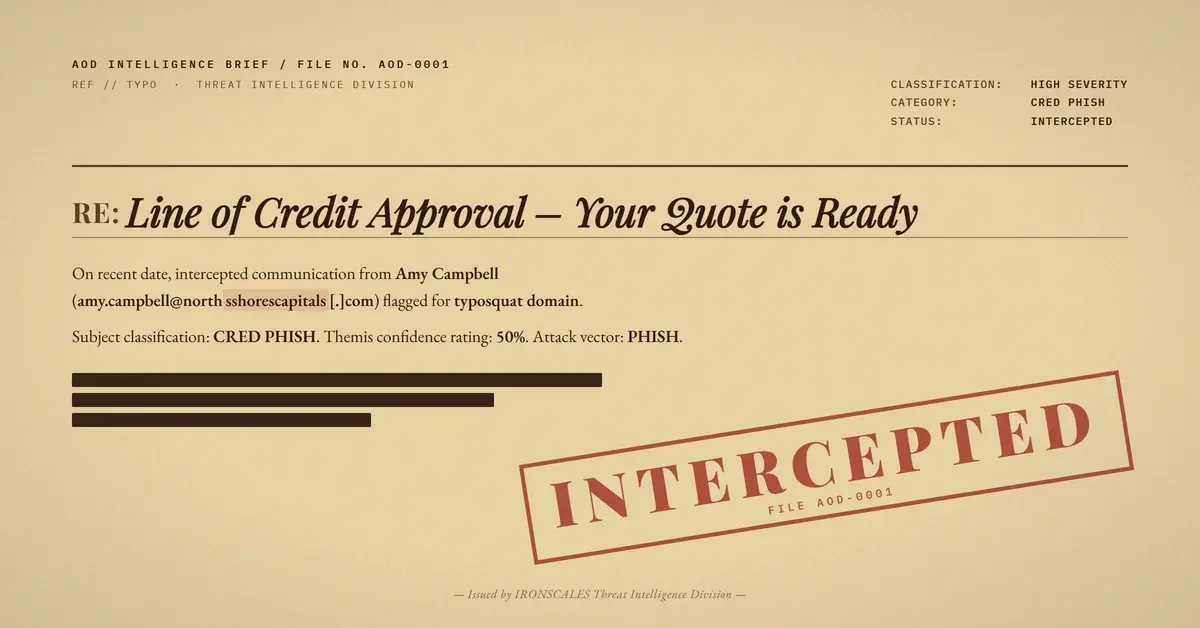
TL;DR The attacker registered a domain one character off from a legitimate commercial lender (extra 's' in the company name), configured it as a sending identity in Salesforce Marketing Cloud (ExactTarget), and sent a personalized line-of-credit approval email. SPF passed for the typosquat domain. DKIM passed with a valid signature aligned to the typosquat domain. DMARC passed. CompAuth returned reason=100. Microsoft scored it SCL=9 with SFTY:9.25, flagging it as high-confidence spam, but authentication alone provided no grounds for rejection. Pardot tracking links (go[.]pardot[.]com) redirected to the real lender's website, and display text in the email showed the legitimate domain. The reply-to address pointed back to the typosquat domain. Themis flagged the recipient as a VIP at 50% confidence.
Severity: High Credential Harvesting Brand Impersonation MITRE: {'id': 'T1566.002', 'name': 'Phishing: Spearphishing Link'} MITRE: {'id': 'T1036.005', 'name': 'Masquerading: Match Legitimate Name or Location'} MITRE: {'id': 'T1583.001', 'name': 'Acquire Infrastructure: Domains'}
A line-of-credit approval email arrived at a mid-size industrial company. The subject referenced a specific LOC approval. The sender's display name matched a known sales representative at a commercial lending firm, and the from address looked right at a glance. It was not right. The domain contained one extra letter, an additional "s" buried in the middle of the company name. That single character was the entire attack.
Full Authentication on a Fake Domain
The typosquat domain was registered and configured as a sending identity in Salesforce Marketing Cloud (ExactTarget). The message was transmitted through akz220[.]mta[.]exacttarget[.]com at IP 128[.]245[.]247[.]220. SPF passed. DKIM passed with a signature aligned to the typosquat domain. DMARC passed. CompAuth returned reason=100, the highest confidence score.
Microsoft's own heuristics scored the message SCL=9 with a safety tip of SFTY:9.25, flagging it as high-confidence spam. But authentication told the opposite story. Every protocol designed to verify sender legitimacy confirmed the message was authorized. The contradiction highlights a persistent gap: authentication validates that a domain authorized a message, not that the domain itself is trustworthy.
Pardot Links That Pointed to the Real Site
The email contained Pardot tracking links routed through go[.]pardot[.]com, a Salesforce-owned domain. Those links redirected to the legitimate lender's website at a /quote/ path. The display text in the email showed the real company's domain. A recipient checking the visible link text would see the correct URL. Only inspection of the underlying HTML would reveal the Pardot redirect chain originating from the typosquat domain's marketing instance.
This is a deliberate layering technique. The attacker did not need a fake landing page. The goal was to establish credibility through a real destination while routing the initial engagement (clicks, opens, reply) through infrastructure tied to the typosquat domain. The reply-to address pointed to the same typosquat domain, meaning any response would go directly to the attacker.
See Your Risk: Calculate how many threats your SEG is missing
What Behavioral Detection Sees
Themis flagged the recipient as a VIP and scored the message at 50% confidence. Four mailboxes were quarantined. The signals that triggered detection were not authentication failures (there were none) but behavioral indicators: a first-time sender using a domain visually similar to a known vendor, combined with a financial action request directed at a high-value recipient.
The attacker did everything right from an authentication standpoint. The domain was properly configured. The ESP was legitimate. The DKIM signature was valid. The links pointed to real infrastructure. What the attacker could not fake was the relationship history between the sender and the recipient's organization, the kind of context that only emerges from longitudinal mailbox-level analysis.
What to Watch For
When a financial action request arrives from a first-time sender with full authentication pass, inspect the domain character by character. Verify that the sending domain matches your known vendor list and that reply-to addresses resolve to the same domain on file, not a near-identical variant.
Indicators of Compromise
| Type | Indicator | Context |
|---|
| Typosquat Domain | northsshorescapitals[.]com | One extra "s" in company name |
| Legitimate Domain | northshorescapital[.]com | Real commercial lender |
| Sender Email | amy.campbell@northsshorescapitals[.]com | From address on typosquat domain |
| Reply-To | amy.campbell@northsshorescapitals[.]com | Reply-to on typosquat domain |
| ESP Relay | akz220[.]mta[.]exacttarget[.]com | Salesforce Marketing Cloud MTA |
| Sending IP | 128[.]245[.]247[.]220 | ExactTarget sending IP |
| Tracking Domain | go[.]pardot[.]com | Pardot tracking redirect |
| Redirect Target | northshorescapital[.]com/quote/ | Legitimate lender's quote page |
MITRE ATT&CK Mapping
| Technique | ID | Relevance |
|---|
| Phishing: Spearphishing Link | T1566.002 | Pardot tracking links to legitimate site as credibility layer |
| Masquerading: Match Legitimate Name or Location | T1036.005 | Display name impersonation of known sales representative |
| Acquire Infrastructure: Domains | T1583.001 | Purpose-registered typosquat domain with ESP integration |
Email Attack of the Day is a daily series from
IRONSCALES spotlighting real phishing attacks caught by Adaptive AI and our community of 36,000+ security professionals. Each post breaks down a real attack. What it looked like, why it worked, and what to do about it.







/Blue%20Feature%20Flower%20Icons/gear%20head%20icon.svg)
/Misc%20Icons/icon-nav-credential-theft.svg)










/Leadership%20Headshots/Audian%20Paxson%20Headshot%201000x1000%20032026.webp?width=100&height=100&name=Audian%20Paxson%20Headshot%201000x1000%20032026.webp)



.png?width=50&height=50&name=Untitled%20-%20July%2030%2c%202026%20at%2014.53.38%20(3).png)



/Misc%20Icons/icon-red-teaming-agent-gradient-simple.svg)
/Misc%20Icons/icon-phishing-soc-agent-gradient-simple.webp?width=158&height=167&name=icon-phishing-soc-agent-gradient-simple.webp)
/Misc%20Icons/icon-phishing-simulation-agent-gradient-simple.svg)


/Misc%20Icons/icon-nav-encryption.svg)