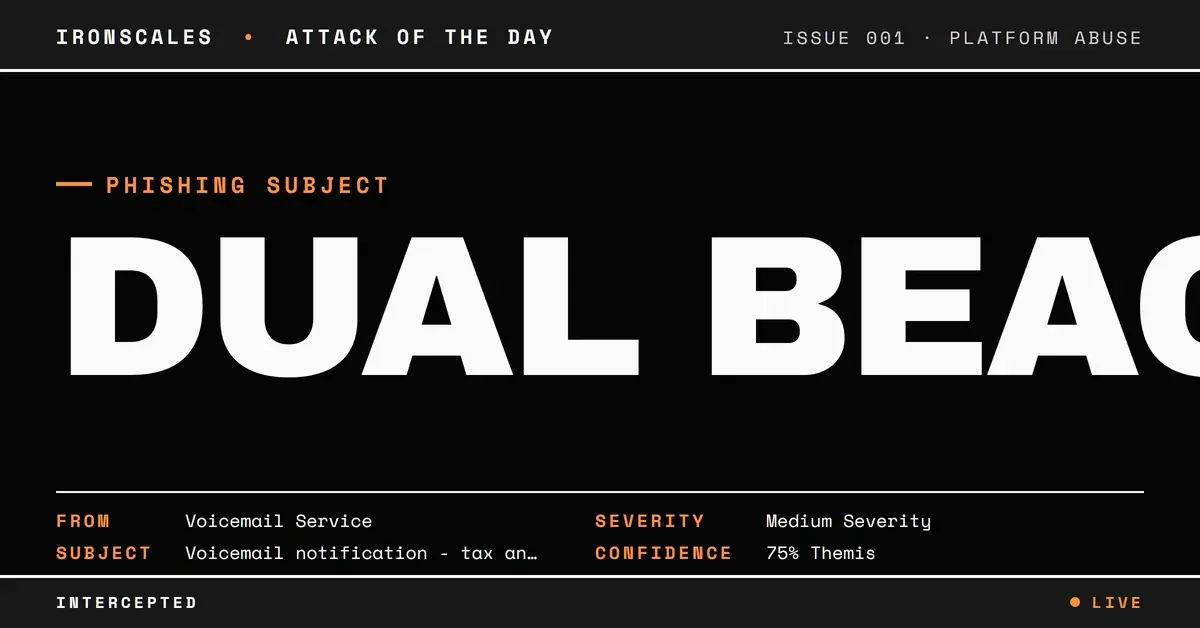
TL;DR A voicemail-pretext message delivered an 847-byte attachment named with a doubled mp3 suffix and declared as audio. The bytes were an HTML document holding two one-pixel image references, both aimed at the same provider open-tracking endpoint. That token differed from the one-pixel beacon already in the message body, so the attachment was a second and independent open-confirmation instrument rather than a payload or a decoy. Two fragments of genuine MPEG header data were appended but corrupted in transit, so the file could never play. Every automated layer scored the message legitimate; a human analyst overrode all of it.
Severity: Medium Phishing Platform Abuse MITRE: T1566.002 MITRE: T1598
Attachment triage runs on a binary. Either a file carries something that executes, or it is an empty prop whose job is to make someone click the link instead. On September 4, 2026, a business voice and unified-communications platform operator received a third kind of file. It was 847 bytes, named with a Voicemail_ prefix, ten digits and a doubled .mp3.mp3 suffix, and declared as audio/mpeg. It carried no script, no form, no macro, no executable content and nothing the recipient could click. The platform logged its verdict as Clean, which was accurate and also beside the point. The file was an instrument, and its entire function was to fire an open-confirmation request from inside the attachment.
The 847 Bytes, Read Byte by Byte
The delivered bytes start with an opening HTML document tag. There is no audio container header at the top of the file and no metadata tag block. What a parser gets is a minimal HTML document holding two image references, each declaring itself one pixel wide and one pixel tall. One sits in a legacy-client conditional block; the other is suppressed with a display-none style. Both point at the same remote URL, extracted verbatim from the decoded bytes: a 256-character token on an open-tracking endpoint belonging to a mainstream email service provider, whose path segment for that function is /tr/op/.
That is the whole file. Rendering it produces nothing a human can see and exactly one outbound request. No scanner reasoning is logged in the record, so the rest is inference: a format-aware analyzer looked for executable content and found none, correctly, because there was none to find.
Why the Audio Was Never the Point
Appended after the HTML are two genuine MPEG-1 Layer III frame headers, at offsets 671 and 805. Decoded field by field they resolve to MPEG-1, Layer III, no CRC, 128 kbps, 44.1 kHz, mono, which computes to a 417-byte frame length for each. Neither has 417 bytes available: the first has 134 before the next sync, the second has 42 before the end of the file.
Two details settle the question. The region carries the Xing-style header frame and the encoder string of a real libavformat encode, so these bytes were lifted from an actual encoded file rather than typed. And inside that header table, an apostrophe byte appears as a five-character HTML entity and a greater-than byte as another, which is what happens when binary data is pasted through an HTML templating path. That escaping corrupts the table, so the file could never play. A deliberate dual-format construction would not corrupt its own binary half; this reads as header bytes pasted in by sloppy tooling to make a filename look honest. The classification as audio came from metadata alone: a content-based type identifier returns unclassified binary data for these bytes, because the file opens with markup. The declared type and the doubled suffix were attacker-supplied text, and they were all the label needed.
See Your Risk: Calculate how many threats your SEG is missing
Two Tokens, Not One
The message body already carried its own one-pixel beacon on the same provider tracking host. The load-bearing fact is that the two tokens differ. The attachment's two image references share one identical 256-character token; the body pixel carries a different one. These are two distinct, independent open-confirmation channels in a single message, and they report separately.
That redundancy is the design: an organization that strips remote body images has closed one channel and left the other open, because the second lives inside a file whose verdict is Clean and whose declared type invites a media player rather than a renderer.
The Arrangement Everything Nearby Gets Backwards
We have covered adjacent cases repeatedly, and every one is the mirror image of this. The usual pattern is a claimed attachment that never arrives, with a tracking pixel delivered in its place: attachment absent, beacon in the body. Here the attachment is present and is itself the beacon carrier. The zero-byte-attachment cases invert it differently, with an inert file whose purpose is to push the recipient toward a link while the tracking rides the links. Location is the whole difference, and location is what attachment triage does not ask about.
The rest of the message was scenery built to justify the file: a claim that a named caller had left a voicemail about a tax and returns meeting, a first-name greeting, and a fabricated voicemail-to-text transcript block. The real call to action was a 120-pixel inline QR image the extractor never read, logging an empty QR list. Decoded independently, it resolved to a gate path on an established third-party domain, with the recipient's own mailbox in the URL fragment so the landing page would know who arrived. A text fallback link existed, but the recipient organization's own inbound link-rewriting service had rewritten it, so its destination is unrecoverable.
Every Automated Layer Said Legitimate
The sending domain is a long-established French business domain relaying through a mainstream email service provider, so the message authenticated cleanly at the recipient's own inbound gateway: reverse DNS, SPF, DKIM and DMARC all passed. A DKIM failure logged at the downstream cloud hop two seconds later is recipient-side, caused by the organization's own relay chain modifying the body after that pass, and is not attacker behavior. Upstream anti-spam scored it legitimate at a zero spam score, the attachment verdict was Clean, the link verdict was clean, and it reached the inbox anyway.
There is no phishing score to report. The automated analyst produced a spam recommendation, its reasoning describing promotional language and mass-mailing patterns. Every machine in the path called this routine bulk mail. The detection was a person at the organization marking the incident malicious, which is the human layer doing work our Adaptive AI exists to amplify rather than replace. No mitigation was applied to either affected mailbox. The 2026 Verizon Data Breach Investigations Report puts the human element in 62% of breaches and phishing as the initial access vector in 16%, and this case is that in miniature.
Indicators of Compromise
| Type | Indicator | Context |
|---|
| File | Voicemail_REDACTED.mp3.mp3, 847 bytes, declared audio/mpeg | HTML document, no executable content, verdict Clean. Filename digits masked: they form a valid US number attributed to nobody in the record |
| Hash (MD5) | 26fdaefea46b1a9169795a83d966cd46 | The 847 delivered bytes of the attachment |
| Hash (MD5) | 8a252baa6e3f269fa9f5a51f92aba2d2 | The 28,999-byte inline QR image part |
| URL path | Open-tracking endpoint /tr/op/ on a mainstream provider tracking host | Attachment beacon. Both image references share one 256-character token, withheld as a live per-recipient identifier |
| URL path | Same endpoint, different token | Body one-pixel beacon, distinct from the attachment's |
| File offsets | 671 and 805 | The only two MPEG frame syncs. Genuine 128 kbps, 44.1 kHz, mono Layer III headers, both truncated below the declared 417-byte frame |
| Sender domain | A long-established French business domain on a mainstream provider relay | SPF, DKIM and DMARC all passed at the recipient gateway. Bystander, not attacker-owned |
| Landing domain | An established third-party domain serving a gate path, behind a CDN, WHOIS privacy-redacted | Decoded from the inline QR. Recipient mailbox sat in the URL fragment and is withheld |
| Subject | [EXTERNAL] Confirm Appointment and Review docs | Two mailboxes at one organization. No evidence of wider scale |
MITRE ATT&CK Mapping
What To Change Tomorrow
Treat a Clean verdict on a very small attachment as unresolved rather than safe, and alert on declared-type-versus-size mismatch: 847 bytes cannot be the recording it claims to be. Decode QR codes out of inline image parts, not only body images and standalone files. Count outbound requests per artifact: a file that fetches a remote asset when opened is a confirmation instrument whatever its verdict, and attachment and URL inspection should surface that behavior rather than only the absence of code. And compare hop timestamps before reading an authentication failure as attacker tradecraft. Both CISA's phishing guidance and NIST's definition of phishing frame the problem as deception carried by legitimate-looking delivery, which is exactly what a truthful Clean verdict on a harmless-looking file exploits.
Email Attack of the Day is a daily series from
IRONSCALES spotlighting real phishing attacks caught by Adaptive AI and our community of 35,000+ security professionals. Each post breaks down a real attack. What it looked like, why it worked, and what to do about it.







/Blue%20Feature%20Flower%20Icons/gear%20head%20icon.svg)
/Misc%20Icons/icon-nav-credential-theft.svg)










/Leadership%20Headshots/Audian%20Paxson%20Headshot%201000x1000%20032026.webp?width=100&height=100&name=Audian%20Paxson%20Headshot%201000x1000%20032026.webp)



.png?width=50&height=50&name=Untitled%20-%20July%2030%2c%202026%20at%2014.53.38%20(3).png)



/Misc%20Icons/icon-red-teaming-agent-gradient-simple.svg)
/Misc%20Icons/icon-phishing-soc-agent-gradient-simple.webp?width=158&height=167&name=icon-phishing-soc-agent-gradient-simple.webp)
/Misc%20Icons/icon-phishing-simulation-agent-gradient-simple.svg)


/Misc%20Icons/icon-nav-encryption.svg)