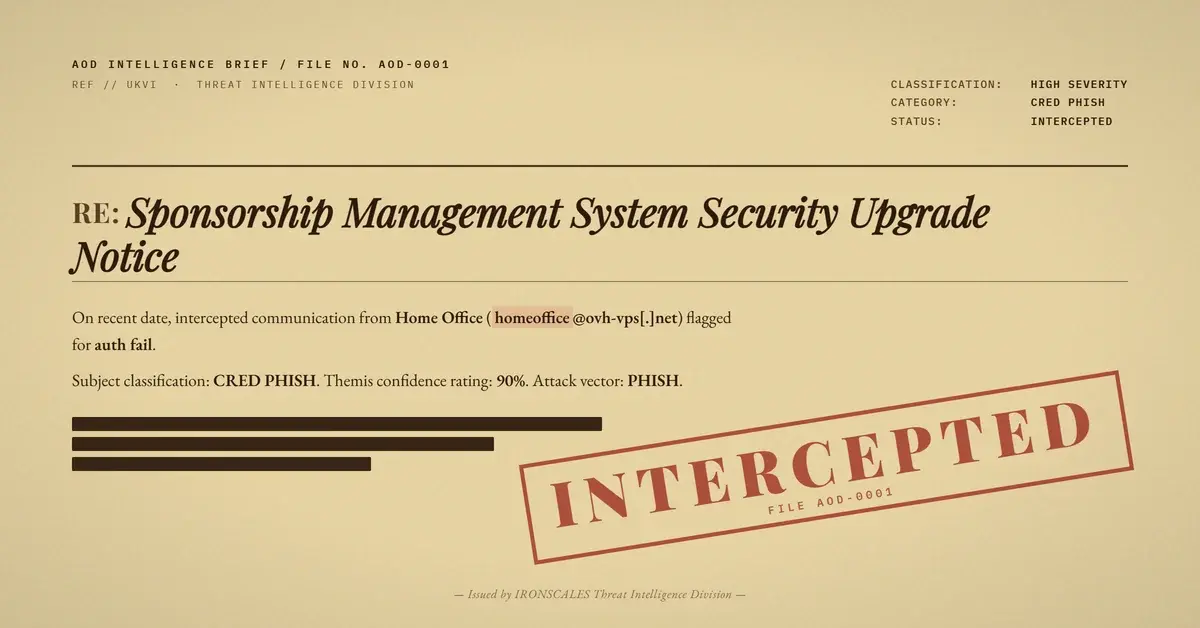
TL;DR A plain-text email impersonating Israel's tax authority demanded payment on a fabricated case file and pointed the recipient at a single bare apex URL. There was no HTML, no image, no tracking pixel and no anchor text, so no display-text-versus-destination check had anything to compare, and Microsoft scored the message benign on arrival at a VIP mailbox. Link scanning flagged the destination malicious, a human verdict followed, and the mail was quarantined. The payment domain had existed for barely three hours.
Severity: High Credential Harvesting Brand Impersonation Payment Fraud MITRE: T1566 MITRE: T1566.002
The only thing wrong with this email was the name of the domain in it.
No HTML. No logo, no payment button, no tracking pixel, no redirect chain. The attacker-authored body was five short lines of Hebrew followed by one bare URL, written out in full at the root of a domain with no path and no parameters. The content type was plain text.
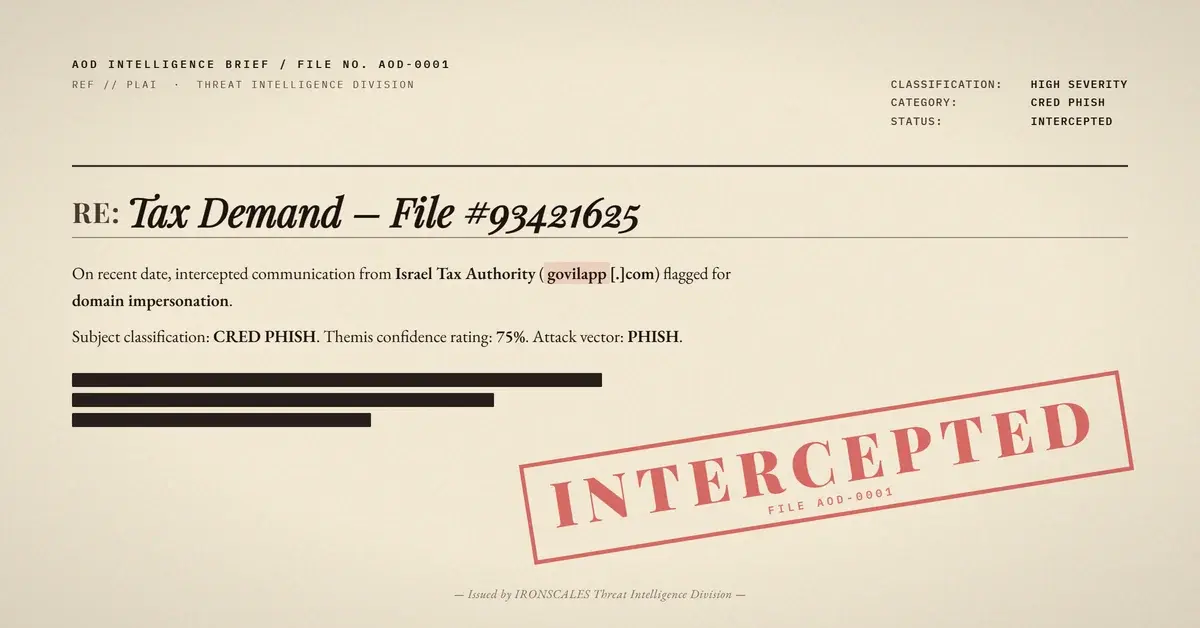
It claimed a real-estate appreciation tax debt against file number 93421625, signed itself as Israel's tax authority, and told the recipient to visit a site to pay. That was the entire message. It landed in a VIP-tagged mailbox at a mid-size Israeli enterprise running Microsoft 365.
Every Link Check Needs Two Strings. This Message Supplied One.
A large share of practical URL detection is comparative: take the text the reader sees, take the destination the browser will follow, look for disagreement. Hidden anchor text, zero-height elements and mismatched button markup are all findings.
None of that machinery had an input here.
The visible string and the destination were the same string, because the attacker never wrote any link text. No HTML for a parser to walk, no image to fingerprint, no kit to match, no tracker to correlate against other sends. The message presented one feature: a domain name.
Microsoft's own scoring reflects it. The message arrived with SCL:1, SFV:NSPM, CAT:NONE and SFTY:9.25, and was not caught at the gateway.
Reading the Name
The destination was govilapp[.]com.
Israel's government publishes on gov.il. Read the attacker's string one way and it is that namespace swallowed whole into a single .com label with app appended, a reading that fits a Hebrew tax-authority pretext and a registrant country of IL. Read it another way and it is simply govil plus app. Nothing in the record speaks to why the attacker picked it, and we are not going to claim otherwise.
What matters defensively is that either reading survives the checks you would normally reach for. There is no homoglyph substitution to flag, because every character is a plain ASCII letter. There is no useful edit distance to gov.il, because the dot separating the second-level label from the country-code top-level domain is gone, and a longer name under a different TLD is not a near neighbour. A typosquat detector tuned for g0v-il[.]com does not fire on a label that never misspells anything.
A namespace does not have to be misspelled to be repackaged.
The Clock Corroborates. It Is Not the Story.
WHOIS gives govilapp[.]com a creation date of 2026-08-10T11:53:44, registrant details redacted, registrant country IL, DNSSEC unsigned. The Date header on the message reads Mon, 10 Aug 2026 15:07:51 +0000.
Three hours, fourteen minutes and seven seconds. Same calendar day.
No tax authority workflow produces that. But domain age is a supporting fact here, not the mechanic. We have written up same-day registration before, and a domain registered minutes before delivery before that. The novelty is what the attacker chose to leave out.
Authentication Was Never in Question
The delivery path was a single external hop from a commercial email service provider into Microsoft's Israel datacenter. No forwarding hop, no gateway rewrite, so the result is not a relay artifact.
At that final hop, SPF, DKIM, DMARC and composite authentication all passed. The signature verified against an Israeli hospitality company's own domain, so a sending identity authorised to sign for that domain put the message on the wire. Whether that authorisation was obtained, resold or abused is not established in the record. The hospitality brand and the mail platform are bystanders: their infrastructure carried the message, and nothing suggests either did anything wrong.
The message also carried RFC 8058 one-click unsubscribe and abuse-reporting headers, which the provider injects platform-wide on every send regardless of content. There was no physical address, no disclaimer, no opt-in evidence, and the content was an unsolicited government tax-debt demand with a payment link. Compliance headers are plumbing, not provenance.
See Your Risk: Calculate how many threats your SEG is missing
The Mirror Image
This corpus already holds a tax-authority lure that ran the opposite way on both legs: a free consumer webmail account, behind a domain aged eleven months. Same pretext family, inverted infrastructure.
Put them side by side and the pretext is the only stable element. Sender reputation, domain age and authentication posture all moved independently while the story told to the human stayed identical. Any control keyed on one of those three legs is one an attacker can trade away.
MITRE Mapping and Indicators
Delivery maps to T1566, Phishing, specifically T1566.002, Spearphishing Link. One link, one recipient, one pretext.
| Type | Indicator | Context |
|---|
| Domain | govilapp[.]com | Payment destination named in the body, flagged malicious by link scanning |
| URL | hxxps://govilapp[.]com | Bare apex URL, no path, no parameters, no anchor text |
| Registration | Created 2026-08-10T11:53:44, registrant country IL, DNSSEC unsigned | 3h14m before the send |
| Pretext artifact | Case file number 93421625 | Fabricated seven-digit tax file reference |
| Mail structure | Plain-text content type, five body lines | No HTML, images, trackers or button markup |
Both links to the attacker domain carry a malicious verdict from IRONSCALES link scanning. Neither has a captured screenshot, so what the site served is unverified. The body says only that the recipient should go there to pay, which places it in credential harvesting and payment-fraud territory without letting us describe a page nobody captured.
What Actually Stopped It
The incident state is Approved Manually, which carries a human malicious verdict, and the mail was quarantined. Relationship context was unambiguous: first-time sender, no prior correspondence either way.
That is the practical answer to a message with no payload. When the only feature is a domain name, the signals that remain concern the relationship and the destination, not the content. Sender-relationship history, link detonation and post-delivery remediation are post-gateway functions, and a secure email gateway (SEG) that scored this 9.25 on safety was never going to supply them. That is the gap SEG augmentation exists to close, and the reason Adaptive AI models per-mailbox relationship baselines instead of grading markup.
Two framings to retire. That a phishing email is a document to be inspected: this one had almost nothing to inspect, and the minimalism was an asset. And that a passing authentication result is a property of the message: it is a property of the sending identity, and sending identities can be borrowed.
CISA guidance treats the phishing cycle as a chain to be broken at several phases rather than a single gate to be passed, and NIST defines phishing by the deception of the recipient rather than by any technical artifact. Both frames survive this message; markup analysis does not. The Microsoft Digital Defense Report 2024 and the FBI IC3 2024 report describe the same drift toward identity abuse, and IRONSCALES platform data across 36,000+ security professionals and 18,000+ organizations shows it from the mailbox side.
The message's only distinguishing feature was a name that reads as a government payment portal. Everything else was left out, and leaving it out is what got it delivered.
Email Attack of the Day is a daily series from
IRONSCALES spotlighting real phishing attacks caught by Adaptive AI and our community of 35,000+ security professionals. Each post breaks down a real attack. What it looked like, why it worked, and what to do about it.






/Blue%20Feature%20Flower%20Icons/gear%20head%20icon.svg)
/Misc%20Icons/icon-nav-credential-theft.svg)









/Leadership%20Headshots/Audian%20Paxson%20Headshot%201000x1000%20032026.webp?width=100&height=100&name=Audian%20Paxson%20Headshot%201000x1000%20032026.webp)



.png?width=50&height=50&name=Untitled%20-%20July%2030%2c%202026%20at%2014.53.38%20(3).png)



/Misc%20Icons/icon-red-teaming-agent-gradient-simple.svg)
/Misc%20Icons/icon-phishing-soc-agent-gradient-simple.webp?width=158&height=167&name=icon-phishing-soc-agent-gradient-simple.webp)
/Misc%20Icons/icon-phishing-simulation-agent-gradient-simple.svg)


/Misc%20Icons/icon-nav-encryption.svg)