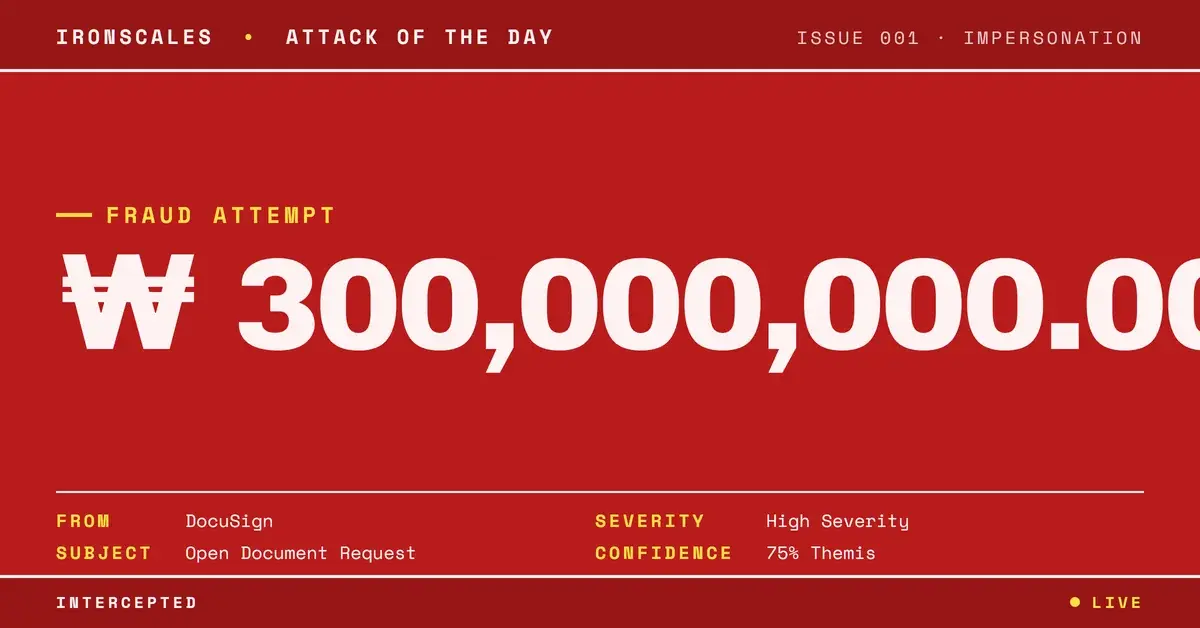
TL;DR A DocuSign-branded message reached a shared hospitality mailbox with every transport signal failing: SPF fail, no DKIM, no DMARC, an empty Return-Path, and a localhost Message-ID. Behind the OPEN DOCUMENT button sat a redirect through Google Maps URLs to an abuse-flagged webhop.me host. A companion obfuscated HTML attachment decoded to a second redirect and carried the recipient's own email, Base64-encoded, for landing-page tailoring. The body demanded a wire of roughly 300 million Korean won to a Shinhan Bank account, split across two payments.
Severity: High Brand Impersonation Wire Transfer Fraud Credential Harvesting MITRE: T1566.001 MITRE: T1204.001 MITRE: T1027 MITRE: T1598.003

Most phishing tries to look like it belongs. This one did not bother. The message that landed in a shared customer-service mailbox at a hospitality brand arrived with SPF failing, no DKIM signature, no DMARC record at all, an empty Return-Path, and a Message-ID that claimed to originate from localhost. By every transport signal a mail server can read, it was a forged injection from an unauthenticated host, not some benign relay quirk. It reached the inbox anyway. And it carried instructions to wire roughly 300 million Korean won to a Shinhan Bank account, split across two transfers, under a DocuSign-branded veneer.

The distance between how obviously fake the envelope was and how far the payload was willing to reach is the whole point of this case.

An Envelope With Nothing Behind It

The sending IP, 136[.]0[.]82[.]150, was not a recognized email gateway. It announced itself with a HELO of [127[.]0[.]0[.]1], the loopback address, which no legitimate mail host would ever present to the outside world. The Return-Path was empty, and the Message-ID referenced localhost. Sender Policy Framework (SPF) failed because that IP is authorized for nothing. Domain Keys Identified Mail (DKIM) was simply absent, so there was no signature to verify. With neither passing, Domain-based Message Authentication, Reporting and Conformance (DMARC) had nothing to align, and no published policy to enforce.

In other words, this was not a subtle spoof that slipped through on a technicality. It was a raw, hand-forged injection that failed every check we have. The only thing dressing it up was the content: DocuSign styling, an OPEN DOCUMENT call to action, and Korean-language wire-transfer instructions naming a specific bank and beneficiary. The authentication layer told the truth. The pixels lied.

The Google Maps Detour

The OPEN DOCUMENT button did not point at a phishing page directly. It pointed at Google. The click ran through Google Maps redirector URLs on Google country domains (hxxps://maps.google[.]it[.]ao/url?q=... and a companion maps.google[.]co[.]ao variant), which then forwarded the browser onward. Open redirectors on trusted, recognized hosts are attractive precisely because the first thing a hover or a link scanner sees is a Google address. The malicious destination sits one hop past the part everyone trusts.

That destination was inifdborivali[.]webhop[.]me, a dynamic-DNS subdomain with public phishing-abuse history, hosted on an AWS EC2 instance (52[.]26[.]213[.]3) whose reverse DNS did not match. None of that is visible at the moment of the click. The reader sees Google, trusts Google, and lands somewhere Google never sent them.

The Attachment That Already Knew You

Riding alongside the link was a small HTML attachment, ck#...[.]html, just over two kilobytes. Open it and it renders locally in the browser. Inside was hex and XOR obfuscated JavaScript that, per static analysis, decodes to a redirect toward a second host, trsnell[.]com. There is no

and no in the file, so it does not harvest credentials inline. It stages the redirect and fires it on open.

The detail worth sitting with is what the script appends to that redirect: the recipient's own email address, Base64-encoded, as a URL fragment. The attackers pre-loaded each attachment with the target it was mailed to, so the landing page can greet the victim by their real address and tailor the credential pitch. It is a small touch that does a lot of work, and it confirms this was a prepared, per-target kit rather than a spray. Because the address is scrambled and delivered as an attachment, a content filter scanning the message body sees nothing actionable at all.

See Your Risk: Calculate how many threats your SEG is missing

Mapping to MITRE ATT&CK

The tradecraft lines up cleanly with the MITRE ATT&CK framework:

  • T1566.001 Spearphishing Attachment covers the obfuscated HTML file staged to fire its redirect on open.
  • T1204.001 User Execution: Malicious Link covers the OPEN DOCUMENT click that walks the victim through the Google Maps hop to the abuse-flagged landing host.
  • T1027 Obfuscated Files or Information covers the hex and XOR encoding that hid the real redirect target from static inspection.
  • T1598.003 Phishing for Information covers the per-target Base64 email fragment used to personalize the landing page.

Indicators of Compromise

TypeIndicatorContext
IP136[.]0[.]82[.]150Unauthenticated sending host, SPF fail, HELO [127[.]0[.]0[.]1], no gateway PTR
Domaininifdborivali[.]webhop[.]meLanding subdomain, public phishing-abuse history, AWS EC2 (52[.]26[.]213[.]3), PTR mismatch
Domaintrsnell[.]comSecondary redirect target decoded from the obfuscated HTML attachment
URL patternhxxps://maps.google[.]it[.]ao/url?q=...Google Maps open redirector abused to obscure the final destination
Fileck#...[.]html (MD5 6a23c5f23b37077e1d6cd5ecaeeb6599, 2272 bytes)Obfuscated hex/XOR JS, decodes to redirect plus Base64 recipient-email fragment, no inline form
FinancialShinhan Bank wire, approximately 300 million KRW across two paymentsFraudulent payment demand embedded in the body

Detection and What to Watch For

A pure authentication verdict was on our side here, and it still was not enough on its own. SPF fail, DKIM absent, DMARC none, empty Return-Path, localhost Message-ID: any one is a strong signal, and the stack of them is damning. The lesson is not that authentication failed. It is that a message this broken at the transport layer still reached a human, which means the tooling watching over that human has to be the backstop.

The signals that matter beyond the failed checks are the mismatch between a DocuSign presentation and a sender that has no relationship to DocuSign, a call to action that launders through a Google redirector before resolving to a dynamic-DNS host, and an HTML attachment whose contents do not render as readable text. This is where IRONSCALES adds a layer static gateways miss. Themis, the Adaptive AI analyst on the IRONSCALES platform, weighs the claimed brand against the actual origin, the redirect chain, and the attachment behavior the way a trained analyst would, flagging the intent even when a message arrives from infrastructure no allow-list has ever seen. The obfuscated attachment and the wrapped link are exactly the surface that advanced malware and URL attack protection is built to inspect, and the six-figure wire demand is textbook payment fraud.

The Takeaway

This is business email compromise in its bluntest form: no clever spoof, no compromised vendor account, just a forged message betting that DocuSign branding and a scary invoice will move money faster than anyone checks the headers. The 2024 Verizon Data Breach Investigations Report puts the human element in 68 percent of breaches and pegs the median business email compromise transaction near 50,000 dollars, and the Microsoft Digital Defense Report 2024 documents the same drift toward abusing trusted services like cloud hosting and mainstream redirectors rather than breaking them. The FBI's 2023 Internet Crime Report ranks business and payment-fraud losses among the costliest categories reported, which is exactly the lever this campaign pulled. Across 35,000+ security professionals and 17,000+ organizations, the pattern holds: the messages that hurt most are rarely the most sophisticated. Verify the destination, never wire against an emailed instruction without an out-of-band confirmation, and let behavioral detection catch what the headers already told you. CISA's guidance on stopping phishing early is a solid reference for building that reflex across a team: https://www.cisa.gov/resources-tools/resources/phishing-guidance-stopping-attack-cycle-phase-one

Email Attack of the Day is a daily series from IRONSCALES spotlighting real phishing attacks caught by Adaptive AI and our community of 35,000+ security professionals. Each post breaks down a real attack. What it looked like, why it worked, and what to do about it.

Related attacks

Attack What happened
The Procore Footer Was Real. The Document Was Not.Every link scanner called the Procore and ExxonMobil URLs clean.
A Pixel-Perfect Sephora Delivery Notice Shows Why Email Authentication Alone Can't Protect YouA fully authenticated Sephora delivery notification passed SPF, DKIM, and DMARC with perfect scores.
The Email That Passed Every Security Check (Because Adobe Sent It)A phishing campaign targeting school district staff used Adobe's own sending infrastructure, real DKIM signatures.
The Phishing Infrastructure Was Canva. The Delivery Mechanism Was Canva. The Authentication Was Canva.An attacker signed up for Canva, built a phishing lure as a design, and used the platform's own sharing feature to deliver it.
When the Sender Domain Is Also the Phishing Kit Host: Dual-Purpose Domain CompromiseAn attacker compromised a legitimate manufacturing company domain and used it two ways at once: as the authenticated sending address and as the host for...

Explore More Articles

Say goodbye to Phishing, BEC, and QR code attacks. Our Adaptive AI automatically learns and evolves to keep your employees safe from email attacks.