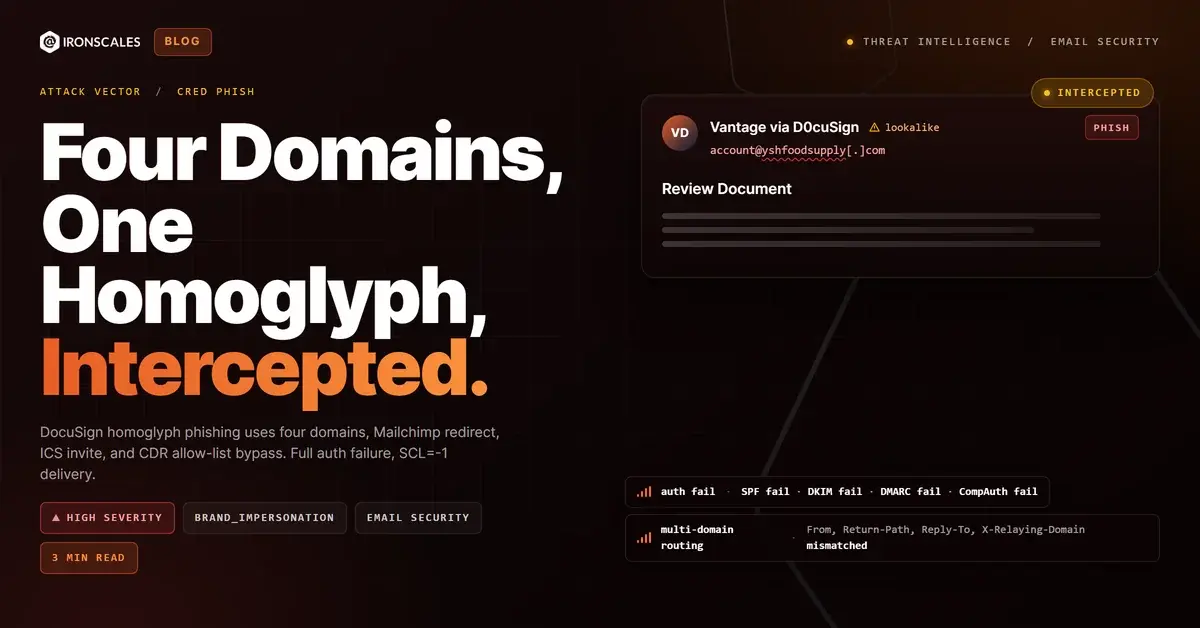
TL;DR The attacker sent an email with display name '[redacted] via D0cuSign' (zero replacing the letter O) from a food supply company's domain (yshfoodsupply[.]com), with a return-path at an Estonian business domain (hansabusad[.]com), reply-to at the real impersonated bank (a-regional-bank[.]example), and a fourth relaying domain (candybreak[.]net) in the X-Relaying-Domain header. SPF, DKIM, DMARC, and CompAuth all returned none/fail (reason=405). Despite total authentication failure, the message was delivered with SCL=-1 because it passed through a Votiro CDR relay (44[.]206[.]213[.]130) on an organizational allow-list. The email contained a Mailchimp redirect CTA ('Review Document'), an ICS calendar invite (580 bytes), and an image file with mismatched extension (document.png served as image/jpeg). Themis flagged the recipient as a VIP at 66% confidence. One mailbox was quarantined.
Severity: Critical Credential Harvesting Brand Impersonation MITRE: {'id': 'T1566.001', 'name': 'Phishing: Spearphishing Attachment'} MITRE: {'id': 'T1566.002', 'name': 'Phishing: Spearphishing Link'} MITRE: {'id': 'T1036.005', 'name': 'Masquerading: Match Legitimate Name or Location'} MITRE: {'id': 'T1204.001', 'name': 'User Execution: Malicious Link'}
The display name read "[redacted] via D0cuSign." The zero replacing the letter O in DocuSign was the quietest part of this attack, and in some ways the least important. Behind that single homoglyph sat four unrelated domains, a Mailchimp redirect, an ICS calendar file, and a CDR relay that overrode every authentication failure to deliver the message clean.
Four Domains, Zero Authentication
The from address belonged to a food supply company: account@yshfoodsupply[.]com. The return-path pointed to an Estonian business domain: postmaster@hansabusad[.]com. The reply-to went to the real bank being impersonated: support@a-regional-bank[.]example. A fourth domain, candybreak[.]net, appeared in the X-Relaying-Domain header.
SPF returned none. DKIM returned none. DMARC returned none. CompAuth returned none with reason=405. By every authentication standard, this message should have been rejected or quarantined. Instead, it was delivered with SCL=-1.
The reason: the message transited a Votiro CDR relay at 44[.]206[.]213[.]130. That relay was on the recipient organization's allow-list. When a message passes through an allow-listed relay, the gateway trusts the relay's judgment and suppresses its own authentication verdict. The allow-list converted total authentication failure into unconditional delivery.
The Payload Stack
The email carried two attachments. The first was invite.ics, a 580-byte calendar file designed to plant a persistent event on the recipient's calendar. Even if the recipient deletes the email, the calendar entry can survive with attacker-controlled content, links, and reminder notifications.
The second was document.png, a 339KB file served with a JPEG content type despite the PNG extension. This MIME type mismatch is a minor evasion technique: some attachment scanners make filtering decisions based on the declared content type rather than the actual file signature.
The primary CTA, labeled "Review Document," routed through us[.]list-manage[.]com, a Mailchimp redirect domain. The email also contained blocks referencing multiple financial brands and a survey platform, creating multi-brand confusion that makes it harder for recipients to determine which organization actually sent the message.
See Your Risk: Calculate how many threats your SEG is missing
What Behavioral Detection Found
Themis scored the message at 66% confidence and flagged the recipient as a VIP. One mailbox was quarantined. The X-Mailer header claimed iPhone Mail (18E212), suggesting a casual mobile send, but the relay chain and multi-domain infrastructure contradicted that claim entirely.
The detection surface here was not authentication (which returned nothing useful) but structural. Detecting phishing like this requires looking at four mismatched domains, a homoglyph in the display name, a CTA routing through a marketing platform, and a calendar file bundled with an image attachment. Each element in isolation might be explainable. Together, they form a pattern that behavioral analysis can act on even when authentication cannot.
What to Watch For
Audit CDR relay allow-lists and evaluate whether messages transiting those relays should inherit blanket trust or still undergo authentication checks. Three or more unrelated domains in From, Return-Path, and Reply-To fields is a high-confidence indicator regardless of the SCL score. Inspect display names character by character. A zero in "D0cuSign" is invisible at reading speed.
Indicators of Compromise
| Type | Indicator | Context |
|---|
| From Address | account@yshfoodsupply[.]com | Food supply company domain (sender) |
| Return-Path | postmaster@hansabusad[.]com | Estonian business domain (bounce handling) |
| Reply-To | support@a-regional-bank[.]example | Real bank being impersonated |
| Relaying Domain | candybreak[.]net | X-Relaying-Domain header |
| CDR Relay IP | 44[.]206[.]213[.]130 | Votiro CDR relay (allow-listed) |
| Gmail Relay IP | 209[.]85[.]218[.]98 | Gmail infrastructure in relay chain |
| CTA Domain | us[.]list-manage[.]com | Mailchimp redirect for "Review Document" |
| Attachment | invite.ics (580 bytes) | Calendar invite file |
| Attachment | document.png (339KB, image/jpeg) | MIME type mismatch (JPEG served as PNG) |
| Display Name | [redacted] via D0cuSign | Zero-for-O homoglyph in DocuSign |
MITRE ATT&CK Mapping
| Technique | ID | Relevance |
|---|
| Phishing: Spearphishing Attachment | T1566.001 | ICS calendar invite and image attachment as payload components |
| Phishing: Spearphishing Link | T1566.002 | Mailchimp redirect CTA to credential harvesting |
| Masquerading: Match Legitimate Name or Location | T1036.005 | Homoglyph substitution in DocuSign display name |
| User Execution: Malicious Link | T1204.001 | "Review Document" CTA requiring recipient click-through |
Email Attack of the Day is a daily series from
IRONSCALES spotlighting real phishing attacks caught by Adaptive AI and our community of 36,000+ security professionals. Each post breaks down a real attack. What it looked like, why it worked, and what to do about it.







/Blue%20Feature%20Flower%20Icons/gear%20head%20icon.svg)
/Misc%20Icons/icon-nav-credential-theft.svg)










/Leadership%20Headshots/Audian%20Paxson%20Headshot%201000x1000%20032026.webp?width=100&height=100&name=Audian%20Paxson%20Headshot%201000x1000%20032026.webp)



.png?width=50&height=50&name=Untitled%20-%20July%2030%2c%202026%20at%2014.53.38%20(3).png)



/Misc%20Icons/icon-red-teaming-agent-gradient-simple.svg)
/Misc%20Icons/icon-phishing-soc-agent-gradient-simple.webp?width=158&height=167&name=icon-phishing-soc-agent-gradient-simple.webp)
/Misc%20Icons/icon-phishing-simulation-agent-gradient-simple.svg)


/Misc%20Icons/icon-nav-encryption.svg)