TL;DR A Korean-language Facebook share notification targeting a medical device company passed all email authentication checks and used genuine Meta infrastructure for delivery. Despite clean link verdicts, the message embedded the recipient's corporate email in URL parameters and routed clicks through Facebook login and redirect endpoints. The inability to verify the final post-click destination made this a credible credential-harvesting vector, and automated threat detection flagged it before it reached the recipient.
Severity: High Credential-Harvesting Platform-Abuse MITRE: T1566.002 MITRE: T1608.005
A Perfectly Authenticated Email That Shouldn't Be Trusted
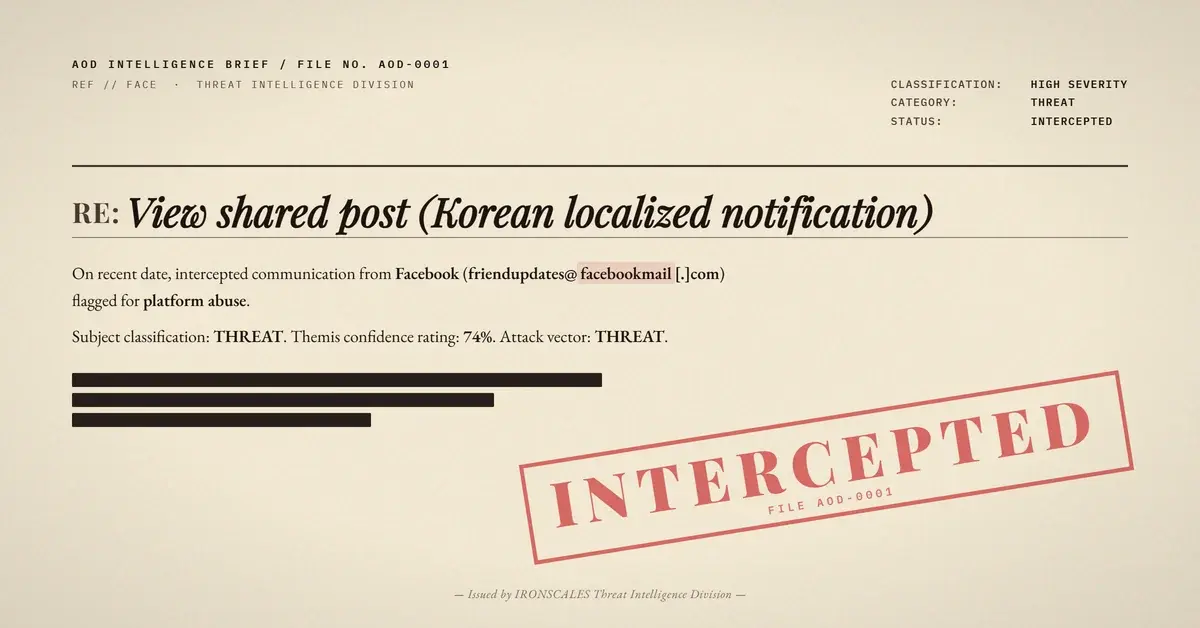
A Facebook share notification landed in the inbox of an employee at a medical device manufacturer. The subject line, written in Korean, invited the recipient to view a shared post. Nothing about the email's technical fingerprint raised a red flag. SPF passed. DKIM passed. DMARC passed. The sending IP belonged to Meta's own mail infrastructure. The message looked, by every measurable standard, legitimate.
It was flagged as a phishing threat anyway.
The reason comes down to a pattern that security teams are seeing more frequently: attackers who weaponize trusted platforms rather than spoofing them. When every authentication check returns green, the danger lives downstream, buried in redirect chains and login endpoints that traditional secure email gateways were never designed to trace.
Anatomy of a Platform-Delivered Threat
The email originated from friendupdates@facebookmail[.]com, a legitimate Meta notification address. It was sent through 66-220-144-149.mail-mail.facebook[.]com, an IP within Facebook's authenticated sending pool. The DKIM signature verified against facebookmail[.]com. Every header, every relay hop, matched what you would expect from a real Facebook notification.
The message body was localized in Korean and personalized to the recipient. It referenced a specific Facebook user and invited the recipient to view a shared post. The layout, images hosted on Facebook CDNs, tracking pixel, footer with Meta's corporate address, all mirrored genuine platform notifications. There was no overt credential request, no urgency language, no payment demand.
But three structural details made this message dangerous:
- Recipient email encoded in URL parameters. Multiple CTA links contained the recipient's full corporate email address as a
n_m= parameter. This level of personalization increases click-through rates and enables the downstream page to pre-populate credential fields.
- Redirect and login endpoints as click targets. The email's primary links routed through
facebook[.]com/o.php and facebook[.]com/login/?next=, both of which are Facebook's internal redirect handlers. These endpoints accept a destination URL as a parameter, meaning the final landing page is determined by whatever content sits behind the redirect, not by the link visible in the email.
- Unverifiable final destination. Enterprise link-rewriting (SafeLinks) wrapped the URLs in transit, adding another layer of obfuscation. The scanned link targets resolved to
facebook[.]com and returned clean verdicts. But scanning a redirect endpoint only tells you the intermediary is safe. It says nothing about what happens after the user authenticates and follows the redirect chain to its conclusion.
MITRE ATT&CK Mapping and the Redirect Chain Problem
This case maps to T1566.002 (Spearphishing Link), where the delivery vehicle is a link embedded in email rather than an attachment. It also touches T1608.005 (Link Target), where the attacker stages content at a destination that the link points to.
The Verizon DBIR 2024 reports that 68% of breaches involve a human element, with phishing and pretexting dominating the social engineering category. Platform-abuse attacks succeed precisely because they exploit the trust gap between authentication (which validates the sender) and content analysis (which should evaluate the payload). The Microsoft Digital Defense Report 2024 highlights this exact blind spot, noting that threat actors increasingly leverage trusted cloud and social media infrastructure to bypass reputation-based defenses. When the sender is genuinely Facebook, most security stacks stop looking.
The FBI IC3 2024 report documented over $12.5 billion in losses from internet crime, with business email compromise and credential harvesting continuing to top the list. Social media platform abuse is an increasingly common initial access vector in these campaigns.
See Your Risk: Calculate how many threats your SEG is missing
Why This Email Got Caught
IRONSCALES automated threat detection flagged this message at a 74% confidence level despite its clean authentication profile. The detection relied on behavioral signals rather than reputation data: the email was from a first-time sender to this recipient, it contained personalized redirect links with encoded corporate email addresses, and the click path led through login endpoints where post-authentication behavior could not be verified.
This is the kind of threat that AI-driven email security is built to catch. Traditional detection depends on blocklists, domain reputation, and binary authentication results. When the sending infrastructure is Meta, those signals all read clean. Behavioral analysis looks at what the email is asking the recipient to do: click a link that routes through a login page, with their email pre-loaded, to an unverifiable destination.
The incident affected multiple mailboxes within the organization, and all copies were mitigated.
Facebook Infrastructure IOCs
| Type | Indicator | Context |
|---|
| Sender | friendupdates@facebookmail[.]com | Legitimate Meta notification address used for delivery |
| Sending IP | 66[.]220[.]144[.]149 | Facebook mail infrastructure |
| Redirect URL | hxxps://facebook[.]com/o[.]php?ee= | Open redirect endpoint accepting destination parameter |
| Login URL | hxxps://facebook[.]com/login/?next= | Login gate chaining to redirect handler |
| X-Mailer | ZuckMail [version 1.00] | Facebook's internal mail system identifier |
What Security Teams Should Do About Platform Notifications
Treat authentication as necessary but not sufficient. SPF, DKIM, and DMARC passing means the email came from where it claims. It does not mean the content is safe. CISA's phishing guidance reinforces that even authenticated messages can carry malicious payloads. Build detection logic that evaluates behavioral context beyond sender validation.
Inspect redirect chains, not just link domains. A link to facebook[.]com is only as safe as the content it ultimately serves. If your security stack stops analysis at the first-hop domain, you are missing the payload.
Flag encoded recipient data in URLs. Legitimate platforms sometimes include recipient identifiers in notification links. But when a corporate email address appears as a URL parameter in a message from an external first-time sender, that combination warrants scrutiny.
Educate users about platform notification risk. Social media notifications in corporate inboxes are inherently risky. If an employee's personal Facebook activity generates notifications to their work email, the organization's attack surface expands to include every compromised account and malicious post on that platform.
The uncomfortable truth about this case is that every individual signal looked clean. The sender was real. The links resolved to a trusted domain. The authentication was flawless. The threat existed in the gap between what could be verified and what could not, and that gap is exactly where modern attackers operate.
Email Attack of the Day is a daily series from
IRONSCALES spotlighting real phishing attacks caught by Adaptive AI and our community of 36,000+ security professionals. Each post breaks down a real attack. What it looked like, why it worked, and what to do about it.







/Blue%20Feature%20Flower%20Icons/gear%20head%20icon.svg)
/Misc%20Icons/icon-nav-credential-theft.svg)










/Leadership%20Headshots/Audian%20Paxson%20Headshot%201000x1000%20032026.webp?width=100&height=100&name=Audian%20Paxson%20Headshot%201000x1000%20032026.webp)



.png?width=50&height=50&name=Untitled%20-%20July%2030%2c%202026%20at%2014.53.38%20(3).png)



/Misc%20Icons/icon-red-teaming-agent-gradient-simple.svg)
/Misc%20Icons/icon-phishing-soc-agent-gradient-simple.webp?width=158&height=167&name=icon-phishing-soc-agent-gradient-simple.webp)
/Misc%20Icons/icon-phishing-simulation-agent-gradient-simple.svg)


/Misc%20Icons/icon-nav-encryption.svg)