TL;DR A first-stage business email compromise attempt used a free Gmail account to impersonate a company CEO by display name and ask a senior EMEA sales leader to move the conversation to WhatsApp. The message passed SPF, DKIM, and DMARC because it genuinely came from Gmail, carried no links or attachments to scan, and never mentioned money. The WhatsApp pivot is reconnaissance designed to move the target off monitored email before the real fraud request. Themis flagged the known-name, unknown-address mismatch and quarantined the message in about ten seconds. Behavioral, relationship-aware detection is the control that catches payload-free impersonation.
Severity: High Bec Impersonation Social Engineering MITRE: T1566 MITRE: T1684.001
There was no link to click. No attachment to open. No invoice, no wire request, no gift-card errand. The email that landed in the inbox of a senior EMEA sales leader at a global B2B software company asked for exactly one thing: a WhatsApp number.
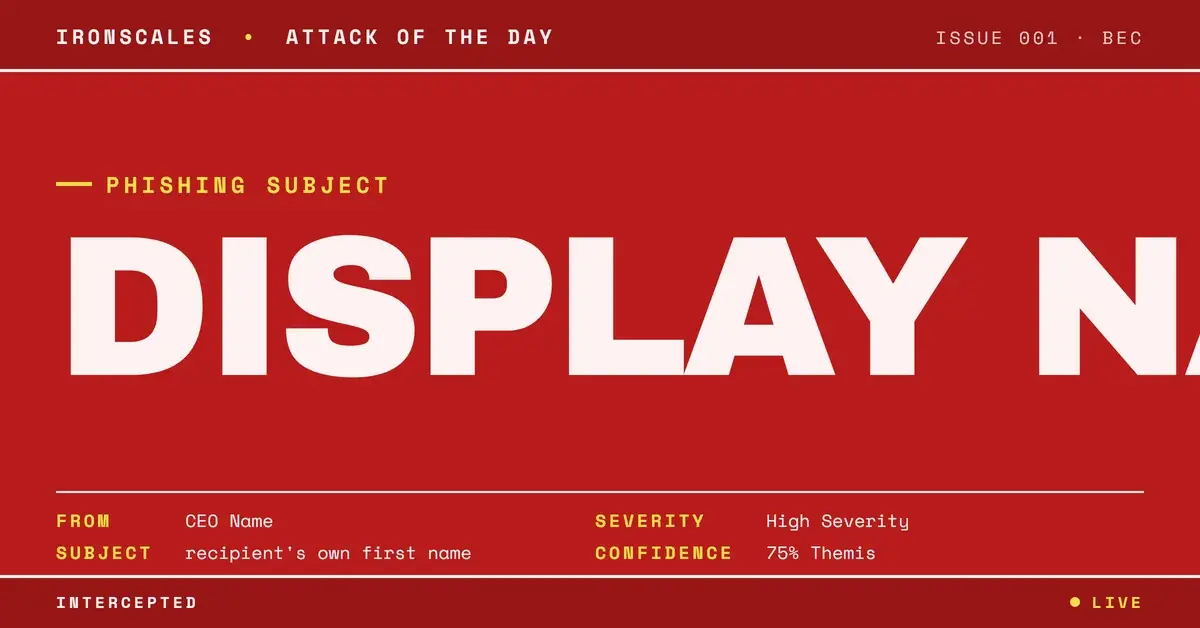
The display name read as the company CEO. The sending address was a free Gmail account with a random string for a handle. The subject line was a single word, the recipient's own first name. The body was two sentences of calm authority, roughly: "Hi [name], there is a task I would like you to complete. Please respond with your WhatsApp number and wait for my text. I am on standby. Regards."
That is the entire attack. And that is exactly why it is dangerous.
The Email That Asked for Nothing Valuable
Most business email compromise (BEC) coverage fixates on the money moment: the fake invoice, the last-minute banking change, the urgent wire. This message had none of that. It is the opener, not the ask.
Asking for a phone number is a low-commitment request. It does not trip the mental alarm that a payment demand does. It feels administrative, almost trivial, the kind of thing you would do for your CEO without a second thought. The attacker is not trying to steal anything in this email. The attacker is trying to start a conversation and relocate it somewhere quieter.
The single-word subject line and first-name greeting are part of the craft. They signal familiarity. A busy executive dashing off a quick note does not write a formal subject. The informality is the disguise.
Why Every Authentication Check Said Yes
Here is the uncomfortable part for anyone who treats email authentication as a phishing filter. This message passed SPF. It passed DKIM. It passed DMARC. Microsoft scored it compauth=100, the top composite authentication result.
None of that was a bug. The mail genuinely originated from Gmail infrastructure, so Gmail's SPF, DKIM signature, and DMARC alignment all validated correctly. Authentication confirmed that the message really came from a Gmail account. It said nothing about who the message claimed to be.
That is the gap attackers exploit with display-name impersonation. SPF, DKIM, and DMARC authenticate the sending domain. The display name, the human-readable "CEO Name" that most email clients show in bold while hiding the actual address, is unauthenticated text the attacker types in freely. On a phone, where clients often show only the display name, the real Gmail address never even surfaces. Authentication was working perfectly and protected nobody.
No Payload Means No Scan Surface
Strip out the link and the attachment and you also strip out most of the modern detection stack. URL reputation and rewriting have no URL to evaluate. Attachment sandboxing has no file to detonate. Content scanners looking for credential-harvesting kits or malware find plain, polite prose.
The message carried no indicators of compromise in the traditional sense. There was nothing to block, nothing to detonate, nothing on a threat feed. A secure email gateway tuned to hunt for malicious payloads had almost no surface to work with. Across the IRONSCALES customer base, gateways miss an average of 67.5 phishing emails per 100 mailboxes each month, and payload-free social engineering like this is a large part of why. Microsoft's Digital Defense Report 2024 similarly documents how identity-centric and social engineering attacks have scaled far faster than malware-based ones.
See Your Risk: Calculate how many threats your SEG is missing
The WhatsApp Pivot Is the Whole Point
The request to move to WhatsApp is not a detail. It is the objective of this stage.
Once the conversation leaves corporate email, it leaves everything that comes with corporate email: logging, retention, external-sender banners, data loss prevention, and email security tooling. On WhatsApp, the "CEO" can escalate at their own pace, with no colleague in the thread and no security control watching. The follow-up, the part that actually asks for money, a gift-card purchase, or confidential data, happens on a channel your defenses cannot see.
This is reconnaissance-first BEC. The Verizon Data Breach Investigations Report series has tracked for years how the human element sits at the center of the majority of breaches, and how pretexting, building a believable scenario before the ask, drives modern BEC. IBM's Cost of a Data Breach research puts the price of these compromises among the highest of any breach type. The pattern here maps cleanly to MITRE ATT&CK: Phishing (T1566) as the delivery vector, and the impersonation technique (T1684.001), where an adversary poses as a trusted executive to build the trust the later fraud depends on.
Targeting a senior sales leader is a deliberate choice. Revenue-facing executives move fast, talk to outsiders constantly, and are conditioned to be responsive to leadership. They are exactly the profile an attacker wants for a quiet side conversation with the boss.
How a Behavioral Signal Caught It in Seconds
If authentication passed and there was no payload to scan, what stopped it? A relationship signal.
The organization was known to communicate with its real CEO from a real internal address. This message carried that CEO's name but arrived from an unrelated external Gmail account with no prior sending history to the recipient. That mismatch, a trusted display name paired with an untrusted, first-time-for-this-identity address, is a behavioral tell that no amount of valid DKIM can hide.
Themis, the IRONSCALES Adaptive AI analyst, scored the message as a VIP impersonation at 90 percent confidence and quarantined it across the affected mailbox in roughly ten seconds, before anyone replied with a phone number. That verdict drew on the sender-to-recipient relationship model and on community signal, where similar impersonation attempts reported across a global network of more than 36,000 security professionals across 18,000+ organizations reinforce the pattern. The detection did not need a link or a file. It needed to understand who normally emails whom.
IOC Table
| Type | Indicator | Context |
|---|
| Email | directm824@gmail[.]com | Attacker-controlled Gmail account sending the impersonation |
| Display name | "[CEO Name]" (spoofed) | Exact display-name impersonation of the company CEO |
| Auth result | SPF pass / DKIM pass / DMARC pass / compauth=100 | Legitimate Gmail origin; authenticates the domain, not the claimed identity |
| Pivot | WhatsApp phone-number request | Off-channel move to unmonitored messaging |
| Payload | None (no links, no attachments) | Minimal scan surface by design |
Closing the Gap on Off-Channel Recon
The takeaway is not "add another link scanner." It is that identity, not content, is the battleground for this class of attack.
Verify out of band, through a known channel. If a leader asks to move to WhatsApp or requests a personal number, confirm through an already-trusted path, a saved phone number or an internal message, never by replying to the email that made the request.
Treat the channel switch as the red flag. The ask itself may be harmless. The push to leave email is the signal. Make that pattern explicit in security awareness training, and simulate it, because employees who have never seen a payload-free "quick favor from the CEO" will not recognize one.
Detect on relationships, not just payloads. BEC protection has to model who communicates with whom and flag when a familiar name shows up from an unfamiliar address. That behavioral view is what catches an attack that passes every authentication check and carries nothing to scan.
The message that asks for nothing is the one worth watching. It is not the fraud. It is the audition for it.
Email Attack of the Day is a daily series from
IRONSCALES spotlighting real phishing attacks caught by Adaptive AI and our community of 36,000+ security professionals. Each post breaks down a real attack. What it looked like, why it worked, and what to do about it.







/Blue%20Feature%20Flower%20Icons/gear%20head%20icon.svg)
/Misc%20Icons/icon-nav-credential-theft.svg)










/Leadership%20Headshots/Audian%20Paxson%20Headshot%201000x1000%20032026.webp?width=100&height=100&name=Audian%20Paxson%20Headshot%201000x1000%20032026.webp)



.png?width=50&height=50&name=Untitled%20-%20July%2030%2c%202026%20at%2014.53.38%20(3).png)



/Misc%20Icons/icon-red-teaming-agent-gradient-simple.svg)
/Misc%20Icons/icon-phishing-soc-agent-gradient-simple.webp?width=158&height=167&name=icon-phishing-soc-agent-gradient-simple.webp)
/Misc%20Icons/icon-phishing-simulation-agent-gradient-simple.svg)


/Misc%20Icons/icon-nav-encryption.svg)