TL;DR A phishing email disguised as a Google Calendar webinar invitation passed SPF, DKIM, and DMARC via legitimate Google infrastructure. The message included an .ics calendar file and a .pkpass Apple Wallet attachment, both structurally clean but functioning as delivery vehicles for external links. The DESCRIPTION and LOCATION fields in the .ics contained a short link that redirected through a custom domain to a landing page, while repeated Google URL wrappers pointed to an unusual domain with suspicious reputation. The sender was flagged as high risk and first-time. Multiple mailboxes were quarantined. Themis flagged the message on behavioral signals including the redirect chains, unusual unsubscribe target, and formatting corruption.
Severity: High Credential Harvesting Social Engineering MITRE: {'id': 'T1566.001', 'name': 'Phishing: Spearphishing Attachment'} MITRE: {'id': 'T1204.001', 'name': 'User Execution: Malicious Link'} MITRE: {'id': 'T1036.005', 'name': 'Masquerading: Match Legitimate Name or Location'}
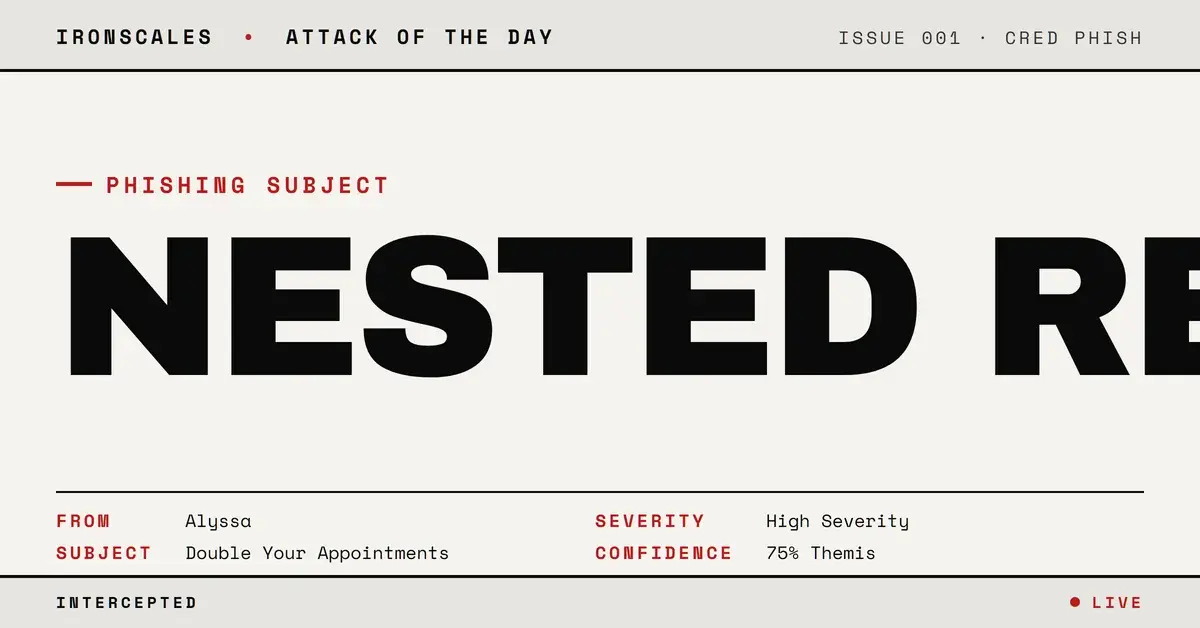
The invitation looked like any other webinar signup: "Double Your Appointments" with a date, time, and RSVP buttons. It arrived through Google Calendar infrastructure. SPF passed. DKIM passed (both google.com and the sender's custom domain). DMARC passed. Composite authentication confirmed.
The invite carried two attachments and half a dozen links. None of them went where they appeared to.
The Calendar File as a Link Delivery Vehicle
The .ics attachment was structurally clean. No embedded executables, no base64 blobs, no encoded payloads. It was a valid iCalendar file produced by Google Calendar, 9,422 bytes, containing a webinar event for an "AI-Driven System" presentation.
The risk lived in the metadata fields. The DESCRIPTION field contained a short link (ryps[.]us/automate) that redirected through a 301 hop to peakconnector[.]com/webinar-3-ai-secrets. The LOCATION field contained the same redirect. Multiple "Remove Me" links used Google URL wrappers (google[.]com/url?q=...) that resolved to removeme-please[.]com, a domain with suspicious reputation in automated checks. The .ics file was not a payload. It was a container for links that scanners would evaluate only at the first hop.
The Apple Wallet Pass
The message also included a .pkpass file, a standard Apple Wallet pass containing images, a pass definition, and a webServiceURL endpoint pointing to api.lu[.]ma with an embedded authentication token. Adding this pass to a Wallet app would trigger HTTP requests to the specified endpoint, enabling server-side tracking and potentially session-based redirection.
The .pkpass format is rarely inspected by email security tools. It is not an executable. It is not a macro-enabled document. It is a ZIP archive containing JSON and images that interacts with device APIs after installation, placing its risk surface outside the email scanning boundary.
The Formatting That Gave It Away
The HTML body contained character-level bold wrapping and corrupted formatting artifacts consistent with automated mass-mail conversion. The organizer address (alyssa@reachyourpeakresources[.]com) did not match the recipient context, and the short-link domain (ryps[.]us) had no DMARC enforcement and no DNSSEC. These were not definitive signals individually, but Themis, the IRONSCALES Adaptive AI engine, combined them with the redirect chains, suspicious unsubscribe target, and first-time sender behavior to flag the message. Multiple mailboxes were quarantined.
See Your Risk: Calculate how many threats your SEG is missing
Indicators of Compromise
| Type | Indicator | Context |
|---|
| Organizer | alyssa@reachyourpeakresources[.]com | Calendar invite organizer, first-time sender |
| Short Link Domain | ryps[.]us | No DMARC enforcement, owned by Reach Your Peak LLC |
| Redirect Landing | peakconnector[.]com/webinar-3-ai-secrets | Final destination after 301 redirect from short link |
| Suspicious Domain | removeme-please[.]com | Repeated unsubscribe target via Google URL wrappers |
| Wallet Endpoint | api.lu[.]ma (with auth token) | webServiceURL in .pkpass, enables tracking |
| ICS File | invite.ics (9,422 bytes) | Structurally clean, contains redirect links in metadata |
| Attachment | .pkpass (Apple Wallet) | Contains embedded webServiceURL and tracking tokens |
MITRE ATT&CK Mapping
| Technique | ID | Relevance |
|---|
| Phishing: Spearphishing Attachment | T1566.001 | .ics and .pkpass as link delivery vehicles |
| User Execution: Malicious Link | T1204.001 | Redirect chains obscuring landing page destination |
| Masquerading: Match Legitimate Name or Location | T1036.005 | Google Calendar branding and legitimate RSVP interface |
Email Attack of the Day is a daily series from
IRONSCALES spotlighting real phishing attacks caught by Adaptive AI and our community of 36,000+ security professionals. Each post breaks down a real attack. What it looked like, why it worked, and what to do about it.







/Blue%20Feature%20Flower%20Icons/gear%20head%20icon.svg)
/Misc%20Icons/icon-nav-credential-theft.svg)










/Leadership%20Headshots/Audian%20Paxson%20Headshot%201000x1000%20032026.webp?width=100&height=100&name=Audian%20Paxson%20Headshot%201000x1000%20032026.webp)



.png?width=50&height=50&name=Untitled%20-%20July%2030%2c%202026%20at%2014.53.38%20(3).png)



/Misc%20Icons/icon-red-teaming-agent-gradient-simple.svg)
/Misc%20Icons/icon-phishing-soc-agent-gradient-simple.webp?width=158&height=167&name=icon-phishing-soc-agent-gradient-simple.webp)
/Misc%20Icons/icon-phishing-simulation-agent-gradient-simple.svg)


/Misc%20Icons/icon-nav-encryption.svg)