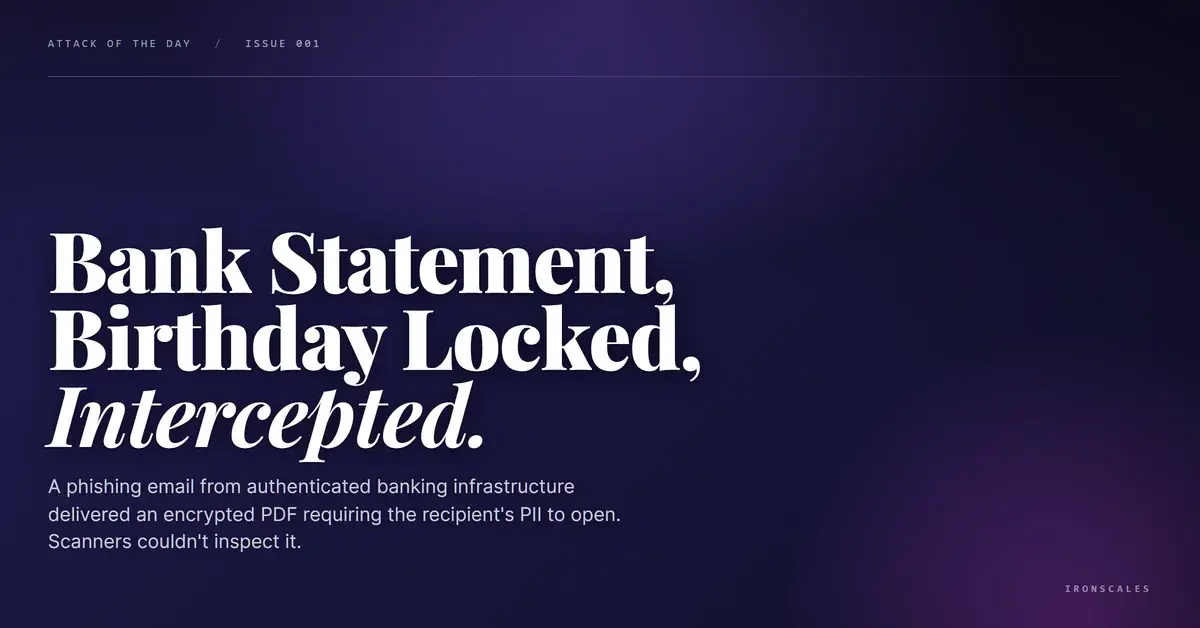
TL;DR A phishing email impersonating a major banking institution arrived through authenticated infrastructure with SPF, DKIM, and DMARC all passing. The message was delivered via a third-party commercial mailer and contained a password-protected PDF that automated scanners rated as clean because encryption blocked inspection. The email instructed recipients to construct the password from the last five digits of their mobile number plus their date of birth in DDMMYY format, but the provided example was inconsistent with this formula. The primary link in the message pointed to a look-alike domain registered in 2000, not the bank's official portal. Themis flagged the message on behavioral and content signals. The mailbox was quarantined automatically.
Severity: High Credential Harvesting Social Engineering MITRE: {'id': 'T1566.001', 'name': 'Phishing: Spearphishing Attachment'} MITRE: {'id': 'T1027', 'name': 'Obfuscated Files or Information'} MITRE: {'id': 'T1036.005', 'name': 'Masquerading: Match Legitimate Name or Location'}
The attachment scanned clean. The email passed SPF, DKIM, and DMARC. The sending infrastructure traced back to servers consistent with a real banking institution's mail configuration. The sender IP geolocated to India, matching the bank's operating region. Every automated check agreed this message was safe.
The PDF was encrypted. That was the point.
Authenticated Infrastructure, Weaponized Attachment
The message arrived from alerts.sbi.bank[.]in, relayed through a host named d37-smtp-out-in.alerts.sbi[.]co[.]in at IP 175.158.69[.]37. SPF passed. DKIM passed for both the bank's alert domain and a secondary commercial mailer domain. DMARC passed. The relay metadata showed the message was sent via NetcoreCloud Mailer (Pepipost), a legitimate third-party email delivery platform used by large organizations for transactional messaging.
The email addressed the recipient by name and referenced account-specific identifiers. It instructed the recipient to open an attached PDF using a password constructed from "the last five digits of your mobile number plus your date of birth in DDMMYY format." The example password provided in the message did not match this formula, an inconsistency that would be invisible to most recipients scanning the email quickly but obvious to anyone who tried to verify the math.
What the Scanner Could Not See
The attachment, a 42KB PDF encrypted with Standard PDF encryption (PDF 1.4), returned a "clean" verdict from automated scanning. That verdict was accurate for what the scanner could evaluate: the unencrypted envelope of the file contained no exposed JavaScript tokens or visible URIs. Everything potentially malicious lived behind the encryption barrier, accessible only to someone who entered the password.
This is the fundamental asymmetry of PII-gated attachment evasion. The human recipient has the information needed to open the file. The scanner does not. The password instruction in the email body normalizes the act of combining personal data to access a document, conditioning the recipient to provide more PII if the opened PDF requests it.
The Domain That Looked Right
The email contained a link to cms.onlinesbi[.]com/CMS/, presented as the bank's online portal. The domain onlinesbi[.]com was registered in 2000, giving it the appearance of legitimacy through age alone. But the bank's official portal operates at onlinesbi.sbi.bank[.]in. The look-alike domain follows the same naming convention without being the actual destination, a distinction that authentication protocols were never designed to evaluate.
Themis flagged the message on the combination of PII-password instructions, domain mismatch between the sender and embedded links, and the encrypted attachment that blocked inspection. The mailbox was quarantined automatically.
See Your Risk: Calculate how many threats your SEG is missing
Indicators of Compromise
| Type | Indicator | Context |
|---|
| Sender Domain | alerts.sbi.bank[.]in | Authenticated banking alert domain |
| Sending Host | d37-smtp-out-in.alerts.sbi[.]co[.]in | Banking infrastructure relay (IP 175.158.69[.]37, India) |
| Mailer Platform | NetcoreCloud / Pepipost | Third-party commercial mailer used for delivery |
| Look-alike Link | cms.onlinesbi[.]com/CMS/ | Not the official portal (onlinesbi.sbi.bank[.]in) |
| Attachment | XXXXXX71790_A_2026_B9B20KFR.pdf | Encrypted PDF, 42KB, scanner verdict "clean" |
| Encryption | Standard PDF 1.4 | Password-protected, blocks static analysis |
| Password Scheme | Last 5 digits of mobile + DOB (DDMMYY) | PII-gated, example inconsistent with formula |
MITRE ATT&CK Mapping
| Technique | ID | Relevance |
|---|
| Phishing: Spearphishing Attachment | T1566.001 | Encrypted PDF as primary delivery vector |
| Obfuscated Files or Information | T1027 | PDF encryption prevents automated content inspection |
| Masquerading: Match Legitimate Name or Location | T1036.005 | Look-alike banking portal domain |
Email Attack of the Day is a daily series from
IRONSCALES spotlighting real phishing attacks caught by Adaptive AI and our community of 36,000+ security professionals. Each post breaks down a real attack. What it looked like, why it worked, and what to do about it.







/Blue%20Feature%20Flower%20Icons/gear%20head%20icon.svg)
/Misc%20Icons/icon-nav-credential-theft.svg)










/Leadership%20Headshots/Audian%20Paxson%20Headshot%201000x1000%20032026.webp?width=100&height=100&name=Audian%20Paxson%20Headshot%201000x1000%20032026.webp)



.png?width=50&height=50&name=Untitled%20-%20July%2030%2c%202026%20at%2014.53.38%20(3).png)



/Misc%20Icons/icon-red-teaming-agent-gradient-simple.svg)
/Misc%20Icons/icon-phishing-soc-agent-gradient-simple.webp?width=158&height=167&name=icon-phishing-soc-agent-gradient-simple.webp)
/Misc%20Icons/icon-phishing-simulation-agent-gradient-simple.svg)


/Misc%20Icons/icon-nav-encryption.svg)