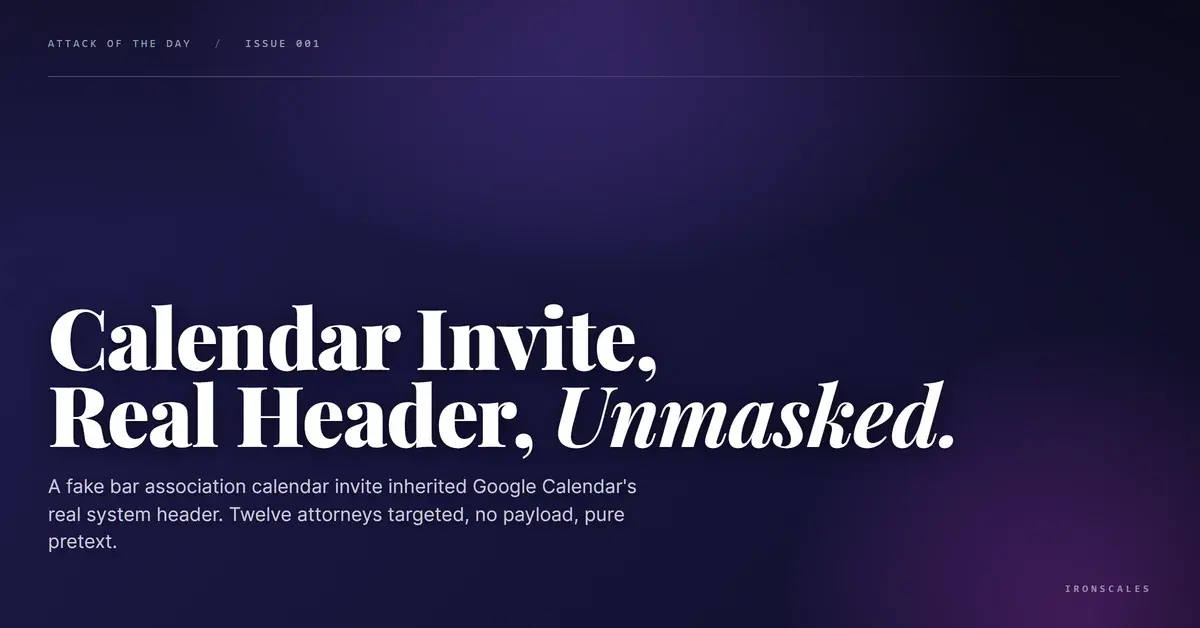
TL;DR A dozen attorneys at unrelated law firms were mass-addressed on one calendar invitation announcing a regional bar association board meeting. Every content control passed it. Roughly thirty links scanned clean, the calendar attachment scanned clean, DKIM validated and composite authentication passed. The message carried a real Sender header naming Google Calendar's own notification address, because the invite genuinely was dispatched through Google Calendar. The visible From and the Reply-To used two different personal-name aliases on an unrelated domain with no SPF record published. A recipient reported it as impersonation and the mailbox was quarantined.
Severity: Medium Impersonation Pretexting Header-Spoofing Mass-Targeting MITRE: T1566 MITRE: T1684.001 MITRE: T1585.003 MITRE: T1583.001
A calendar invitation arrived in a dozen mailboxes at once. The recipients were attorneys at unrelated law firms with no connection to each other beyond a shared professional membership, plus one contact at an insurance brokerage. The invite announced a board meeting for a regional bar association, a one hour midday slot, with an agenda document and a set of prior meeting minutes linked in the body and a routine invite.ics attachment. One of the recipients reported it and tagged it as an impersonation attempt.
Every control that inspects content passed the message. Roughly thirty URLs were scanned and all of them came back clean. The attachment came back clean. DKIM validated. Composite authentication passed. There was no landing page, no credential form, and nothing to detonate, because none of that was present. What was wrong with this message lived entirely in its identity structure.
The Platform Header Was Genuine
Mail carries two separate notions of who sent it. There is the author, which is the visible From, and there is the submitting agent, which is what a Sender header records when the two differ. Google Calendar populates that second header with its own notification address on every invite it dispatches. It is boilerplate plumbing, applied uniformly.
This message carried that header, and it was not forged. The invite really had been created in Google Calendar and pushed out by Google Calendar, so the platform stamped its own notification address on the way through, exactly as designed.
That is the part worth sitting with. A header that reads like a strong provenance signal was in fact one of the weakest claims in the message. It says which system relayed the bytes. It says nothing about who booked the meeting, because it is inherited automatically by anybody with an account on the platform. Read as identity evidence, it is inherited trust, and a technique catalogued in MITRE ATT&CK as establishing cloud accounts is all it takes to acquire.
From and Reply-To Sat on a Domain With No SPF Record
Underneath the platform header, the visible From used a personal-sounding first-and-last-name alias at a domain that had nothing to do with any bar association. The Reply-To carried a different personal-name alias, on a different mailbox, at that same domain. So the message presented three identities at once: a calendar platform in the submission header, one individual as the author, and a second individual as the person any reply would reach.
The authentication results on that domain are the interesting half. SPF returned none. Not a soft fail, not a hard fail. The domain publishes no SPF record at all, so there was no policy for a receiving system to evaluate. DMARC was likewise absent, so there was no alignment requirement and no disposition to apply. DKIM passed on two selectors, one belonging to the platform and one belonging to the attacker domain's own cloud tenant, which confirmed only that whoever controlled the domain had authorized the send. Composite authentication passed on implicit signals.
Absence is the quiet option. A domain that publishes a policy and then violates it produces a fail that filters can score. A domain that publishes nothing produces a shrug. That asymmetry is why the DMARC specification treats a missing record as no policy rather than as a negative result, and why DMARC management and monitoring matters as much for reading inbound records as for protecting your own.
Nothing In The Message Was Malicious
The link inventory deserves specifics, because it is the reason payload analysis had no purchase here. The agenda and prior-minutes links pointed into a genuine association document tenant. There was a video conference join link. The rest were the response and view-in-calendar links the platform appends to every invite. All clean, every one.
This is what a pretext-first message looks like. There is no infrastructure to reputation-check, no redirect chain to unwind, no attachment to sandbox. The 2024 Verizon Data Breach Investigations Report puts pretexting at the top of the social engineering categories it tracks, ahead of payload delivery, and content inspection is structurally blind to a message whose only false statement is who it came from. Both CISA phishing guidance and the NIST definition frame the problem as deception rather than delivery, which is the right frame for this one.
See Your Risk: Calculate how many threats your SEG is missing
A Dozen Attorneys And One Insurance Contact
The recipient list was the loudest thing in the message and the only part no header could launder. Twelve external mailboxes, openly addressed on a single invite, spread across unrelated legal practices with one insurance contact among them, and not one of them internal to the sending domain.
Compare that to the genuine article. A real board invitation is sent from the association's own tenant to the board roster, and the roster is small, consistent, and known to itself. What was addressed here reads like a scrape of a public professional directory, which is what a bar association membership listing is. Attorneys are a rational target for exactly that reason: the directory is public, and unsolicited meeting requests from unfamiliar counsel are an ordinary part of the job rather than an anomaly.
The Case Closed On A Human Report
Themis, the IRONSCALES Adaptive AI analyst, scored the message at 72 percent on a generic phishing pattern match with no specific label assigned, which is a soft signal and honest about being one. There was no malicious verdict available to escalate on, because there was nothing malicious to find.
What actually resolved it was a recipient reading an invitation to an unexpected meeting, from an unrecognized name, at a domain unconnected to the organization supposedly convening it, and reporting it as impersonation. An analyst confirmed the verdict and the mailbox was quarantined. When authentication is clean and content is clean, the human element is not a fallback layer. It is the detection surface.
What To Take From This Case
Treat a platform's own system headers as transport evidence, never as identity evidence. If a message claims an organization, check the domain on the visible From and the Reply-To against that organization, and treat a mismatch as decisive no matter how legitimate the plumbing around it looks.
Read an SPF result of none as an unanswered question rather than a benign one. Then look at the recipient list, because a mass-addressed invitation to a group that has no reason to be on the same invite is a strong signal that costs nothing to check and cannot be faked away by header polish.
Indicators of Compromise
| Type | Indicator | Context |
|---|
| Domain | fldivorcesite[.]com | Attacker sending domain on a cloud productivity suite, no SPF record published |
| Email | calendar-notification@google[.]com | Genuine calendar platform system address, stamped into the Sender header automatically |
| Header artifact | Sender header naming the calendar platform | Platform-issued provenance, inherited by any account holder |
| Mailbox pattern | Two personal-name aliases at the same attacker domain, split across From and Reply-To | Author and reply identities deliberately separated |
| Authentication | spf=none, dmarc=none, dkim=pass, composite authentication pass | No sender policy and no DMARC disposition, so nothing to fail against |
| Attachment | invite.ics | Standard calendar attachment, scanned clean |
| Link profile | Roughly thirty URLs, all clean | Association document links, a conference join link, platform response links |
| Targeting | Twelve external mailboxes openly addressed on one invite | Unrelated legal practices plus one insurance contact, no board roster |
MITRE ATT&CK Mapping
| Technique | ID | Application |
|---|
| Phishing | T1566 | Fabricated professional association board meeting invitation mass-addressed to attorneys at unrelated firms |
| Impersonation | T1684.001 | A regional bar association impersonated as the convening body, with two invented individuals as author and reply contact |
| Establish Accounts: Cloud Accounts | T1585.003 | Attacker domain provisioned on a mainstream cloud productivity suite, which supplied valid DKIM signing and the calendar platform header |
| Acquire Infrastructure: Domains | T1583.001 | Unrelated sending domain used for both the visible From and the Reply-To, with no SPF or DMARC records published |
See You Next Time
Clean links and a passing header check can still add up to a message that is lying about the only thing that matters. Back tomorrow with the next teardown.
Email Attack of the Day is a daily series from
IRONSCALES spotlighting real phishing attacks caught by Adaptive AI and our community of 36,000+ security professionals. Each post breaks down a real attack. What it looked like, why it worked, and what to do about it.







/Blue%20Feature%20Flower%20Icons/gear%20head%20icon.svg)
/Misc%20Icons/icon-nav-credential-theft.svg)










/Leadership%20Headshots/Audian%20Paxson%20Headshot%201000x1000%20032026.webp?width=100&height=100&name=Audian%20Paxson%20Headshot%201000x1000%20032026.webp)



.png?width=50&height=50&name=Untitled%20-%20July%2030%2c%202026%20at%2014.53.38%20(3).png)



/Misc%20Icons/icon-red-teaming-agent-gradient-simple.svg)
/Misc%20Icons/icon-phishing-soc-agent-gradient-simple.webp?width=158&height=167&name=icon-phishing-soc-agent-gradient-simple.webp)
/Misc%20Icons/icon-phishing-simulation-agent-gradient-simple.svg)


/Misc%20Icons/icon-nav-encryption.svg)