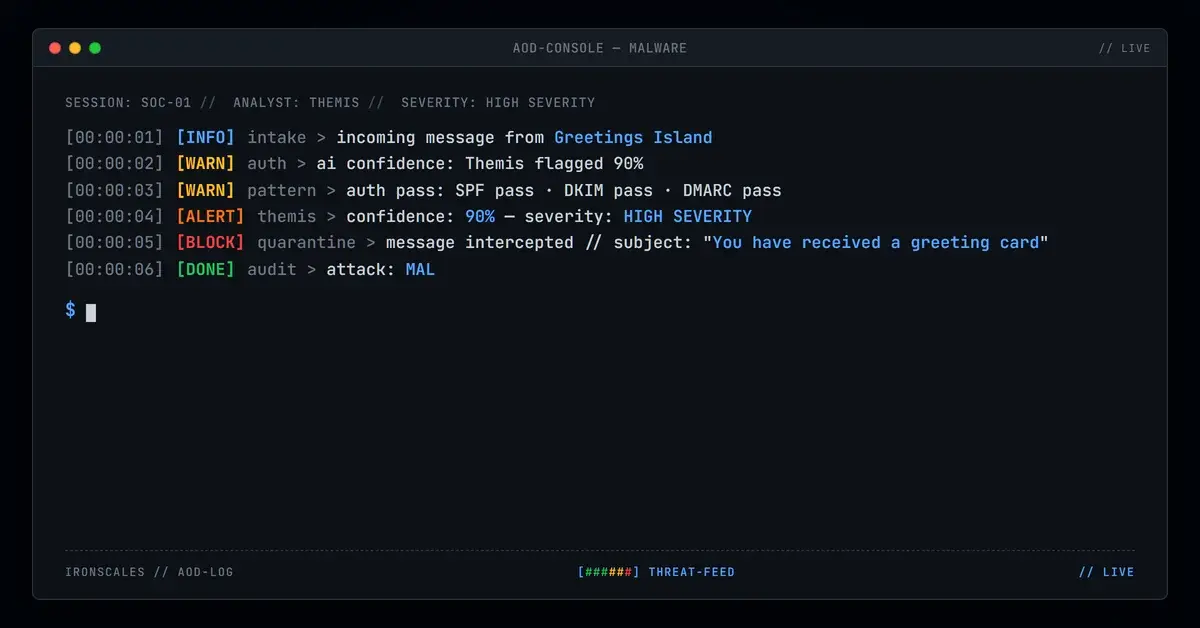
TL;DR An e-card notification reached a data-protection analyst at a regional nonprofit health system carrying real greeting-card artwork hotlinked from the vendor's own network. Every anchor in the body had been globally rewritten to a ScreenConnect remote-access installer requesting guest access, including social icons, Help, About, Privacy, Terms, and Unsubscribe. Authentication passed cleanly because the sender used a free consumer mailbox it actually controlled, and automated URL reputation rated both destination links clean. Microsoft routed the message to Junk, and Themis flagged it at 90 percent confidence, resolving the incident automatically as phishing.
Severity: High Malware Delivery Remote Access Abuse Impersonation MITRE: T1566.002 MITRE: T1204.002 MITRE: T1219
The email looked like a greeting card, because most of it genuinely was one. The layout came from a real consumer e-card service, and the logo, envelope artwork, and social icons were hotlinked live from that vendor's own image network rather than re-hosted copies. A green button offered to open the invitation.
What makes it worth pulling apart is how far the tampering went. Not just that button. The banner reading "CLICK HERE TO VIEW ON COMPUTER." The envelope graphic. The Pinterest, Facebook, and Instagram icons. Help, Blog, About, Contact. The block-sender link. Unsubscribe. Privacy. Terms. Roughly a dozen anchors, most of which nobody clicks on purpose, all rewritten to one destination: a ScreenConnect remote-support installer, ScreenConnect.ClientSetup.msi, requesting guest access on a subdomain of the vendor's own platform.
The recipient held a data-protection analyst role at a regional nonprofit health system. Microsoft's content filter scored it as spam, confidence level 5, and routed it to Junk. Themis, the IRONSCALES Adaptive AI analyst, flagged it at 90 percent and closed it automatically as phishing. The automated URL reputation check on both links returned a verdict of clean.
One Payload Behind a Dozen Different Anchors
Exactly one link differed. The footer text inviting you to visit the brand's website, displayed as greetingsisland[.]com, pointed at a second, unrelated instance subdomain serving the same installer with the same guest-access parameters. Everything else resolved to the first.
That is the signature of a bulk find-and-replace over a saved copy of a real template rather than a hand-built kit. It is crude, and in one way more effective than precision: it removes every safe exit. The careful reader who ignores the call to action and reaches for Unsubscribe lands where the button-clicker lands. MITRE ATT&CK tracks the delivery as Spearphishing Link (T1566.002), and the standing advice is to hover before clicking. Here, hovering anywhere returned the same answer. It also leaves a signal the design gives no hint of: ordinary mail diverges from its displayed destination only at the payload, while this one diverged everywhere at once.
The Payload Was Software, Not a Password Box
No fake sign-in page in this chain, no credential field, none of the artifacts most phishing programs are trained to look for. What the links delivered was a Windows installer for a commercial remote-support product, with query parameters requesting guest access. MITRE maps the halves of that outcome as User Execution: Malicious File (T1204.002) and Remote Access Software (T1219). The distinction from credential theft is operational. A stolen password buys an account until somebody rotates it. A remote session buys a keyboard on a managed endpoint, and it looks like the tooling a help desk uses every day.
That is why advanced malware and malicious URL protection has to reason about context, not content. The file is not malware by any scanner's definition, and the only thing wrong with it is that it showed up unrequested, in a greeting card, addressed to a security analyst.
See Your Risk: Calculate how many threats your SEG is missing
Why the Reputation Verdict Came Back Clean
The platform domain behind both links was registered in 2004 and belongs to a well known remote-support product, with more than twenty years of clean history and an active registration. There is nothing for a reputation engine to score badly. The gap is structural. The platform is self-service, and a tenant names its own subdomain at signup, so the parent domain's accumulated reputation is inherited by every instance under it, including one created an hour ago by someone with a throwaway address. Reputation scoring answers "is this domain disreputable," and the honest answer was no. The question that mattered, "should this file be arriving here by email," is not one a domain lookup can express.
The vendor itself was not breached. Its platform was used as designed by an account that should not have existed, which makes it bystander infrastructure, like the greeting-card brand whose template and images were borrowed wholesale. NIST defines phishing around the deception, not the hosting.
Authentication Passed Because Nothing Was Forged
Every check came back green. SPF passed, with the sending address authorized for the consumer webmail domain in the envelope. DKIM passed against that domain's own selector, DMARC passed on an aligned header, the ARC chain validated end to end, and composite authentication returned a perfect score.
None of that is a failure of email authentication. It is authentication working. The attacker sent from a free mailbox it actually controlled, so there was no spoofing to detect and every header assertion was true. RFC 9989, the DMARCbis specification that replaced the original DMARC RFC in May 2026, is explicit that the mechanism validates domain alignment and nothing else. It confirmed the sender was who it claimed to be, nothing more. The spam verdict deserves the same scrutiny: Junk is a folder, not containment, and people retrieve things from it when expected mail has not arrived.
The Instances Were Already Gone
By the time the case reached investigation, neither instance subdomain resolved. They were live at delivery and unavailable afterward, consistent with disposable self-service trial tenants that lapsed or were shut down, not a compromised third-party account. The instance name on the primary subdomain reads like an organization, but nothing ties it to a real one and no legitimate tenant appears to have been hijacked.
That short lifespan is the argument against indicator-based defense here: a subdomain with days of usefulness will never reach a blocklist in time to matter. What persisted was the pattern, and it came back: the same template and infrastructure signature hit the same organization weeks later under a different personal-sounding sender alias, then again weeks after that. Themis flagged the original partly on that basis, matching resolutions of the same template from a community of 36,000+ security professionals across 18,000+ organizations. The 2026 Verizon Data Breach Investigations Report puts the human element in 62 percent of breaches, with phishing the initial access vector in 16 percent of them. For a health system that exposure sits one endpoint away from clinical systems, which is why healthcare email security has to assume the payload will look boring.
Indicators of Compromise
| Type | Indicator | Context |
|---|
| Email | *****@gmail[.]com | Attacker-controlled free webmail sending mailbox, first-time sender, alias read as an ordinary personal name |
| URL | hxxps://[attacker-instance][.]screenconnect[.]com/Bin/ScreenConnect.ClientSetup.msi?e=Access&y=Guest | Destination of nearly every anchor in the body, including footer boilerplate; reputation verdict clean; did not resolve at investigation time |
| URL | hxxps://ps10[.]screenconnect[.]com/Bin/ScreenConnect.ClientSetup.msi?e=Access&y=Guest | Destination behind the footer text link displaying the greeting-card brand domain; reputation verdict clean; did not resolve at investigation time |
| Domain | screenconnect[.]com | Legitimate remote-support platform registered 2004; bystander infrastructure abused via self-service subdomain provisioning |
| Domain | images[.]greetingsisland[.]com | Genuine brand image network hotlinked for logo, envelope artwork, and social icons |
| File | ScreenConnect.ClientSetup.msi | Signed commercial remote-support installer requesting guest access |
| Technique | Global anchor rewrite | Every link in a real template, including Unsubscribe, Privacy, and Terms, pointed at the installer |
| Auth | SPF pass, DKIM pass, DMARC pass, ARC pass, compauth 100 | Nothing forged; spam confidence level 5 routed the message to junk anyway |
MITRE ATT&CK Mapping
What This Case Rewards
Score the whole link set, not the primary call to action. Uniform destinations across a template, boilerplate included, beats any individual URL as a signal. Per-link reputation evaluated both of these in isolation and passed both; the anomaly exists only at the level of the message.
Treat an unsolicited remote-support installer as an incident, not a download. The CISA phishing guidance for network defenders makes the case for controlling what users can execute, and legitimate software running for an illegitimate reason will not trip an antivirus engine.
Every trust signal here was accurate. The sender authenticated, the images were real, the destination domain was more than twenty years old and reputable, the file was properly signed. Nothing on that list was a lie, and the message was still an attempt to hand an attacker a keyboard inside a hospital network. That gap, between every individual signal being true and the whole being false, is where the work in email security now lives.
Email Attack of the Day is a daily series from
IRONSCALES spotlighting real phishing attacks caught by Adaptive AI and our community of 36,000+ security professionals. Each post breaks down a real attack. What it looked like, why it worked, and what to do about it.







/Blue%20Feature%20Flower%20Icons/gear%20head%20icon.svg)
/Misc%20Icons/icon-nav-credential-theft.svg)










/Leadership%20Headshots/Audian%20Paxson%20Headshot%201000x1000%20032026.webp?width=100&height=100&name=Audian%20Paxson%20Headshot%201000x1000%20032026.webp)



.png?width=50&height=50&name=Untitled%20-%20July%2030%2c%202026%20at%2014.53.38%20(3).png)



/Misc%20Icons/icon-red-teaming-agent-gradient-simple.svg)
/Misc%20Icons/icon-phishing-soc-agent-gradient-simple.webp?width=158&height=167&name=icon-phishing-soc-agent-gradient-simple.webp)
/Misc%20Icons/icon-phishing-simulation-agent-gradient-simple.svg)


/Misc%20Icons/icon-nav-encryption.svg)