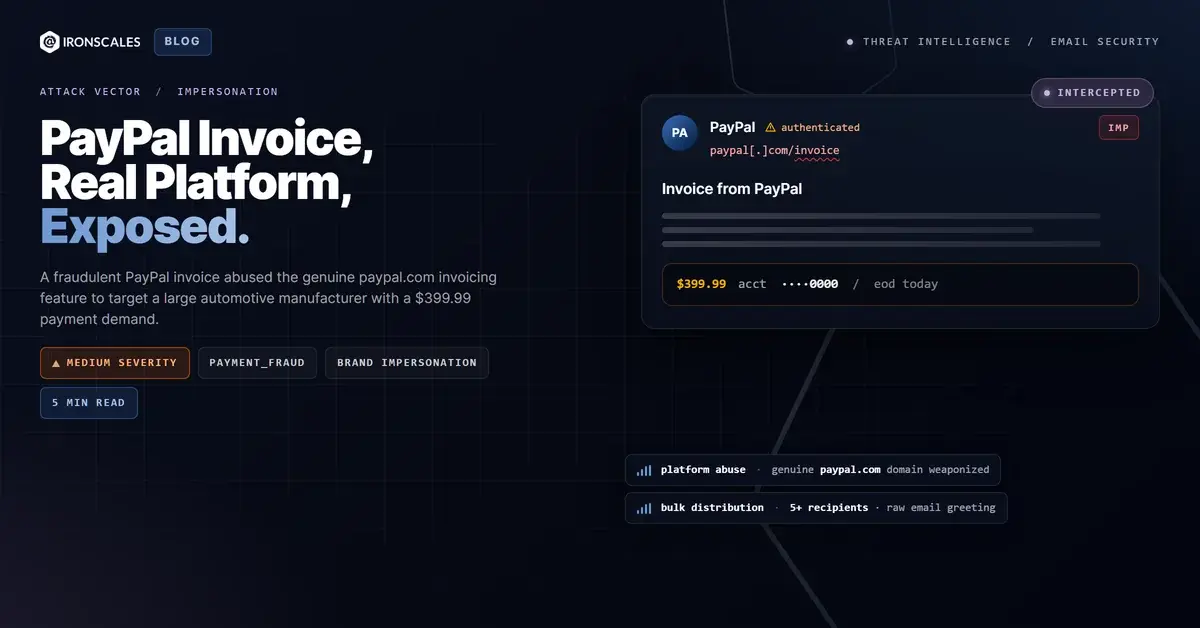
TL;DR An attacker sent a fabricated $399.99 invoice through PayPal's own genuine invoicing feature, then blasted it to at least five employees at a large automotive manufacturer. Because the payment link was a real paypal.com URL, the automated scanner returned a mixed verdict instead of a clean block. The sending identity belonged to an abused small business, authentication came back inconsistent across hops, and recipients were greeted by their raw email address rather than a name. The platform was legitimate. The transaction was not.
Severity: Medium Brand Impersonation Payment Fraud Business Email Compromise MITRE: T1566.002 MITRE: T1657 MITRE: T1684.001
The invoice was really from PayPal. That was the problem.
A $399.99 charge arrived in at least five mailboxes at a large US automotive manufacturer, presented as a PayPal invoice with a familiar blue View and Pay Invoice button. The button worked. It resolved to a genuine paypal.com page, because the invoice was generated inside PayPal's own invoicing feature. No spoofed domain, no lookalike host, no freshly registered payment portal. The attacker did not build fake infrastructure. They rented the real thing.
This is what makes platform abuse so effective. A link scanner is trained to ask one question about a URL: is this domain trustworthy? Here the answer was yes, unambiguously, so the automated verdict came back partial and mixed rather than a clean block. The fraud lived in the content and the distribution, not in the address bar.
Why the Scanner Blinked
Every automated defense that leans on reputation depends on there being something with a bad reputation to catch. Blocklists, domain-age heuristics, and URL categorization all key off the destination. When the destination is paypal.com, those signals fire green.
The payment link pointed at PayPal's invoice viewer, the paypal.com/invoice/payerView path that legitimate PayPal invoices use every day. That path is not going to sit on any blocklist, and it should not. So the scanner did what it was built to do and declined to block a trusted domain. The problem is that a trusted domain says nothing about whether a specific invoice is real, who created it, or whether the person receiving it ever did business with the invoicer. The platform vouched for its own infrastructure. It could not vouch for the intent behind a single invoice.
The Sender That Was Not a Vendor
PayPal invoices are sent from PayPal, but the invoice itself carries a creator identity, and this one traced back to the email identity of a small, legitimate business whose account or address was abused to originate the charge. That business is a victim here, not a culprit, so its name stays out of this writeup. What matters is the pattern: a real, low-profile business identity gave the fraudulent invoice a plausible origin, while the invoicer name printed on the charge was fabricated outright.
The authentication picture matched that muddle. Sender Policy Framework (SPF) failed at several sending hops yet passed at one Proofpoint-hosted gateway relay, a legitimate mail-scanning service that accounts for part of the variance. DKIM was largely absent, and the ARC chain showed body-hash mismatches from message rewriting along the path. At the tenant boundary, composite authentication ultimately reported compauth=fail and dmarc=fail, and the platform automatically resolved the message as phishing. Even so, the delivery had already ridden trusted PayPal notification infrastructure far enough to land in front of employees.
See Your Risk: Calculate how many threats your SEG is missing
The Tell Was the Distribution
If a link scanner cannot help, the recipient behavior can. A genuine invoice is a one-to-one document. You get one because you bought something. This one went to at least five people at the same company in a single blast, and the distribution list itself was oddly formed, consistent with bulk targeting rather than a real transaction. Each recipient was greeted by their raw email address instead of a name, which is what happens when an attacker mail-merges an invoice across a scraped list rather than billing a specific customer.
That low-personalization, high-fanout shape is the fingerprint of invoice fraud running at volume. The dollar figure is deliberately modest. A $399.99 charge is small enough to clear an expense approval without much scrutiny and plausible enough to look like a subscription or a vendor fee someone forgot about. Multiply a few hundred dollars across every inbox that pays without checking, and the economics work.
Mapping to MITRE ATT&CK
The tradecraft lines up with a handful of techniques in the MITRE ATT&CK framework:
- T1566.002 Spearphishing Link covers the core delivery. The payload was a link, and that link pointed at a real platform page rather than an attacker-controlled site.
- T1684.001 Impersonation covers the fabricated invoicer identity riding an abused business email account to make the charge look sourced.
- T1657 Financial Theft covers the objective. There was no credential capture and no malware. The goal was a direct payment for a charge that was never owed.
Indicators of Compromise
| Indicator | Type | Notes |
|---|
hxxps://www[.]paypal[.]com/invoice/payerView/details/INV2-HPDS-RGGW-VUU6-XMW8 | Payment URL | Genuine PayPal invoice page weaponized as the payment CTA |
$399.99 | Invoice amount | Modest figure chosen to clear low-scrutiny expense approval |
| Fabricated invoicer name | Invoice metadata | Attacker-supplied creator name printed on the PayPal invoice |
| Bulk send to 5+ mailboxes | Distribution | Recipients greeted by raw email address, no personalization |
Detection and What to Watch For
Signature and reputation tooling was never going to stop this, because the infrastructure is legitimate and there is nothing to blocklist. Detection has to read intent. The signals that matter are a transactional notice from a real platform that lands on multiple internal mailboxes at once, a greeting that uses an email address instead of a name, an invoicer or vendor no one in the finance chain recognizes, and authentication that comes back inconsistent across hops even when the final link is clean.
This is the gap that behavioral analysis closes. Themis, the Adaptive AI analyst on the IRONSCALES platform, weighs the relationship between the claimed transaction, the sending identity, and the recipient context the way an analyst would, so a fraudulent invoice riding a trusted brand still gets flagged when domain checks pass. Trained on signal from 36,000+ security professionals across 18,000+ organizations, that model treats a five-mailbox invoice blast as the anomaly it is. The 2024 Verizon Data Breach Investigations Report names pretexting, mostly business email compromise, as the top social-engineering incident type, with a median transaction near $50,000, and it puts the human element in 68 percent of breaches. The Microsoft Digital Defense Report 2024 documents the same drift toward abusing trusted services instead of breaking them, and the FBI's 2023 Internet Crime Report puts invoice and business-identity fraud among the costliest categories year after year.
The Takeaway
A trusted domain is not a trusted transaction. The reflex to pay an invoice because it came from PayPal is the exact reflex this campaign monetized, and no amount of URL scanning fixes it, because the URL was never the problem. Real vendors bill you for things you bought, one recipient at a time, and they know your name. Verify unexpected charges inside the platform account rather than from the email, and pair that habit with detection that reads intent instead of reputation. For a target-rich environment like a large manufacturer, where accounts-payable volume is high and a few hundred dollars looks like noise, closing that gap is what separates a caught fraud from a paid one.
CISA's guidance on recognizing and stopping phishing early is a solid reference for building that reflex across a team: https://www.cisa.gov/resources-tools/resources/phishing-guidance-stopping-attack-cycle-phase-one
Email Attack of the Day is a daily series from
IRONSCALES spotlighting real phishing attacks caught by Adaptive AI and our community of 36,000+ security professionals. Each post breaks down a real attack. What it looked like, why it worked, and what to do about it.







/Blue%20Feature%20Flower%20Icons/gear%20head%20icon.svg)
/Misc%20Icons/icon-nav-credential-theft.svg)










/Leadership%20Headshots/Audian%20Paxson%20Headshot%201000x1000%20032026.webp?width=100&height=100&name=Audian%20Paxson%20Headshot%201000x1000%20032026.webp)



.png?width=50&height=50&name=Untitled%20-%20July%2030%2c%202026%20at%2014.53.38%20(3).png)



/Misc%20Icons/icon-red-teaming-agent-gradient-simple.svg)
/Misc%20Icons/icon-phishing-soc-agent-gradient-simple.webp?width=158&height=167&name=icon-phishing-soc-agent-gradient-simple.webp)
/Misc%20Icons/icon-phishing-simulation-agent-gradient-simple.svg)


/Misc%20Icons/icon-nav-encryption.svg)