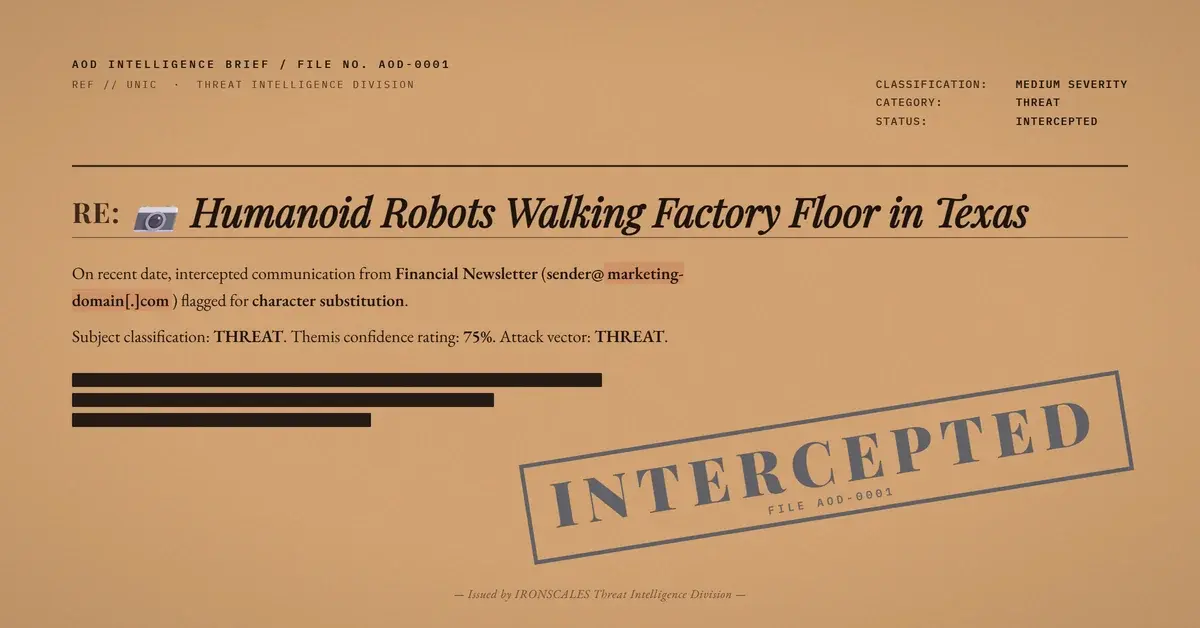
TL;DR A financial newsletter arrived from a young, privacy-shielded domain sending through a legitimate marketing-cloud platform, so SPF, DKIM, and DMARC all passed. The evasion was not in the headers. Dozens of ordinary letters across the subject line and body had been replaced with Greek and Cyrillic look-alikes, so words like here, rally, winners, and millions rendered perfectly to a reader while matching nothing on a keyword list. Clicks routed through a branded tracker into a third-party redirect domain with prior low-reputation history. Behavioral signals caught it.
Severity: Medium Investment-Fraud Filter-Evasion Redirect-Abuse MITRE: T1566.002 MITRE: T1583.001 MITRE: T1204.001 MITRE: T1036
The message that reached a retired senior leader at a nonprofit science and education institution looked like a financial newsletter having a very exciting morning. A camera emoji opened the subject line, followed by a teaser about humanoid robots walking a factory floor in Texas. The body promised footage that certain people in Washington did not expect to go public, described real machines walking, turning, and working, and pointed at a text link offering to reveal which three stocks stood to benefit. No attachment, no login page, no credential form anywhere in the chain. This was a stock-pitch scam, and nearly all of its technical effort went into making sure a content filter could not read the pitch. Underneath the legible text, most of the interesting words were not spelled the way they looked.
The same trick, applied dozens of times
Start with the subject line, where the substitution begins in the first word that matters. What rendered as Humanoid was not spelled with a Latin capital H and a Latin lowercase u. It used a Greek capital Eta and a Greek lowercase upsilon, two characters that render close enough to their Latin counterparts that no reader would pause. On its own that swap is a footnote, a variant of masquerading documented for years.
What made this send worth writing up is that the operator did it again, and again, and again. The word that read as here used a Cyrillic character in place of a Latin e. The words reading as rally, contracts, winners, millions, and factory all carried substituted glyphs. Across the subject and the body, dozens of characters had been swapped for visual twins from other Unicode blocks. Not a brand name. Not a domain. Just the ordinary vocabulary of a hard-sell investment pitch, character by character.
The result is two documents inside one message. Keyword lists and high-pressure-language heuristics scored a text that did not hold the terms they were built for, while the recipient read the fluent version the operator actually wrote. That is the whole trick, and it cost the attacker a find-and-replace pass.
Authentication was not the weak point
None of this was hidden behind broken headers. SPF passed, DKIM passed with two valid signatures (one for the sender's own subdomain, one for the marketing platform that relayed it), DMARC passed, and composite authentication returned a perfect score. The sending domain even published a DMARC policy of reject, stricter than most legitimate senders bother with.
The reason is straightforward. The operator was not spoofing anyone. They registered their own domain roughly twelve weeks before this send, behind registrar privacy protection, stood up a subdomain, pointed its mail records at a mainstream marketing-cloud platform, and sent as themselves. Every check answered the question it was designed to answer: did this domain really send this mail. Nothing in the DMARC specification claims to answer whether the domain deserves trust, and here it did not. A domain that has existed for a single quarter, registered anonymously, pushing polished financial promotions through enterprise mail infrastructure, is a risk profile authentication is structurally blind to.
The click path ran through a borrowed reputation
Every clickable element, the hero image, the text call to action, the footer buttons, even the unsubscribe link, pointed at a branded click-tracking host on the sender's own subdomain, alongside a 1x1 open-tracking pixel. That is exactly what legitimate marketing email looks like, and it is the point.
At least one of those tracked links was observed forwarding into a third-party redirect service, which carried the visitor onward to a branded stock-tip page. The redirect URL embedded the recipient's own address as a path segment, which means each click was attributable to a specific mailbox. Scanners rated the visible links clean, because a marketing tracker and a redirect service are not malicious infrastructure by themselves. What the verdict could not express is that this redirect domain already carried a documented low-reputation history. The pattern is a phishing link laundered through two layers of ordinary-looking telemetry, and the first hop tells you nothing about the destination.
See Your Risk: Calculate how many threats your SEG is missing
What actually caught it
The message was quarantined on receipt and resolved as phishing automatically, affecting a single mailbox. The signals that mattered were not authentication results, because those were flawless. They were a sending domain barely three months old, an unusual density of non-Latin characters substituted into plain English words, and multiple tracking and redirect hops including one with prior bad history. Those are compositional and relational judgments about a message, the kind of reasoning our Adaptive AI applies alongside header checks rather than after them. Character anomalies and multi-hop link behavior are also what advanced malware and URL attack protection has to evaluate at the destination, not just at the visible link.
The urgency is not abstract. The 2024 Verizon Data Breach Investigations Report measured the median time to click a phishing link at 21 seconds and put the human element in 68% of breaches. CISA phishing guidance makes the same case from the defender's side: assume the lure will be read and will be convincing.
Indicators of Compromise
| Type | Indicator | Context |
|---|
| Domain | safeinvestzone[.]com | Core sending domain, registered roughly twelve weeks earlier, privacy-protected |
| Domain | siz[.]safeinvestzone[.]com | Sending subdomain, DMARC reject, mail records pointed at a marketing-cloud platform |
| Email | your[@]siz[.]safeinvestzone[.]com | Sender address; display name referenced plant footage plus a ticker-style suffix |
| Hostname | mta[.]siz[.]safeinvestzone[.]com | Outbound relay, SPF-authorized for the bounce domain |
| IPv4 | 128[.]245[.]71[.]211 | Sending mail transfer agent, US-geolocated |
| IPv4 | 13[.]111[.]67[.]8 | Second address for the sending subdomain |
| Domain | click[.]siz[.]safeinvestzone[.]com | Branded click-tracking host for every link, plus the open-tracking pixel |
| Domain | clkmg[.]com | Third-party redirect service with prior low-reputation phishing history |
| URL | hxxps://www[.]clkmg[.]com/magicarty/btei/[recipient-email]/839SIZ/B/BTEI609GI2 | Redirect hop from the scan record; recipient address removed |
| Technique | Non-Latin character substitution | Greek Eta and upsilon for Latin H and u in the subject; Cyrillic and other glyphs in words rendering as here, rally, contracts, winners, millions, factory |
Disposition: spam confidence level 6, quarantined on receipt, resolved as phishing. Payload: link-only. One mailbox affected.
MITRE ATT&CK mapping
See you next time
The lesson is not that look-alike characters exist. It is that one cheap substitution, repeated dozens of times in ordinary words rather than brand names, separates the document your filters read from the document your people read. Check what the characters actually are, how old the sending domain is, and where the later link hops go. Clean headers begin the question, not the answer.
Email Attack of the Day is a daily series from
IRONSCALES spotlighting real phishing attacks caught by Adaptive AI and our community of 36,000+ security professionals. Each post breaks down a real attack. What it looked like, why it worked, and what to do about it.







/Blue%20Feature%20Flower%20Icons/gear%20head%20icon.svg)
/Misc%20Icons/icon-nav-credential-theft.svg)










/Leadership%20Headshots/Audian%20Paxson%20Headshot%201000x1000%20032026.webp?width=100&height=100&name=Audian%20Paxson%20Headshot%201000x1000%20032026.webp)



.png?width=50&height=50&name=Untitled%20-%20July%2030%2c%202026%20at%2014.53.38%20(3).png)



/Misc%20Icons/icon-red-teaming-agent-gradient-simple.svg)
/Misc%20Icons/icon-phishing-soc-agent-gradient-simple.webp?width=158&height=167&name=icon-phishing-soc-agent-gradient-simple.webp)
/Misc%20Icons/icon-phishing-simulation-agent-gradient-simple.svg)


/Misc%20Icons/icon-nav-encryption.svg)