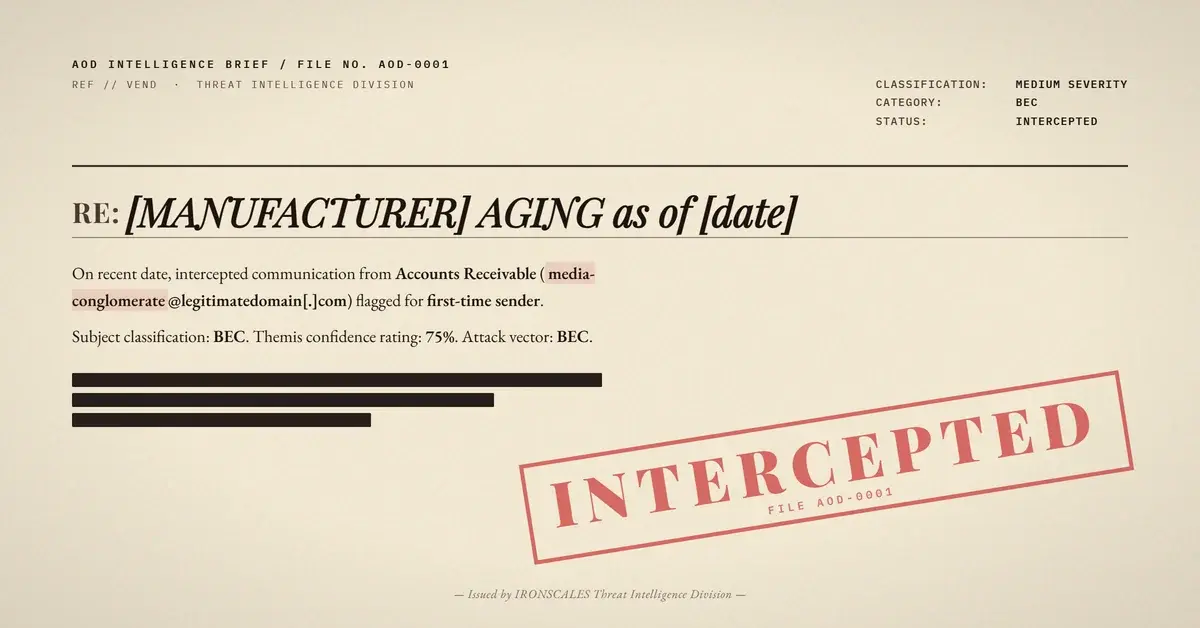
TL;DR A junior accountant at a personal-care and pharmaceutical manufacturer received a first-time collections email from the account of a major media conglomerate the company actually advertises with. The message passed SPF, DKIM, DMARC, and ARC, all aligned to the sender's real domain, because it came from a genuine mailbox rather than a spoof. There was no link and no payment demand, just a broken-English request for invoice status and any missing credit memos, plus an unsolicited aging-statement spreadsheet. This is vendor email compromise in its quietest form: a low-friction probe designed to open a dialogue.
Severity: Medium Vendor Email Compromise Business Email Compromise Trusted Relationship Abuse MITRE: T1566.001 MITRE: T1199 MITRE: T1585
A junior accountant in the finance department of a personal-care and pharmaceutical manufacturer opened a routine-looking collections email. It came from a name her employer knew well, the accounts-receivable side of a major media conglomerate the company actually buys advertising from. The email asked for a status update on some invoices and any missing credit memos. Attached was an aging-statement spreadsheet. Nothing was on fire, no one was demanding a wire, and no link waited to be clicked.
That restraint is exactly what makes this case worth studying. Almost every phishing teardown turns on an artifact you can block: a lookalike domain, a credential-harvest URL, a malicious payload. This message had none of them. It sailed through every authentication check clean, because it was not a forgery at all.
A cold email from a warm relationship
The sender address belonged to the media conglomerate's real domain, and the account behind it was a genuine mailbox, not a spoofed header. The two organizations have a real commercial relationship. The manufacturer is a known, heavy advertiser with the broadcaster, which means an invoice-and-collections conversation between their finance teams is entirely plausible. An attacker operating from inside that trusted account does not have to manufacture a pretext. The relationship supplies it.
What broke the illusion was context, not infrastructure. This was a first-time sender to the recipient's mailbox despite the long-standing business relationship, which is odd for an established accounts-receivable contact. The ask was generic rather than specific to any real open balance. And the grammar wobbled in ways a native accounts-receivable clerk would not produce, with phrases like "currency Network aging" and a possessive that read "Collections's team." Legitimate collections notes from a large media company are templated and clean. This one was templated and wrong.
This is vendor email compromise in its most patient form. There was no payment demand and no credential prompt in the visible body. The entire message was a low-friction probe: get a finance staffer to reply, confirm the mailbox is live and monitored, and open a thread that a later message can escalate into a fraudulent payment redirect. The first email in a business email compromise chain rarely asks for money. It asks for a conversation.
Authentication was never the problem
Here is the uncomfortable part for anyone relying on the email authentication trinity as a verdict. The message passed SPF. It passed DKIM. It passed DMARC, aligned to the sender's real domain. The ARC chain passed as well, and it relayed through Microsoft Office 365 protection infrastructure and landed with a low spam confidence level (SCL 1). Every server-level signal a secure email gateway leans on came back green.
They came back green because they were telling the truth. SPF, DKIM, and DMARC exist to prove a message came from where it claims to come from. This one genuinely did. When the sending account is real, authentication is not a defense, it is a rubber stamp. That is the structural weakness business email compromise exploits, and it is why VEC and BEC consistently outrank malware in financial damage.
The only technical oddity was the attachment: an unsolicited spreadsheet described as an aging statement, roughly 11 KB. The gateway scanned it clean. That verdict means the scanner found no known-bad signature. It does not mean the workbook was deep-inspected for macros or external data connections, and it does not mean the accountant should have opened it. An unexpected spreadsheet from a first-time sender is a prompt to pick up the phone, not to double-click.
The tell was in the grammar, not the headers
See Your Risk: Calculate how many threats your SEG is missing
Strip away the authentication noise and the signals that mattered were all behavioral. A first-time sender inside a domain the organization already trusts. A generic collections ask with no reference to a specific, verifiable open invoice. Machine-broken phrasing inconsistent with a large enterprise's accounts-receivable team. An attachment nobody requested. None of those are things a signature engine or a reputation list can catch. The domain is legitimate, the infrastructure is legitimate, the relationship is legitimate. Only the intent is not.
Mapping to MITRE ATT&CK
The tradecraft maps cleanly to a few techniques in the MITRE ATT&CK framework:
- T1566.001 Spearphishing Attachment covers the delivery vehicle, the unsolicited aging-statement spreadsheet used to carry the pretext and probe engagement.
- T1199 Trusted Relationship covers the core of the attack, abusing the genuine advertiser-broadcaster relationship and a real authenticated account to bypass suspicion.
- T1585 Establish Accounts covers the operator's foothold in a legitimate mailbox used to originate the fully authenticated message.
Indicators of Compromise
There is not much here to block, which is the entire point of the case.
| Indicator | Type | Notes |
|---|
[manufacturer]_EstadoCuenta_[timestamp].xlsx | Attachment | Unsolicited aging-statement spreadsheet (~11 KB), scanned clean but not deep-inspected |
672423756aa6efc4b404c4c8d516cabf | File hash (MD5) | Hash of the attached spreadsheet |
[MANUFACTURER] AGING as of [date] | Subject pattern | Generic collections-statement subject naming the recipient's own employer |
| First-time sender inside a trusted vendor domain | Behavioral signal | Established relationship, no prior direct correspondence with this mailbox |
Detecting an attack that brings no attack tools
Signature and reputation checks were never going to catch this. The sender is real, the domain is real, and the attachment carried no known-bad payload. Detection has to move to the layer where the anomaly actually lives: the relationship and the behavior around the message.
This is where IRONSCALES adds a layer static gateways miss. Themis, the Adaptive AI analyst on the IRONSCALES platform, models normal sender-recipient relationships and reads the intent behind a message the way a seasoned analyst would, flagging a first-time contact and an out-of-pattern financial ask even when SPF, DKIM, and DMARC all pass. That perspective is sharpened by anomaly reporting from the 36,000+ security professionals across 18,000+ organizations in the IRONSCALES community. The 2024 Verizon Data Breach Investigations Report names pretexting, largely business email compromise, as the top social-engineering incident type, with a median BEC transaction around 50,000 dollars, and puts the human element in 68 percent of breaches. The Microsoft Digital Defense Report 2024 documents the same shift toward abusing trusted services and identities rather than breaking them, and the FBI's 2023 Internet Crime Report ranks business email compromise among the costliest crime categories year after year.
The takeaway
The most dangerous phishing email of the day may be the one that does nothing alarming. No urgency, no link, no wire request, just a familiar name asking a reasonable question. Authentication will tell you the message is genuine, and it will be right, which is precisely why authentication cannot be the last word. Treat unexpected financial asks from a trusted vendor as claims to verify, not facts to act on, and confirm through a known phone number or portal before touching an unsolicited attachment. Pairing that reflex with behavioral detection is what closes the gap this quiet probe was built to find. CISA's guidance on recognizing and stopping phishing early is a solid reference for building that habit across a finance team: https://www.cisa.gov/resources-tools/resources/phishing-guidance-stopping-attack-cycle-phase-one
Email Attack of the Day is a daily series from
IRONSCALES spotlighting real phishing attacks caught by Adaptive AI and our community of 36,000+ security professionals. Each post breaks down a real attack. What it looked like, why it worked, and what to do about it.







/Blue%20Feature%20Flower%20Icons/gear%20head%20icon.svg)
/Misc%20Icons/icon-nav-credential-theft.svg)










/Leadership%20Headshots/Audian%20Paxson%20Headshot%201000x1000%20032026.webp?width=100&height=100&name=Audian%20Paxson%20Headshot%201000x1000%20032026.webp)



.png?width=50&height=50&name=Untitled%20-%20July%2030%2c%202026%20at%2014.53.38%20(3).png)



/Misc%20Icons/icon-red-teaming-agent-gradient-simple.svg)
/Misc%20Icons/icon-phishing-soc-agent-gradient-simple.webp?width=158&height=167&name=icon-phishing-soc-agent-gradient-simple.webp)
/Misc%20Icons/icon-phishing-simulation-agent-gradient-simple.svg)


/Misc%20Icons/icon-nav-encryption.svg)