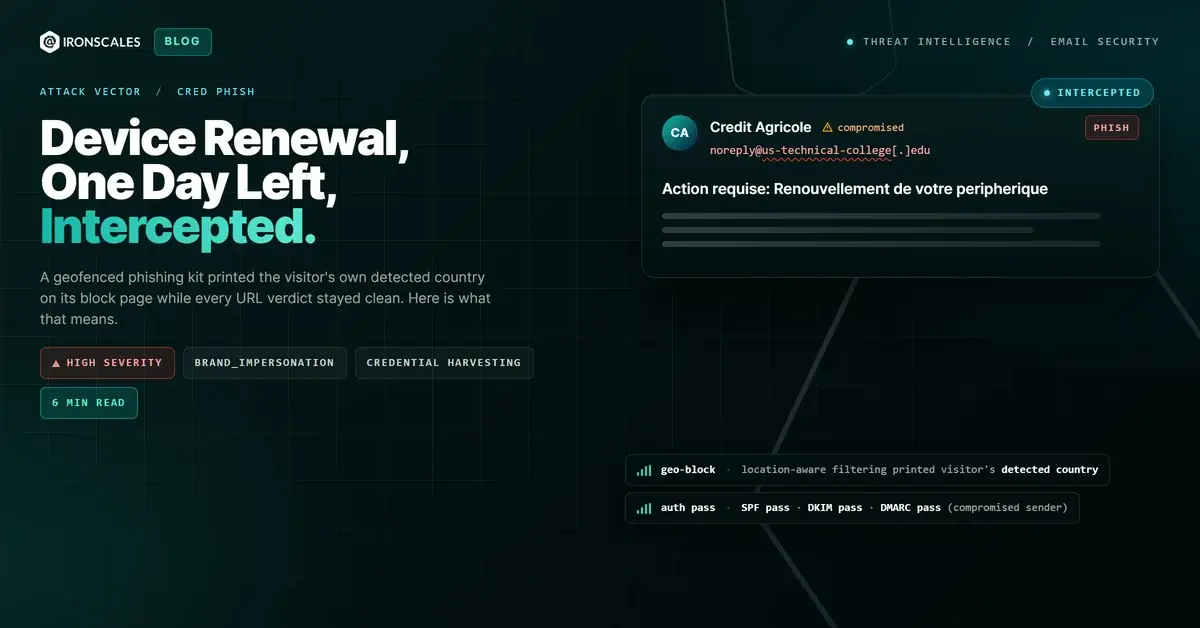
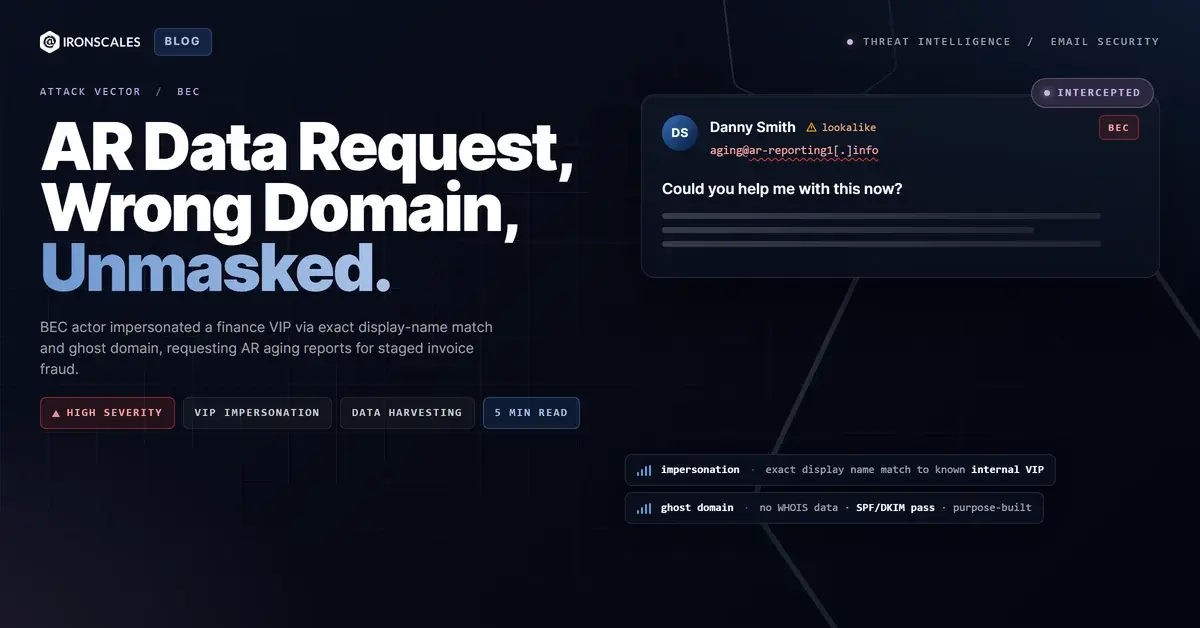
TL;DR A business email compromise (BEC) actor created a sending identity on ar-reporting1[.]info, a domain with no public WHOIS registration data, and used it to impersonate an internal finance director at a metals and building products firm by matching the director's display name exactly. The email asked a finance staff member for accounts receivable aging reports and customer A/P contact emails, the first step in a staged invoice fraud playbook. Full SPF and DKIM authentication passed because the attacker correctly configured the sending domain, but Microsoft 365 anti-spam scored the message as high-risk (SCL 5, CAT:PHISH) and quarantined it. IRONSCALES flagged it as VIP impersonation and it was mitigated within seconds of delivery.
Severity: High Bec Vip Impersonation Data Harvesting MITRE: T1566.002 MITRE: T1078
The attacker did not need a link. They did not need an attachment. They needed a name and a question.
In early June 2026, a finance operations staff member at a mid-size metals distribution company received an email from "Danny Smith" asking for the most recent accounts receivable aging reports and the A/P contact emails for customers with invoices past 30 days. The message was professional, personally addressed, and modestly urgent: "Could you help me with this now?" Danny Smith was a real person in the organization. The email was not from him.
The Anatomy of a Ghost-Domain BEC
The actual sending address was aging@ar-reporting1[.]info. The domain has no publicly available WHOIS data, a red flag that legitimate corporate mail domains almost never carry. Established companies register their mail-sending domains through registrars that publish at minimum the registrar name and creation date; a domain with no retrievable registration details is an indicator of purpose-built fraud infrastructure designed to be difficult to trace.
The attacker configured the domain correctly for authentication. SPF passed because the sending IP (63[.]250[.]43[.]88, an outbound Spacemail relay) was authorized in the DNS record for ar-reporting1[.]info. DKIM passed with a valid signature for the same domain. DMARC returned a "bestguesspass" result. From a raw authentication standpoint, the message was technically sound, which is exactly the point.
Business email compromise actors have long understood that authentication and legitimacy are not the same thing. The FBI IC3 2024 report (FBI) recorded over $2.9 billion in BEC losses, with a significant portion involving exactly this pattern: purpose-built domains that authenticate correctly while impersonating insiders. The Verizon DBIR 2024 attributes 38% of breaches to credential compromise across the kill chain; AR data and A/P contacts are the upstream intelligence that makes those credential attacks more precise.
See Your Risk: Calculate how many threats your SEG is missing
Staged Fraud: Why AR Data Is the First Step, Not the Last
The request in this email sounds like a data pull, not a fraud attempt. No wire transfer was requested. No bank account was mentioned. This is deliberate. Sophisticated BEC actors operate in stages. The first email collects intelligence: who are the customers, what do they owe, who processes their payments. The second email, sent to those customers posing as the vendor, delivers the fraud payload: updated bank account details, a new payment portal, or an emergency wire request.
The social engineering was precise. The message body mentioned invoices due within 30 days and those more than 30 days past due, terminology consistent with real AR operations. The greeting used the recipient's first name. The sender display name matched the internal VIP's name exactly, a match confirmed by the IRONSCALES platform's impersonation detection. The only structural tell was the domain itself, which no standard mail client surfaces prominently.
IRONSCALES Themis identified the impersonation because the platform maintains a knowledge graph of known sender-to-address relationships. The combination of an exact display name match to a known VIP and a sending domain with no prior correspondence history with the organization produced a clear impersonation signal. The message was quarantined within seconds of delivery.
Why the Filter Caught What Training Might Have Missed
Microsoft 365 also flagged this message at SCL 5 with category PHISH and routed it to Junk. That outcome is not guaranteed. SCL scoring is probabilistic, and the configuration of recipient tenant quarantine policies varies. An organization where junk-folder review is not routine might have had this message surface in the inbox with a delayed human review.
More important, the absence of links or attachments removes most of the technical signals that user security awareness training focuses on. There was no suspicious URL to hover over. There was no attachment to scan. The attack surface was entirely behavioral: a name match, a plausible request, and a mild urgency cue. CISA's phishing guidance and NIST's phishing definition both acknowledge that the most effective phishing does not require a payload if the social engineering is sufficient to prompt the target to act.
For security teams, the operative control is a process change inside the finance function: out-of-pattern requests for financial data should require a second-channel confirmation regardless of how legitimate the sender appears. The MITRE ATT&CK technique here is Spearphishing via Link (T1566.002) combined with impersonation of internal accounts.
Ghost-Domain BEC Infrastructure
| Type | Indicator | Context |
|---|
| Domain | ar-reporting1[.]info | Attacker sending domain; no WHOIS data available |
| Email | aging@ar-reporting1[.]info | Attacker From address, display name "Danny Smith" |
| IP | 63[.]250[.]43[.]88 | Authorized sending relay for ar-reporting1[.]info (Spacemail) |
Defending the Finance Inbox Against Display-Name Fraud
The control gap here is not technical: it is procedural. Authentication passed. Anti-spam partially flagged the message. What prevented harm was automated impersonation detection, not a policy requiring second-channel verification of data requests. Both layers matter, and neither replaces the other.
Organizations should configure mail clients to surface the actual sending domain beside the display name for external senders. Many Microsoft 365 tenants have external-sender banners enabled, but that banner only signals "external origin," not "display name mismatch." A solution purpose-built for business email compromise protection compares the display name against a known-good registry of internal identities and flags the mismatch even when authentication is clean.
IRONSCALES platform data shows that 36,000+ security professionals rely on this kind of behavioral analysis to catch what technical authentication cannot. In this case, the gap between what authentication checked (is this domain authorized to send?) and what mattered (is this actually the finance director?) was precisely where the attacker operated.
The IBM Cost of a Data Breach 2024 report (IBM) puts the average total breach cost at $4.88 million, with social engineering consistently among the top initial access vectors. Organizations using SOC automation can correlate display-name impersonation signals with sender history and VIP registries at machine speed, closing the detection gap before a finance team member has an opportunity to respond.
Email Attack of the Day is a daily series from
IRONSCALES spotlighting real phishing attacks caught by Adaptive AI and our community of 36,000+ security professionals. Each post breaks down a real attack. What it looked like, why it worked, and what to do about it.







/Blue%20Feature%20Flower%20Icons/gear%20head%20icon.svg)
/Misc%20Icons/icon-nav-credential-theft.svg)










/Leadership%20Headshots/Audian%20Paxson%20Headshot%201000x1000%20032026.webp?width=100&height=100&name=Audian%20Paxson%20Headshot%201000x1000%20032026.webp)



.png?width=50&height=50&name=Untitled%20-%20July%2030%2c%202026%20at%2014.53.38%20(3).png)



/Misc%20Icons/icon-red-teaming-agent-gradient-simple.svg)
/Misc%20Icons/icon-phishing-soc-agent-gradient-simple.webp?width=158&height=167&name=icon-phishing-soc-agent-gradient-simple.webp)
/Misc%20Icons/icon-phishing-simulation-agent-gradient-simple.svg)


/Misc%20Icons/icon-nav-encryption.svg)