TL;DR A fully authenticated email reached a marketing mailbox at a global agrochemical company carrying no links and no attachments. The visible body was a Chinese-language pitch to join a paid stock-tip group, whose only call to action was a messaging-app handle and a payment to be sent after profiting rather than before. Beneath the pitch, font markup set both text and background to silver, hiding paragraphs of public-domain English novel prose that were invisible on render but present in the body. Exchange scored it as spam, Themis flagged it on language alone, and the mailbox was quarantined.
Severity: Medium Phishing Social Engineering Advance Fee Fraud MITRE: T1566 MITRE: T1585.002
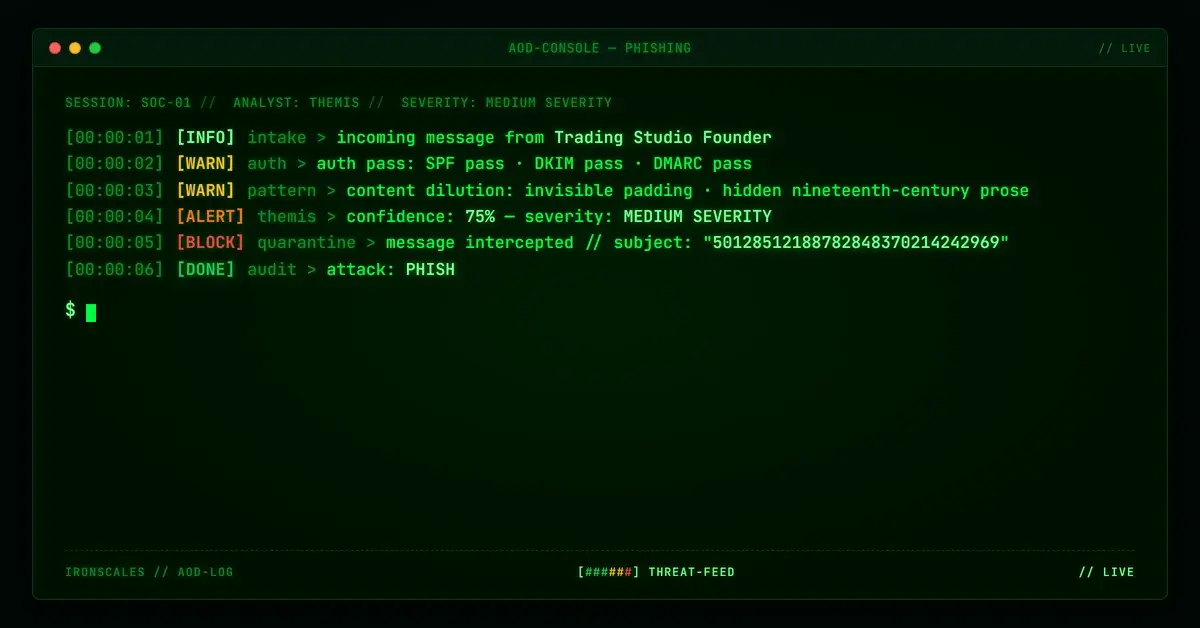
At 01:04 UTC on a Monday in early March 2026, an email landed in the mailbox of a marketing lead at a global agrochemical and crop-protection company. It carried no links. It carried no attachments. SPF passed, DKIM passed, DMARC passed, and Microsoft's composite authentication returned a clean pass at the top of its scale. There was nothing for a URL scanner to fetch and nothing for a sandbox to open.
The subject line was 29 digits long.
A Subject Line That Was Just a Number
50128512188782848370214242969. That was the entire subject. No words, no brand, no manufactured urgency, no fake invoice number.
A hand-built spear-phishing lure does not look like that. The subject line is the most valuable real estate an attacker has, and anyone writing to one specific person spends it deliberately. A 29-digit numeric string is the signature of tooling instead: a per-recipient tracking token from a bulk mail-merge system, dropped into the subject field by operator error or indifference.
That detail reframes everything downstream. This was not a targeted operation against the company. It was a volume send that landed on a marketing-team mailbox, and the person who opened it was one row in a list.
The Pitch: Profit First, Pay Later
The visible body was written in Chinese, in the first person, and read as a pitch rather than a notification. In translation, the sender presented himself as a nine-year veteran of short-term trading in China's A-share market, credited a well-known retail-trading forum with teaching him the craft, and said he had founded a small trading studio earlier in 2026.
The offer had two steps. Add this WeChat contact, and he would share a stock pick for free. Then, once the recipient had made money on it, they could send a 588 RMB payment through the same app, framed as a "red envelope" of good faith, to formally join the group, with the same amount recurring monthly. The handle itself is the only address in the message, and it is withheld here.
That ordering inverts the standard advance-fee structure. The familiar version asks for money up front against a promised return. This one gives the target something first and asks for payment only after a win, which removes the objection that kills most cold approaches and turns the transaction into something the victim initiates voluntarily. Investment fraud was the single largest loss category in the FBI's 2025 Internet Crime Report at $7.2 billion out of $20.877 billion in total reported losses, and structures that make the victim feel like a buyer are part of why.
This was not a romance or relationship investment scam. No relationship building, no romantic framing, no weeks of cultivated rapport, just a single cold solicitation whose entire ask was an off-platform contact.
A Wall of Text Nobody Could See
Underneath the pitch, the HTML carried something the recipient never saw: several paragraphs of English prose, excerpts from public-domain nineteenth and early twentieth century novels, with no connection to the sender's story. The block was wrapped in font markup setting the text color and the background color to the same value, silver on silver. On render it is invisible. In the raw body it is simply more text.
The record does not state the attacker's intent, so what follows is inference. The effect of that padding is to change the statistical shape of the message: a keyword rule, a content classifier, or a language model scoring the body as a whole sees a document that is mostly ordinary literary English with a short financial solicitation embedded in it. The solicitation's share of the text drops sharply, and so does its weight in any verdict computed across the message.
Worth separating from the more familiar tricks: this is dilution, not encoding. Character-level evasion such as Unicode look-alikes or zero-width insertions breaks tokenization and leaves artifacts in the string. Invisible padding leaves the malicious text perfectly intact and attacks the denominator instead. A control hunting for mangled words finds nothing wrong here.
Why Every Authentication Check Passed
Nothing in the envelope was forged, which is exactly why the auth chain was spotless. The sender used a free consumer webmail mailbox, an eight-letter first name followed by an eight-digit suffix at the provider's own domain, registered in the two minutes that takes. Mail from it leaves Microsoft's own outbound infrastructure, so SPF passed against the provider's published record, DKIM passed on the provider's own signature and selector, DMARC passed on an aligned identifier, and composite authentication returned a pass at reason 100.
None of that was a bypass. DMARC, as specified in RFC 9989, answers one question: did the domain in the From header authorize this message. It did. The domain belonged to a consumer mail provider, and the provider had authorized its own user. Authentication was never built to judge whether the human behind a legitimately authorized mailbox is honest, and NIST's definition of phishing turns on deception of the recipient, not on any property of the transport. The 2026 Verizon Data Breach Investigations Report puts the human element in 62% of breaches and pretexting, newly tracked this year, at 6% of initial access vectors.
See Your Risk: Calculate how many threats your SEG is missing
The Only Signals Left Were Language and Context
With no URL and no file, detection had to come from the words and the circumstances, and two independent layers got there.
Exchange Online's own transport heuristics scored the message first, setting a spam confidence level of 6 and categorizing it as spam in the Forefront antispam report, in open disagreement with the clean authentication chain the same platform had just produced.
Then Themis, the Adaptive AI analyst inside the IRONSCALES platform, flagged it at 71% confidence on language and structure alone. Two things about that flag deserve honesty. The label it returned was literally "Extortion," which does not describe this content well, since there is no threat or coercion in the body, only a solicitation. And it was not a link or attachment verdict, because neither existed: it was a judgment about a first-time sender with no prior relationship sending an unsolicited financial pitch that asked to move the conversation elsewhere. The mailbox was quarantined, and a human analyst approved that action rather than releasing it.
Indicators of Compromise
| Type | Indicator | Context |
|---|
| Sender mailbox | *****@outlook[.]com (local part withheld: an eight-letter first name plus an eight-digit suffix) | Attacker-registered free consumer webmail account; first-time sender, platform sender risk level high, no impersonation of a known contact |
| Subject | 50128512188782848370214242969 | 29-digit numeric string in place of a lure; consistent with a per-recipient token from bulk mail-merge tooling |
| Messaging-app handle | A short lowercase alphanumeric WeChat ID (withheld) | The message's only call to action and the attacker's payment channel |
| Payment demand | 588 RMB "red envelope" after a claimed profit, then 588 RMB monthly | Inverted advance-fee structure; payment requested after a win rather than before |
| HTML artifact | Font markup setting text color and background color both to silver | Concealed several paragraphs of public-domain English novel prose beneath the visible pitch, invisible on render but present in the body |
| Originating IP | 2a01:111:f403:d001::1 | Microsoft's own outbound consumer webmail egress, not attacker infrastructure; permitted by the provider's SPF record |
| Auth result | spf=pass; dkim=pass (d=outlook[.]com, s=selector1); dmarc=pass action=none; compauth=pass reason=100 | Full pass end to end because nothing in the envelope was spoofed |
| Transport score | X-MS-Exchange-Organization-SCL: 6 with CAT:SPM in the Forefront antispam report | Exchange Online's own heuristics scored the message as spam despite the clean auth chain |
| Payload | No links and no attachments present | Nothing for URL reputation or attachment sandboxing to evaluate |
MITRE ATT&CK Mapping
- T1566 Phishing for a socially engineered solicitation delivered by mail with no link and no attachment, where the call to action is an off-channel handoff.
- T1585.002 Establish Accounts: Email Accounts for the throwaway consumer webmail mailbox registered specifically to send, which is also what produced the clean authentication result.
The hidden-text padding is left unmapped: the record does not support a confident claim about its purpose.
Closing the Off-Channel Gap
Three changes make this shape of attack much harder to land.
Treat a request to move channels as the payload. When a message carries no link and no file, the pivot is the attack, and it is the point after which nothing you own can observe the conversation. CISA phishing guidance is direct about the limits of controls built to recognize bad infrastructure. There was none here to recognize.
Read the whole body, including what does not render. Any control that scores text needs to know how much of a message a human can actually see. Text styled to match its own background, sized to nothing, or positioned off the visible canvas should raise the score rather than dilute it.
Teach the pattern, not the indicator. There is no domain to block and no hash to add here, so the durable control is a person who recognizes the shape: an unsolicited financial offer, a stranger, and an immediate move to an encrypted app. That is what security awareness training has to produce when the technical surface is empty.
The controls worked, and an analyst confirmed the quarantine. What is worth remembering is how little they had to work with: a number where a subject line should have been, a stranger's pitch, and an invitation to keep talking somewhere nobody was watching.
Email Attack of the Day is a daily series from
IRONSCALES spotlighting real phishing attacks caught by Adaptive AI and our community of 36,000+ security professionals. Each post breaks down a real attack. What it looked like, why it worked, and what to do about it.






/Blue%20Feature%20Flower%20Icons/gear%20head%20icon.svg)
/Misc%20Icons/icon-nav-credential-theft.svg)









/Leadership%20Headshots/Audian%20Paxson%20Headshot%201000x1000%20032026.webp?width=100&height=100&name=Audian%20Paxson%20Headshot%201000x1000%20032026.webp)



.png?width=50&height=50&name=Untitled%20-%20July%2030%2c%202026%20at%2014.53.38%20(3).png)



/Misc%20Icons/icon-red-teaming-agent-gradient-simple.svg)
/Misc%20Icons/icon-phishing-soc-agent-gradient-simple.webp?width=158&height=167&name=icon-phishing-soc-agent-gradient-simple.webp)
/Misc%20Icons/icon-phishing-simulation-agent-gradient-simple.svg)


/Misc%20Icons/icon-nav-encryption.svg)