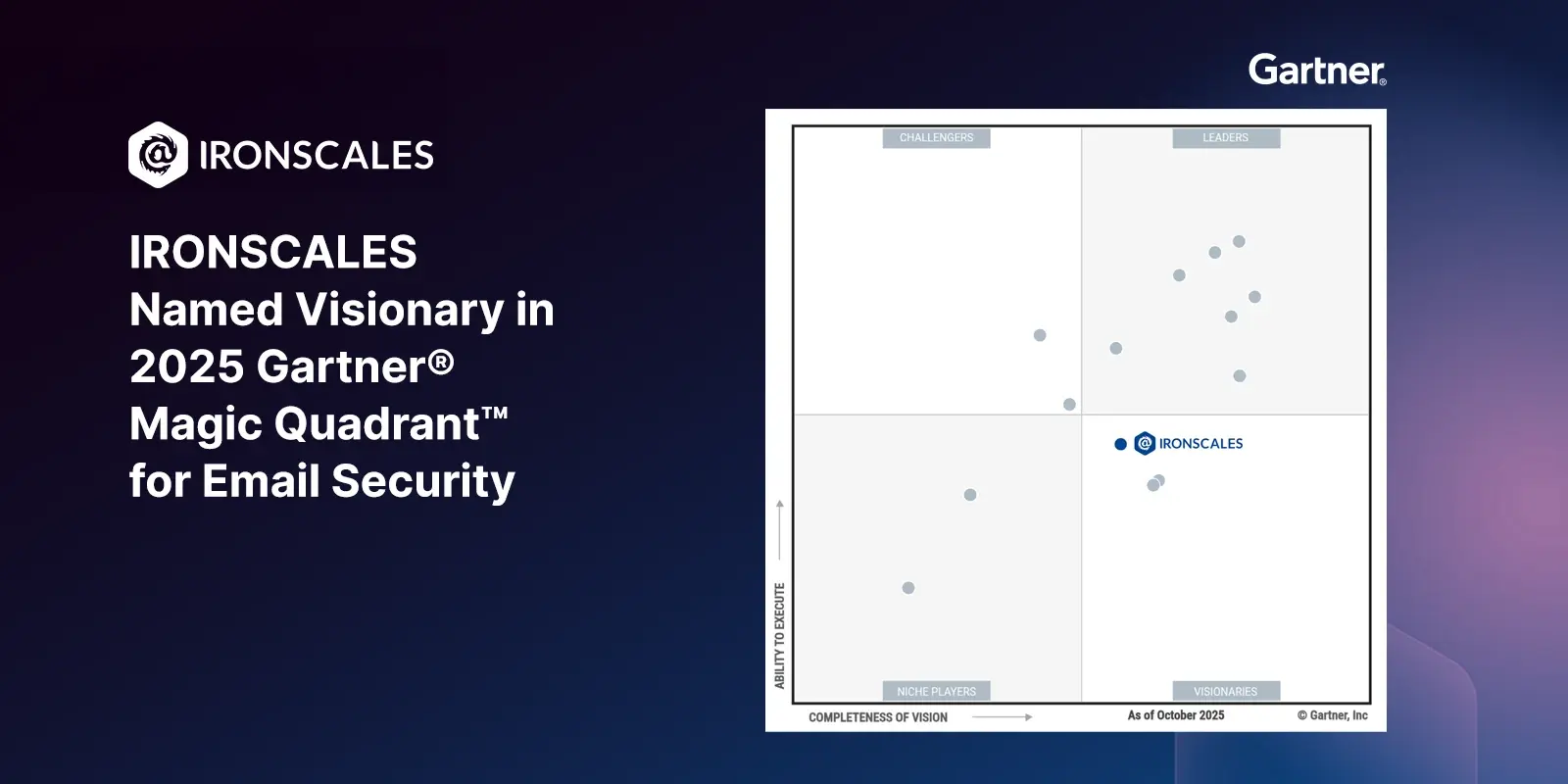
This post is about what Gartner actually said between the lines and how you can use it alongside other resources to build a shortlist that fits your organization, not theirs.
The Buried Lede
Here's a sentence from the 2025 MQ that deserves more attention than any dot on the chart:
"The high volume of sophisticated, email-enabled social engineering attacks, combined with the difficulty in consistently quantifying true detection efficacy across the market, justifies organizations utilizing multiple vendors for comprehensive protection."
Read that again.
Gartner is telling you that no single vendor catches everything, and layering your defenses isn't paranoia, it's best practice. If you've been running Microsoft Defender for Office 365 and wondering whether you need something else on top, Gartner just answered your question.
This isn't new thinking for us. We've positioned IRONSCALES as a complement to native security (or legacy SEGs) for years. But seeing Gartner say it explicitly? That's validation for every security leader who's had to justify "why two tools?" to their CFO.
What Gartner Got Right About Us
I'll keep the victory lap short. Gartner called out three strengths:
Market responsiveness - Specifically, "anticipating the need for and delivering deepfake detection ahead of other email security vendors." We shipped deepfake protection for Microsoft Teams while others were still debating whether it was a real threat. (spoiler, it is.)
Innovation – "Internal processes around R&D support innovation and enable the delivery of new-to-market features ahead of other vendors." Translation = we build fast.
Sales execution – "Pricing is competitive across organization sizes and has a transparent pricing and discounting structure." No pricing games.
That first one matters most. In a market where attackers move faster than most vendors' roadmaps, being first to address emerging threats isn't a nice-to-have. It's the job.
The Cautions (and What They Actually Mean)
Gartner flagged us for being "one of the more lightly staffed vendors" and appearing "less frequently on competitive shortlists."
Fair observations. Here's context:
On staffing... We're lean by design. Smaller teams, faster decisions, less bureaucracy between "customers are asking for X" and "X ships." That trade-off works for us (and apparently for our customers) since we consistently rank at the top of Gartner Peer Insights for support and services. Not among Visionaries. Among all vendors in the MQ, including Leaders.
On shortlist presence... Gartner's methodology naturally favors vendors with large enterprise footprints. That's who buys Gartner advisory services. It's not a conspiracy, it's just how the incentives align. Meanwhile, we're a GigaOm Outperformer, a Frost & Sullivan leader, and a KuppingerCole leader.
Different methodologies surface different strengths. Which brings me to...
Use More Than One Map
Last month I wrote about GigaOm's 2025 Phishing Defense Radar and why I think their approach (weighted scoring against real operational criteria) gives buyers something the MQ doesn't...a filter for how vendors solve problems, not just that they exist.
My advice? Use both.
Use Gartner for market context and vendor viability signals. Use GigaOm for capability depth and how it fits with your operations and processes. Layer in Peer Insights and G2 reviews from organizations that look like yours. Then run your own POC.
No single report tells the whole story. Gartner even says so (though you have to dig for it).
What the Visionary Label Actually Means
Gartner's own quadrant description for Visionaries is worth reading:
"Visionaries focus on solving emerging and complex problems through innovative, AI-driven approaches such as deepfake prevention and advanced identity protection... They demonstrate agility by being first to market with specialized threat defense capabilities."
That's not a consolation prize. That's a description of what modern email security should be doing...addressing the threats that legacy platforms weren't built for.
Leaders, by contrast, are defined by "strong market adoption, financial stability, and established integrations." Important qualities. But not the same as being first to stop the attack that didn't exist six months ago.
Three Questions for Your Next Vendor Conversation
Borrowing from my GigaOm post, here's what I'd ask any email security vendor before adding them to your shortlist:
When did you ship protection for [current emerging threat]? Deepfakes. QR code phishing. AI-generated BEC. Pick one. If the answer is "it's on the roadmap," ask when (and if) your inbox can wait.
What do your customers say about support? Not what the vendor says. What Peer Insights and G2 reviewers from mid-market or enterprise orgs actually report. Post-sale experience matters more than pre-sale demos.
How do you complement what I already have? If the answer requires ripping out your existing infrastructure, ask whether that's solving your problem or creating a new one.
So...
Gartner's MQ is useful. It's not scripture. The vendors in the upper right aren't automatically right for you, and the vendors elsewhere aren't automatically wrong.
We're proud to be recognized as a Visionary, especially for doing exactly what Visionaries are supposed to do: ship protection for emerging threats before they become mainstream problems.
But don't take my word for it.
Don't take Gartner's word for it either.
Build your shortlist from multiple sources, ask hard questions, and test what actually works in your environment.







/Blue%20Feature%20Flower%20Icons/gear%20head%20icon.svg)
/Misc%20Icons/icon-nav-credential-theft.svg)










/Leadership%20Headshots/Audian%20Paxson%20Headshot%201000x1000%20032026.webp?width=100&height=100&name=Audian%20Paxson%20Headshot%201000x1000%20032026.webp)




.png?width=50&height=50&name=Untitled%20-%20July%2030%2c%202026%20at%2014.53.38%20(3).png)



/Misc%20Icons/icon-red-teaming-agent-gradient-simple.svg)
/Misc%20Icons/icon-phishing-soc-agent-gradient-simple.webp?width=158&height=167&name=icon-phishing-soc-agent-gradient-simple.webp)
/Misc%20Icons/icon-phishing-simulation-agent-gradient-simple.svg)


/Misc%20Icons/icon-nav-encryption.svg)