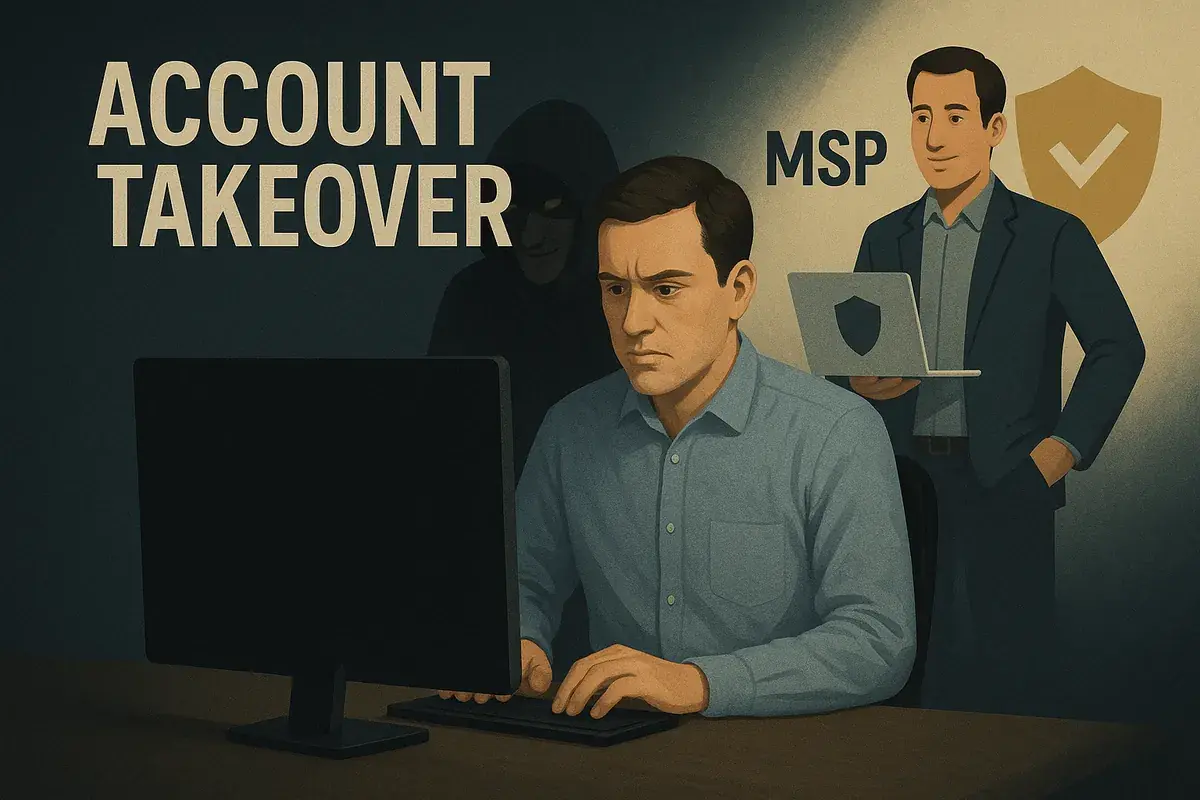
According to IBM’s 2025 Cost of a Data Breach report, breaches initiated with stolen credentials take an average of 246 days to identify and contain. That is more than eight months of undetected access. Eight months of reconnaissance. Eight months of quietly learning how your organization communicates, who approves payments, how vendors are onboarded, and where trust is assumed rather than verified.
Account takeovers do not announce themselves. They blend in. That is why they continue to be one of the most damaging and persistent attack paths for orgs today.
Why Account Takeovers Keep Working
Most account takeovers begin with stolen credentials, often harvested through phishing or pulled from breach data. Once attackers authenticate successfully, the hardest part of the attack is over. There is no exploit to fire and no malware to drop.
Instead, attackers operate as trusted users. They create mailbox forwarding and auto-delete rules to hide activity. They observe internal conversations to understand finance processes, vendor relationships, and approval flows. Then they act, often weeks or months later, when the timing is right.
This is why organizations with strong perimeter defenses, MFA, and bot mitigation still experience ATO-driven incidents. The weakness is not always at the login screen. It is the lack of visibility into how accounts behave after authentication.
ATO is a behavior-driven threat, and perimeter-only controls are not built to catch it.
Rethinking ATO Defense: Prevent, Detect, and Respond
A sustainable approach to account takeover defense follows three principles. Not as separate tools or teams, but as a connected program that spans identity, email security, and the SOC.
1. Prevent What You Can
Prevention is still your cheapest control, but only when it reflects how attackers actually operate. Strong passwords, MFA, and conditional access matter, but they are not fail-safe.
Putting prevention into practice means tightening identity posture while accepting that some credentials will still be compromised.
Putting this into practice:
- Requiring phishing-resistant MFA for privileged users and high-risk workflows, then expanding coverage based on targeting patterns.
- Enforcing conditional access policies that evaluate device posture, geography, and sign-in risk rather than treating all logins equally.
- Blocking known-compromised passwords and reducing reuse through identity provider controls.
- Hardening email authentication and sender trust to limit credential-harvest lures.
- Running short, role-based phishing simulations focused on credential theft and MFA fatigue scenarios.
What good looks like: attackers face friction early, and even when credentials are stolen, turning them into durable access becomes harder.
2. Detect Based on Behavior
Once a login succeeds, the signal shifts from who logged in to what they did next. That is where most ATO detection programs fall short.
Effective detection requires combining identity telemetry with mailbox behavior to spot subtle misuse.
Putting this into practice:
- Treating impossible travel and anomalous sign-ins as higher risk when paired with mailbox changes.
- Monitoring for new or modified mailbox rules, especially forwarding to external domains or auto-delete rules that suppress visibility.
- Watching for outbound anomalies such as sudden volume spikes, unusual recipients, or finance- and vendor-themed outreach from unexpected users.
- Elevating user-reported suspicious emails into an automated analysis and correlation pipeline instead of manual triage.
- Correlating identity, mailbox, and message behavior into a single incident view so analysts see patterns, not isolated alerts.
What good looks like: takeovers are detected during setup and reconnaissance, not after fraud or data exposure has occurred.
3. Respond Quickly and Consistently
Most ATO response efforts fail in two places. They stop at password resets, and they rely too heavily on bespoke analyst work.
Effective response must remove access, eliminate persistence, and clean up what the attacker already touched.
Putting this into practice:
- Standardizing a first-hour response that forces sign-out, revokes tokens, and resets credentials with stronger MFA where appropriate.
- Removing attacker persistence by deleting malicious mailbox rules, forwarding configurations, and suspicious OAuth grants.
- Containing impact by searching for and removing attacker-sent messages across affected mailboxes.
- Expanding investigation laterally to peer accounts, executives, shared mailboxes, and recently targeted groups.
- Feeding lessons learned back into preventive controls, detection tuning, and awareness training.
What good looks like: response is fast, repeatable, and consistent enough that attackers cannot maintain access or scale impact.
How IRONSCALES Helps Prevent Account Takeovers
IRONSCALES is designed around how account takeovers actually unfold, not how perimeter defenses expect them to.
By integrating directly with Microsoft 365 through native APIs, IRONSCALES operates inside the inbox. This provides visibility into internal and external email activity, mailbox rule changes, and user-reported messages without disrupting mail flow.
From there, Adaptive AI builds a behavioral baseline for each user. It learns how they communicate, who they interact with, and what normal looks like. When behavior deviates in meaningful ways, such as unusual forwarding rules, internal phishing from trusted accounts, or subtle changes in communication patterns, those signals surface quickly.
Detection is paired with automated response. Related incidents are clustered, remediation can be applied across mailboxes, and analysts are presented with clear context instead of fragmented alerts. This reduces dwell time and operational overhead while improving containment speed.
Rather than treating ATOs as one-off investigations, IRONSCALES helps security teams turn them into a managed, measurable class of incident.
The Bottom Line for Security Leaders
Account takeovers are not edge cases. They are one of the most reliable ways attackers gain long-term access, precisely because they exploit trust instead of vulnerabilities.
Reducing ATO risk requires more than strong authentication. It requires visibility into account behavior, the ability to detect subtle misuse inside the inbox, and response workflows that move faster than attackers can adapt.
IRONSCALES brings those elements together, helping organizations move from prolonged compromise to controlled, repeatable response. When email security, identity context, and automation work together, account takeovers stop being silent breaches and become incidents you can contain with confidence.
Curious to learn more about what we're doing to help our clients stop ATOs? Reach out to us and let's talk shop or visit our Account Takeover Protection section to find out more!







/Blue%20Feature%20Flower%20Icons/gear%20head%20icon.svg)
/Misc%20Icons/icon-nav-credential-theft.svg)















.png?width=50&height=50&name=Untitled%20-%20July%2030%2c%202026%20at%2014.53.38%20(3).png)



/Misc%20Icons/icon-red-teaming-agent-gradient-simple.svg)
/Misc%20Icons/icon-phishing-soc-agent-gradient-simple.webp?width=158&height=167&name=icon-phishing-soc-agent-gradient-simple.webp)
/Misc%20Icons/icon-phishing-simulation-agent-gradient-simple.svg)


/Misc%20Icons/icon-nav-encryption.svg)
/Leadership%20Headshots/Audian%20Paxson%20Headshot%201000x1000%20032026.webp?width=100&height=100&name=Audian%20Paxson%20Headshot%201000x1000%20032026.webp)