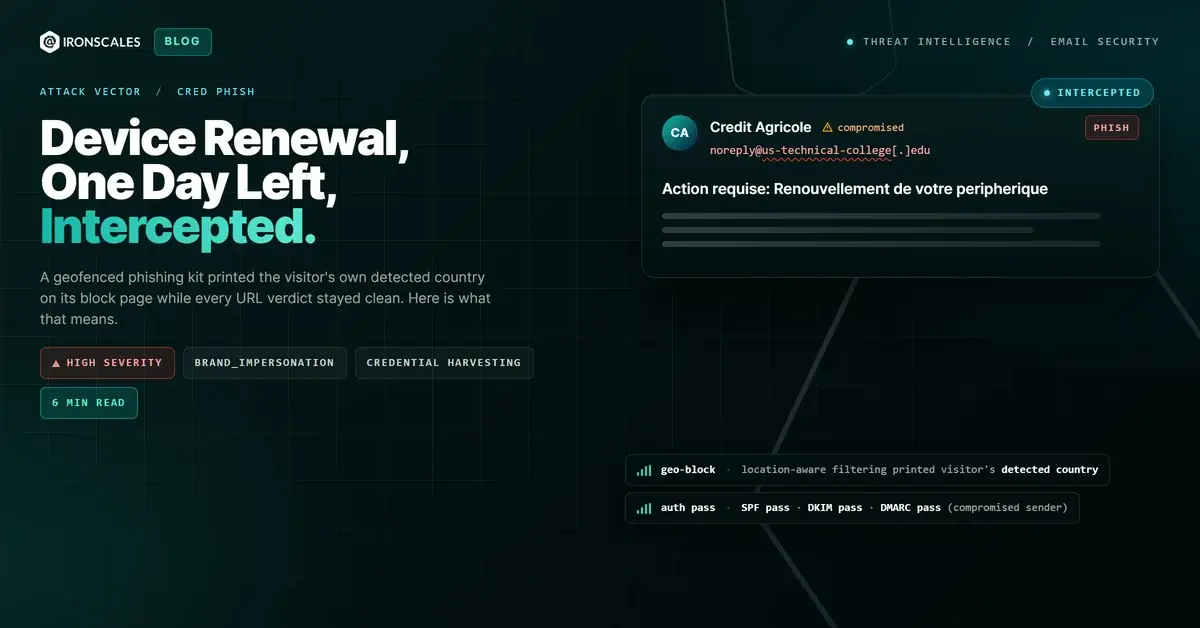
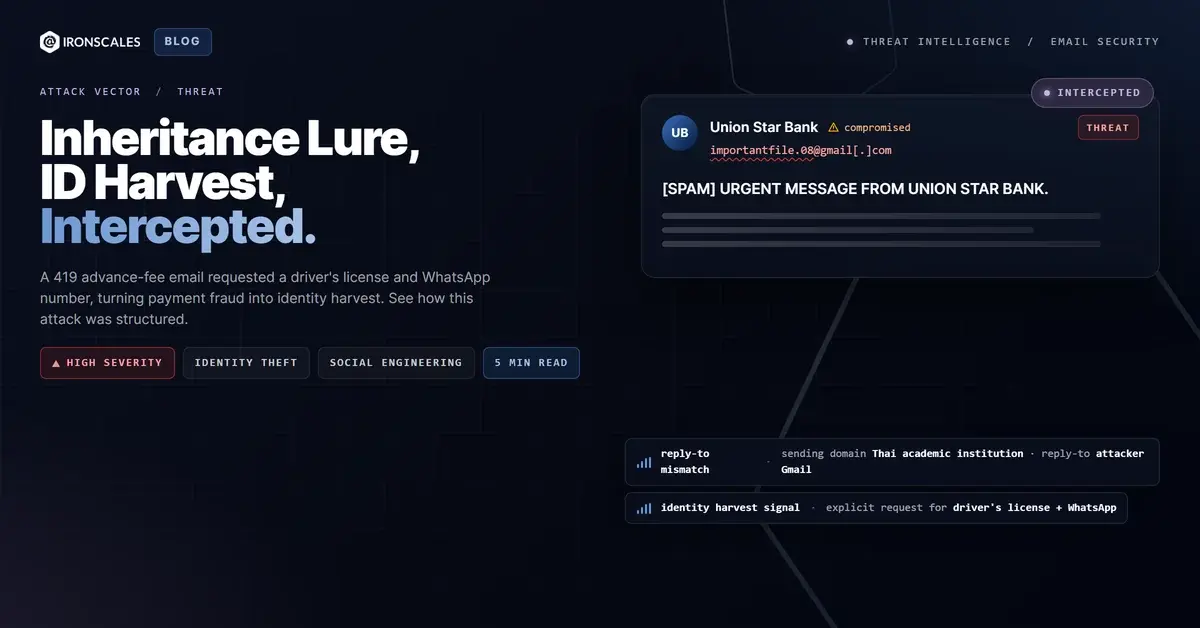
TL;DR An advance-fee fraud email arrived via a compromised account at a Thai academic institution, impersonating a purported bank. The reply-to address was diverted to an attacker-controlled Gmail, ensuring any response went directly to the attacker rather than the compromised sending account. The message claimed a $5.5 million inheritance requiring the recipient to pay fees and provide a driver's license plus WhatsApp number to claim it. This is not a routine 419 scam. The government ID request transforms the attack from a payment-fraud attempt into an identity-harvest operation. IRONSCALES Adaptive AI rated it at 90% confidence and labeled it Advance-fee Scam.
Severity: High Advance-Fee Fraud Identity Theft Social Engineering MITRE: T1566 MITRE: T1598
Subject line: "[SPAM] URGENT MESSAGE FROM UNION STAR BANK." The spam tag is right there in the subject, pre-applied by a filter somewhere in the relay chain, and the message still reached the inbox. The sending account belonged to a long-established Thai academic institution. Reply-To pointed somewhere else entirely.
If a recipient replied, their response would go to an attacker Gmail. At the end of the message, the attacker asked for a driver's license.
The Classic 419 Shell, Modernized for Identity Theft
Advance-fee fraud is one of the oldest social engineering schemes in email history, but the variant here has a meaningful update. The message claimed the recipient was entitled to a $5.5 million inheritance from a purported bank. To release the funds, the recipient would need to pay processing fees and establish contact. Standard 419 structure.
The modernization is in what the attacker asked for beyond the fees. The message explicitly requested the recipient's driver's license and a WhatsApp contact number. That combination is not for processing a wire transfer. It is for identity theft.
A government-issued ID document provides full legal name, date of birth, address, issue date, and a document number tied to a state or national identity system. Combined with a WhatsApp number, the attacker has a direct communication channel and a near-complete identity profile. Whether or not the victim ever pays the advance fee, the attacker has acquired data with significant independent resale and fraud value.
This is the difference between a classic 419 and a modern identity-harvest operation wearing a 419 wrapper. The money ask is bait. The ID request is the actual objective.
Reply-To Diversion: Separating the Sending Account from the Attacker's Inbox
The email was sent from a legitimate account at a long-established Thai academic institution. Its domain carried years of institutional sending history. The message passed authentication checks because it originated from the real mail infrastructure of that institution.
The reply-to header was set to importantfile.08@gmail[.]com. This is the reply-to diversion technique, a standard mechanism in compromised-account fraud. The compromised account serves as the delivery vehicle because of its inherited trust. The attacker-controlled Gmail address is where the conversation actually goes.
From the recipient's perspective, any reply appears to go back to whoever sent the message. The email client fills in the reply-to address automatically. A non-technical recipient has no reason to notice that the reply is going somewhere different from the sending address unless they specifically inspect both headers.
The separation serves the attacker in two ways. First, the account owner at the academic institution receives no reply and may not notice the account was used for fraud for some time. Second, the attacker maintains full control of the conversation thread without needing continued access to the compromised account after the initial send.
See Your Risk: Calculate how many threats your SEG is missing
Why a [SPAM] Tag in the Subject Did Not Stop Delivery
The subject line arrived pre-tagged with "[SPAM]" by an upstream filter, which is notable. A tagging system identified this message as suspect but did not quarantine it. Tagging-without-blocking is a common gateway configuration when administrators want visibility without risking false-positive rejections.
This is a real operational tension. Academic and professional email environments frequently receive high volumes of legitimate mail from unfamiliar senders. Aggressive blocking increases complaints from users who miss valid messages. The result is that tagged messages often pass through to the inbox, where the recipient's judgment is the last line of defense.
The "[SPAM]" tag, counterintuitively, may have reduced the recipient's concern. If their spam filter flagged it and the message still arrived, some recipients reason that it "passed." The tag becomes a false signal of review rather than a genuine warning.
IRONSCALES Adaptive AI rated this message at 90% confidence, the highest of any case in this batch. The advance-fee pattern, the reply-to mismatch between the sending domain and a free Gmail address, the request for government ID documents, and the implausible financial claim all contributed to a high-confidence verdict.
The Identity Data Ask Changes the Risk Calculus
Standard phishing awareness training addresses advance-fee fraud as a financial risk: do not pay fees to claim prizes or inheritances. That framing misses the identity-harvest dimension.
If a recipient dismisses the financial claim and still replies to ask a follow-up question, they have connected to the attacker's Gmail. If they include their name, role, or workplace in the reply signature, the attacker has organizational intelligence. If they follow through with the ID document request even partially, the attacker has government identity data.
The FBI IC3 2024 report documents advance-fee fraud as a persistent category with significant victim losses, and notes that identity data losses compound financial losses because victims face downstream fraud well after the initial incident. The Verizon DBIR 2024 notes that credentials appear in 38% of breach kill chains. A driver's license is a richer identity artifact than most phished credentials because it is harder to rotate than a password.
MITRE ATT&CK classifies social-engineering-based phishing delivery broadly under T1566. CISA guidance specifically advises never sharing government ID or financial account information in response to unsolicited email requests, regardless of how official the message appears. NIST defines phishing as including deceptive requests for sensitive data, which encompasses PII harvest directly. IRONSCALES platform data shows that gateways miss roughly 67.5 phishing emails per 100 mailboxes each month, including social-engineering-only attacks with no malicious links or attachments. The Microsoft Digital Defense Report 2024 identifies business email compromise and social engineering as the fastest-growing categories of human-targeted attacks.
For security teams, the lesson is that training materials need to cover the ID request dimension explicitly, not just the financial dimension. "Do not pay fees" is necessary but no longer sufficient for modern 419 variants.
---
| Type | Indicator | Context |
|---|
| Email | importantfile.08@gmail[.]com | Attacker reply-to address; all victim replies diverted here |
| Phone | +1[.]312[.]585[.]6352 (WhatsApp) | Attacker contact number requested alongside government ID |
Email Attack of the Day is a daily series from
IRONSCALES spotlighting real phishing attacks caught by Adaptive AI and our community of 36,000+ security professionals. Each post breaks down a real attack. What it looked like, why it worked, and what to do about it.







/Blue%20Feature%20Flower%20Icons/gear%20head%20icon.svg)
/Misc%20Icons/icon-nav-credential-theft.svg)










/Leadership%20Headshots/Audian%20Paxson%20Headshot%201000x1000%20032026.webp?width=100&height=100&name=Audian%20Paxson%20Headshot%201000x1000%20032026.webp)



.png?width=50&height=50&name=Untitled%20-%20July%2030%2c%202026%20at%2014.53.38%20(3).png)



/Misc%20Icons/icon-red-teaming-agent-gradient-simple.svg)
/Misc%20Icons/icon-phishing-soc-agent-gradient-simple.webp?width=158&height=167&name=icon-phishing-soc-agent-gradient-simple.webp)
/Misc%20Icons/icon-phishing-simulation-agent-gradient-simple.svg)


/Misc%20Icons/icon-nav-encryption.svg)